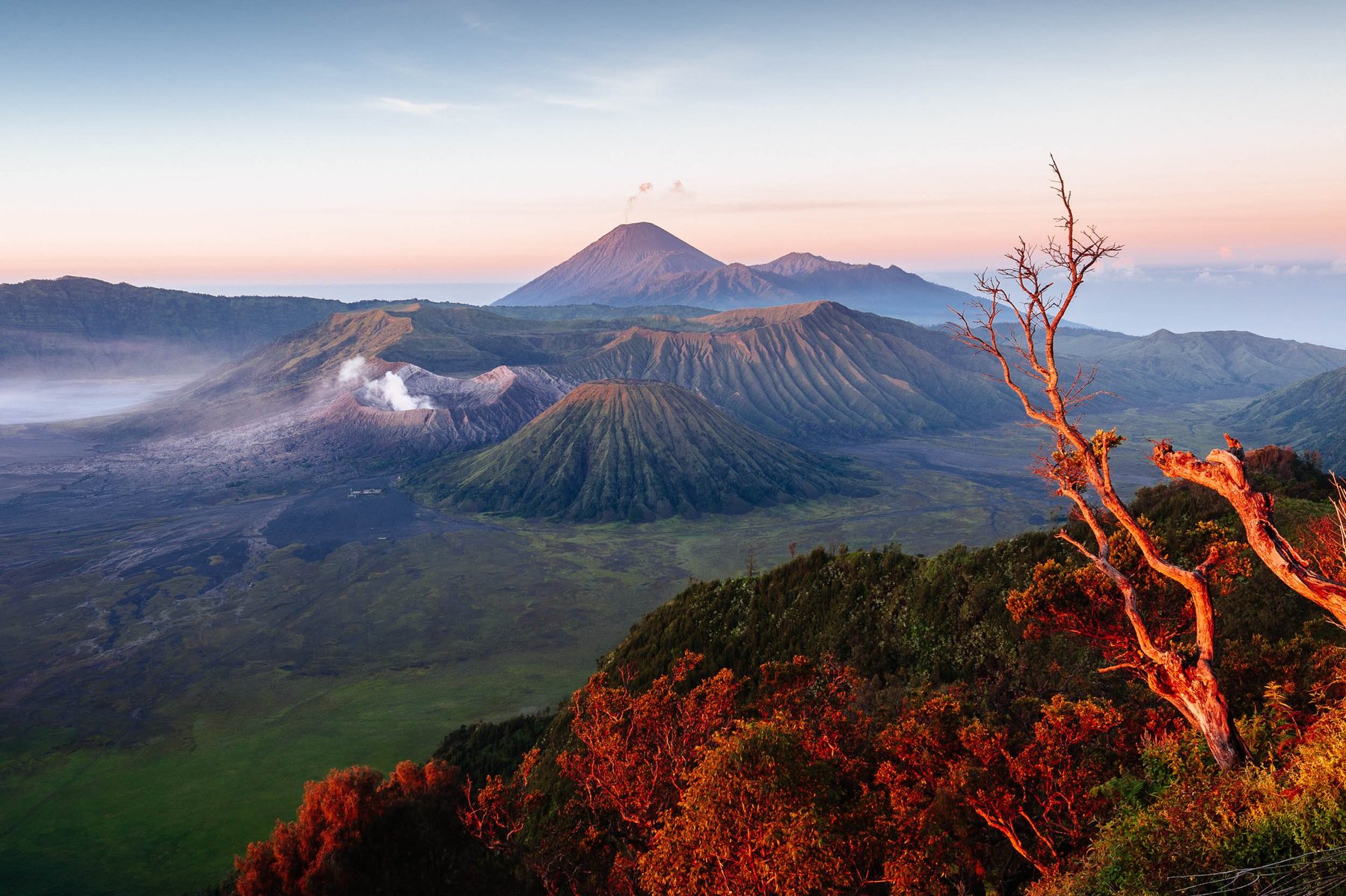
The Tengger Massif, formally known as Bromo-Tengger-Semeru National Park, is a volcanic highland in East Java that contains some of the most dramatic scenery in Indonesia. At its heart is a vast caldera, the Tengger Sand Sea, a 10 km wide plain of grey volcanic sand from which several cones rise abruptly — among them Mount Bromo, the most visited active volcano in Java, and Mount Batok with its perfectly ridged flanks. Towering above everything is Mount Semeru at 3,676 metres, the highest peak on Java, which erupts frequently and puffs smoke almost continuously.
The landscape is otherworldly. At dawn, when the mist fills the caldera and the sun rises behind the peaks, it draws crowds for good reason. The viewpoint at Mount Penanjakan is the classic spot, reached by jeep or on foot before first light. From there, the panorama takes in Bromo, Batok, the sand sea, and Semeru in a single sweep.
The Tenggerese people who live in the highland villages have maintained a distinct Hindu culture while the surrounding lowlands converted to Islam centuries ago. Their most important ceremony, the Yadnya Kasada, takes place each year on the full moon of the twelfth month of the Tenggerese calendar. Worshippers climb to the rim of Bromo's crater and cast offerings of vegetables, livestock, and money into the crater as thanks to the mountain gods.
The most common approach to the park is via Probolinggo, from where minibuses and shared jeeps run to Cemoro Lawang, the village on the caldera rim that serves as the main base. From Cemoro Lawang you can walk down into the sand sea and up to Bromo's crater rim in about two hours, or hire a jeep for the full sunrise circuit. Madakaripura waterfall, about 20 km away, is worth a half-day detour — a narrow gorge leads to a near-circular amphitheatre with water cascading down the walls.