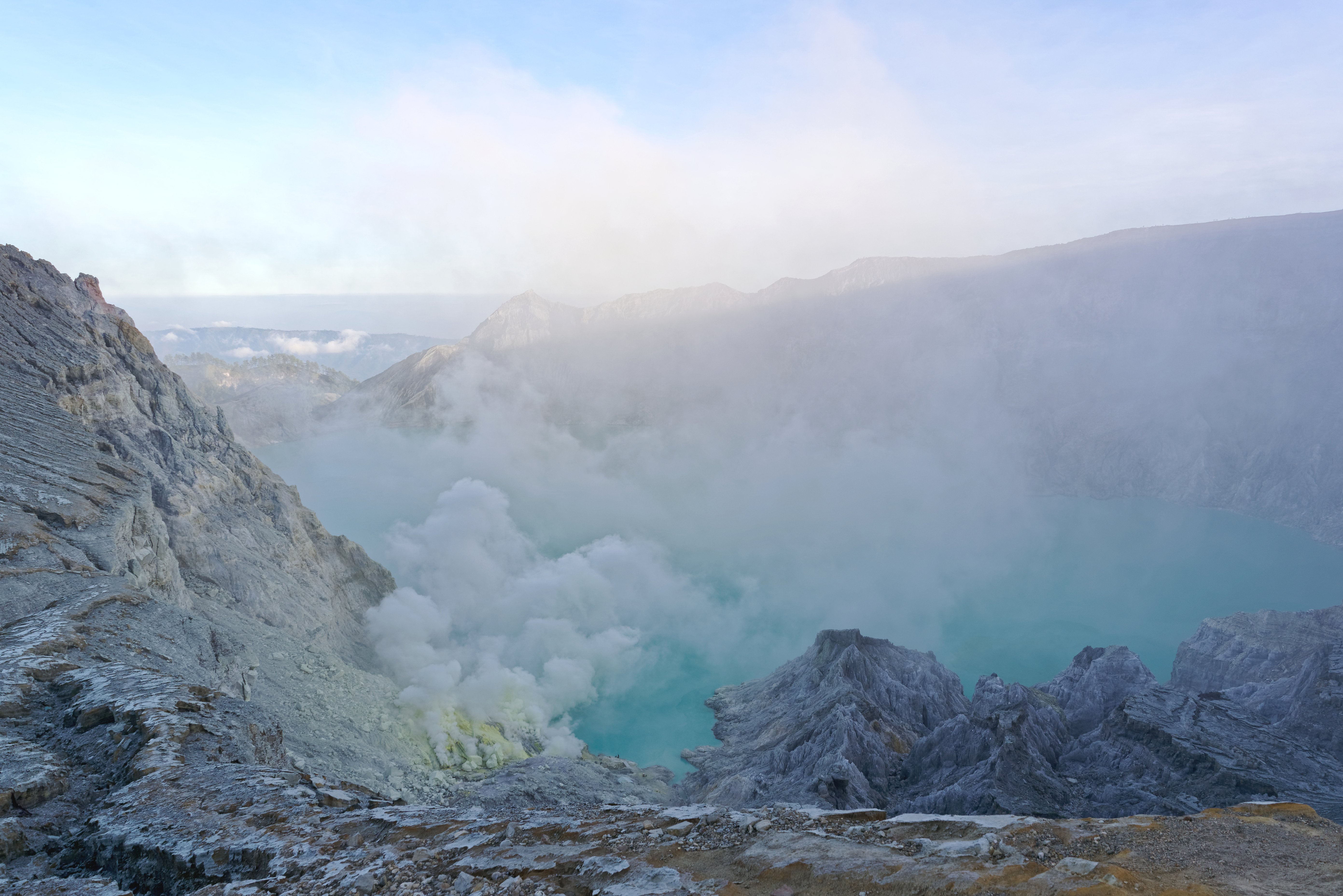
Mount Ijen (Gunung Ijen) is an active stratovolcano on the border of Banyuwangi and Bondowoso regencies in East Java, famous worldwide for two phenomena that exist nowhere else at this scale: the electric-blue volcanic flames that ignite sulphuric gases in the crater at night, and the extraordinary community of sulfur miners who descend into that same acidic crater every day carrying loads of up to 80 kilograms up 300-metre slopes for wages of around USD 13 per day.
The crater lake — Kawah Ijen — is the world's largest highly acidic crater lake, a one-kilometre-wide turquoise body of water with a pH below 0.3, more corrosive than battery acid. At the lake's edge, sulphuric gases emerge from volcanic vents, condense into liquid sulphur, and then ignite as they hit the air — creating the blue fire that is Ijen's signature spectacle. The flames are visible only in darkness and require an early-morning hike from the Paltuding basecamp to the crater rim, then a steep descent to the lakeshore.
The trek starts at the Paltuding basecamp at 1,841 metres elevation. The 3-kilometre hike to the crater rim gains 435 metres and takes most visitors 90 minutes to two hours. From the rim you can look down into the turquoise lake and across to the steaming vents. Descending into the crater for the blue fire views requires care and a gas mask — sulphuric fumes are dangerous and conditions change quickly with the wind. The Ijen Geopark was designated a UNESCO Global Geopark in 2023.
From the same base, Banyuwangi — the regency capital and main town — is about 1.5 hours by road. Many visitors combine an Ijen visit with Baluran National Park to the north or a crossing to Bali via the Ketapang-Gilimanuk ferry.