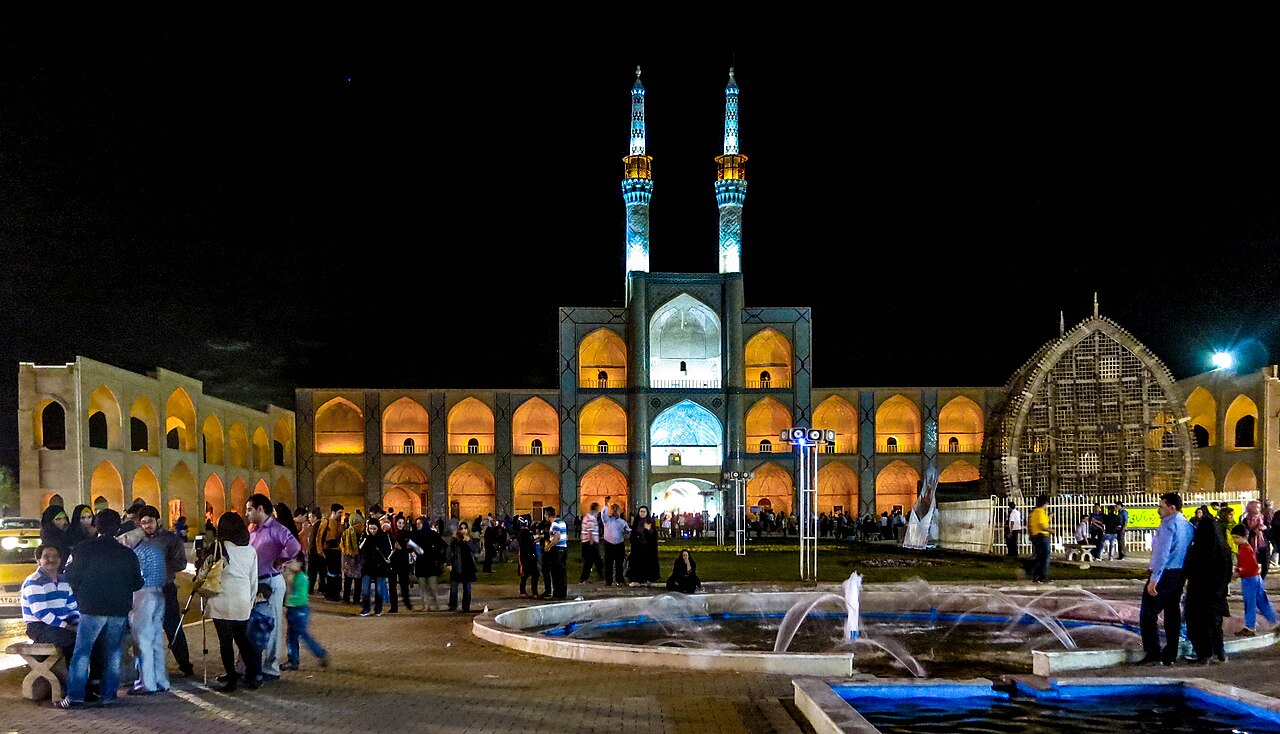
Yazd is one of the oldest continuously inhabited cities in the world, set in the desert between Isfahan and Kerman. It has played a role in Persian history for millennia but never made it to imperial capital — which may be why its old city has survived so well. The mud-brick labyrinth of lanes, domed roofs, and badgirs (wind towers) was recognised as a UNESCO World Heritage Site in 2017.
The wind towers are the city's most distinctive feature: tall chimneys that catch desert breezes and funnel cool air down into the rooms below, an ingenious form of natural air conditioning perfected over centuries. They punctuate the skyline everywhere you look. The tallest in the world stands in the Dolat Abad Garden, a restored 18th-century estate on the edge of the old city.
The Jameh Mosque is one of the great sights of Iran. Its twin minarets are the highest in the country, and the portal is decorated from top to bottom in dazzling tilework, predominantly blue. Inside, the sanctuary chamber under a squat tiled dome contains an exquisite faience mihrab dated 1365 — one of the finest of its kind. The Khan Bazaar entrance nearby rivals the mosque for grandeur, with glazed tiles and plaster stalactite vaulting. Yazd is famous for its sweets — particularly qottab and pashmak — and the bazaar is the best place to find them fresh.
Yazd is also one of the most important centres of Zoroastrianism, the ancient Persian religion that predates both Christianity and Islam. The Atashkadeh (Fire Temple) houses a flame that is said to have burned continuously for over 1,500 years. On the outskirts of town, the Towers of Silence — circular stone platforms where the dead were once laid out for the birds — overlook an impressive desert and mountain landscape. The Amir Chakhmaq Complex, with its iconic three-storey facade, anchors the central square and is best seen at dusk when it is lit.