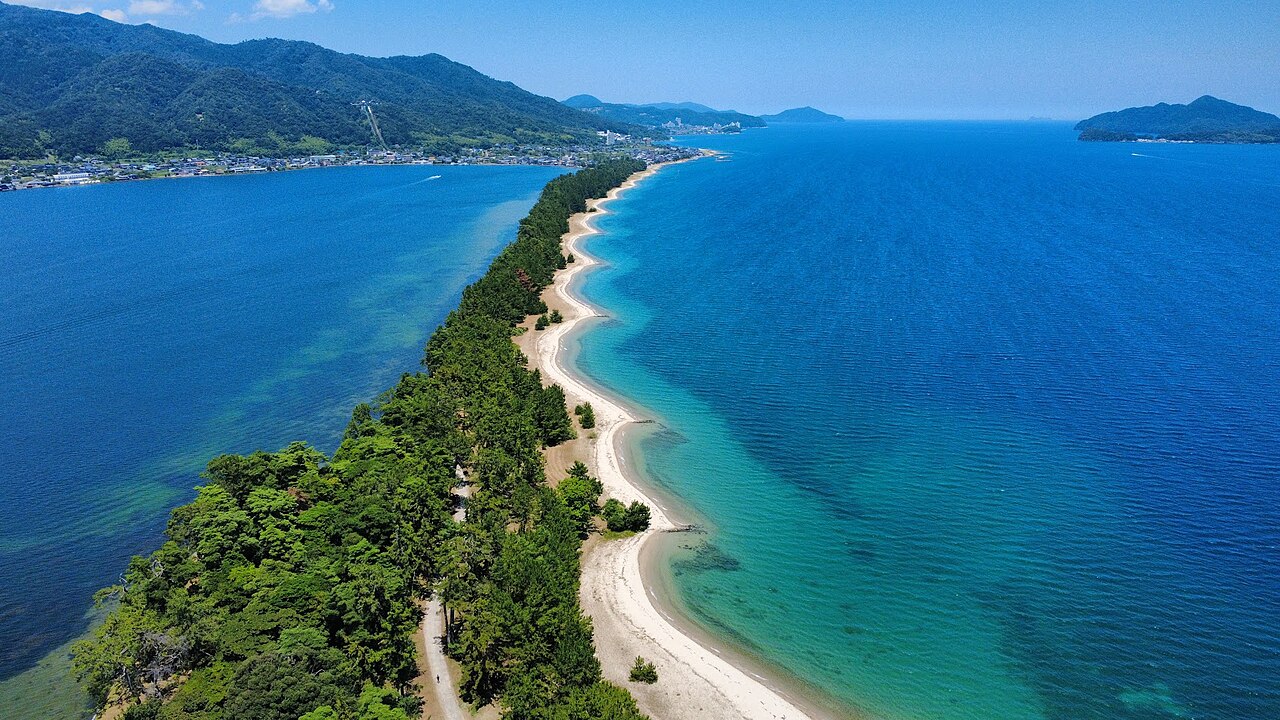
Pine-covered sand spit across Miyazu Bay, counted among Japan's traditional Three Great Views.
Amanohashidate — the "Bridge to Heaven" — is one of the Nihon Sankei, the Three Great Views of Japan. It is a 3.6 km pine-covered sand spit stretching across Miyazu Bay on the northern coast of Kyoto Prefecture.
The traditional way to appreciate the view is to turn your back to it, bend over, and look at the sandbar upside down between your legs — framed against the sky, it is said to resemble a bridge ascending to heaven. The Amanohashidate Cable Car at the northern end of the bay takes you to the classic Kasamatsu Park viewpoint, where you can perform this ritual. Near the top, Kono Shrine is one of the oldest in the Tango region, dedicated to the deities of sea and safe travel.
Walking or cycling along the spit itself is pleasant, with over 5,000 pine trees providing shade. At the southern end, Chionji Temple houses one of Japan's most important images of Monju Bosatsu. A boat service crosses the bay if you prefer not to walk back. The hill above the northern viewpoint is also home to Nariai-ji, a venerable temple on the Saigoku Kannon Pilgrimage. A short train ride away, Miyazu Castle adds a feudal layer to the visit. The area's ryokan and onsen are excellent, and the seafood — especially matsuba crab in winter — is superb.
Guide
Getting There
There are direct train services from Kyoto, taking just under two hours. Part of the journey runs on the Kitakinki Tango Railway (now Kyoto Tango Railway), a private line, so JR Rail Pass holders will need to pay a supplement for that section.
From Osaka, the journey takes around two and a half hours with a change in Kyoto or Fukuchiyama. Highway buses also run from Kyoto and Osaka.
Guide
When to Go
Amanohashidate is most visited in late spring and during the summer beach season. Cherry blossom season (late March to early April) brings crowds and beautiful pink colouring to the hill viewpoints. Autumn, from October to November, offers clear skies and the forested hillsides turning red and gold — arguably the most photogenic time.
Winter is off-season for the beach but peak season for crab. From November through March the local ryokan serve matsuba crab kaiseki courses, and if eating the finest winter crab in Japan is on your agenda, this is when to come. The sandbar itself is open year-round; even in cold weather, cycling along the pines on a clear day is memorable.
July and August are hot, humid, and crowded. Weekdays are considerably quieter than weekends at any time of year.