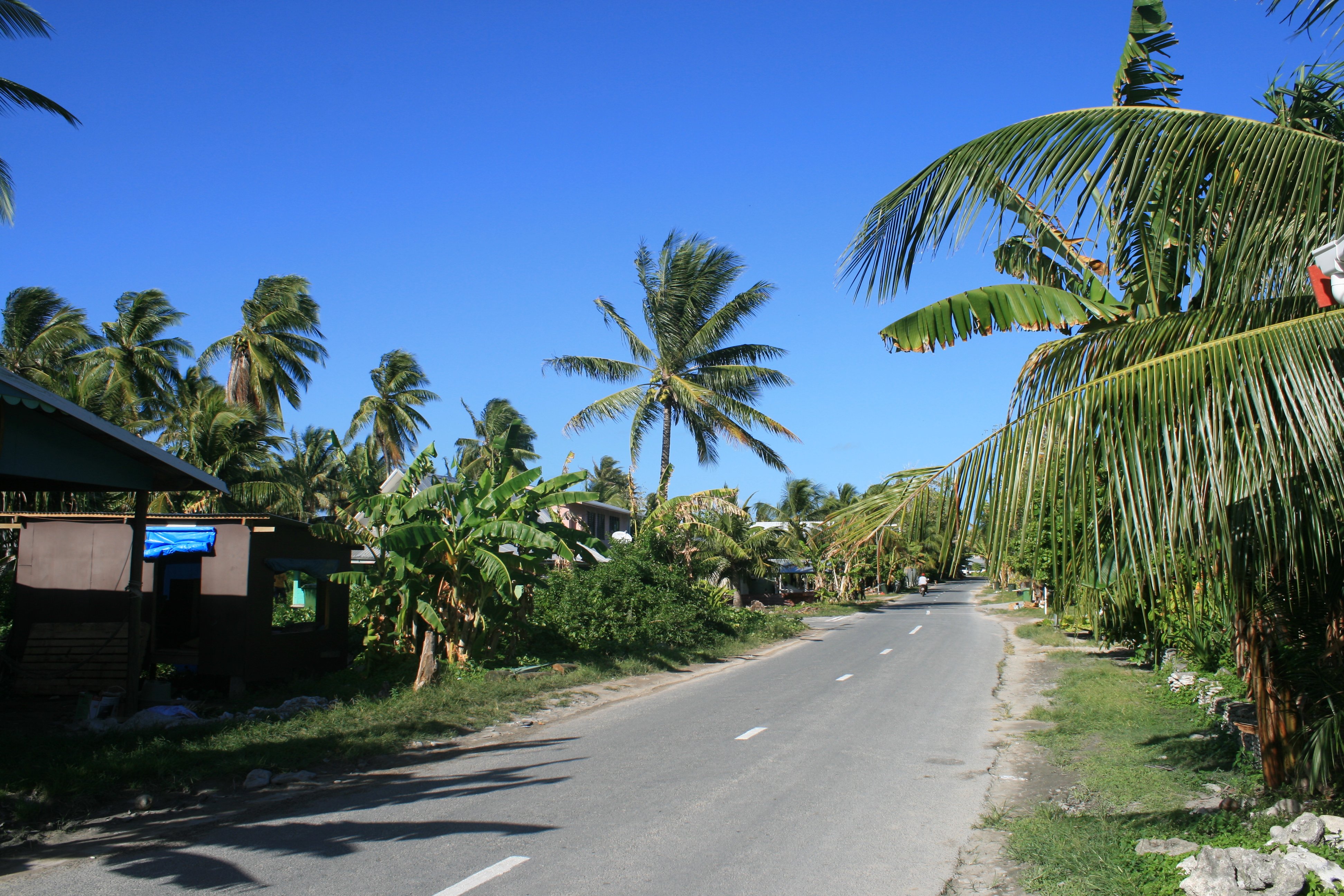
Funafuti is the capital atoll of Tuvalu and the only place in the country with anything resembling infrastructure. It is a thin ribbon of coral and palm strung around a wide turquoise lagoon — roughly 25 kilometres long, with thirty-three named islets, of which Fongafale is by far the largest and the only one with permanent settlement. Around 6,000 people live here, more than half of Tuvalu's total population, and almost everything that happens in the country — government, banking, the single high school, the one paved road — happens on this strip of land.
Fongafale is a thin sliver, in places only a couple of hundred metres wide between the lagoon and the open Pacific. The international airport runs down its spine, and outside flight hours the airstrip becomes the de facto town square: kids play football on it, families walk in the cool of the evening, and motorbikes race the length. When a plane is due, a siren sounds and people clear off. Vaiaku, the administrative village, holds the government buildings, the National Bank of Tuvalu, the post office (a small but reliable source of Tuvaluan stamps), and the Funafuti Lagoon Hotel — the country's only proper hotel.
The lagoon itself is the main reason to come. The Funafuti Conservation Area covers six uninhabited islets and a large chunk of reef on the western side, with excellent snorkelling, sea turtles, and water clear enough to see the bottom at depth. Boat trips out to islets like Tepuka or Fualopa can be arranged through guesthouses for negotiable rates. The Second World War left its mark here too — Funafuti was a major Allied staging base for the central Pacific campaign, and old aircraft parts, gun emplacements, and the remains of Naval Base Funafuti are scattered along the islets.
You will not find restaurants in the Western sense, or bars, or shops with much in them. What you will find is a small Polynesian community living at sea level, on a strip of land that may not exist in a hundred years, with a lagoon that is one of the loveliest in the Pacific. Stay a few nights, walk the runway at dusk, eat what the guesthouse cooks, and let the pace of the place slow you down — there is no other speed available here.