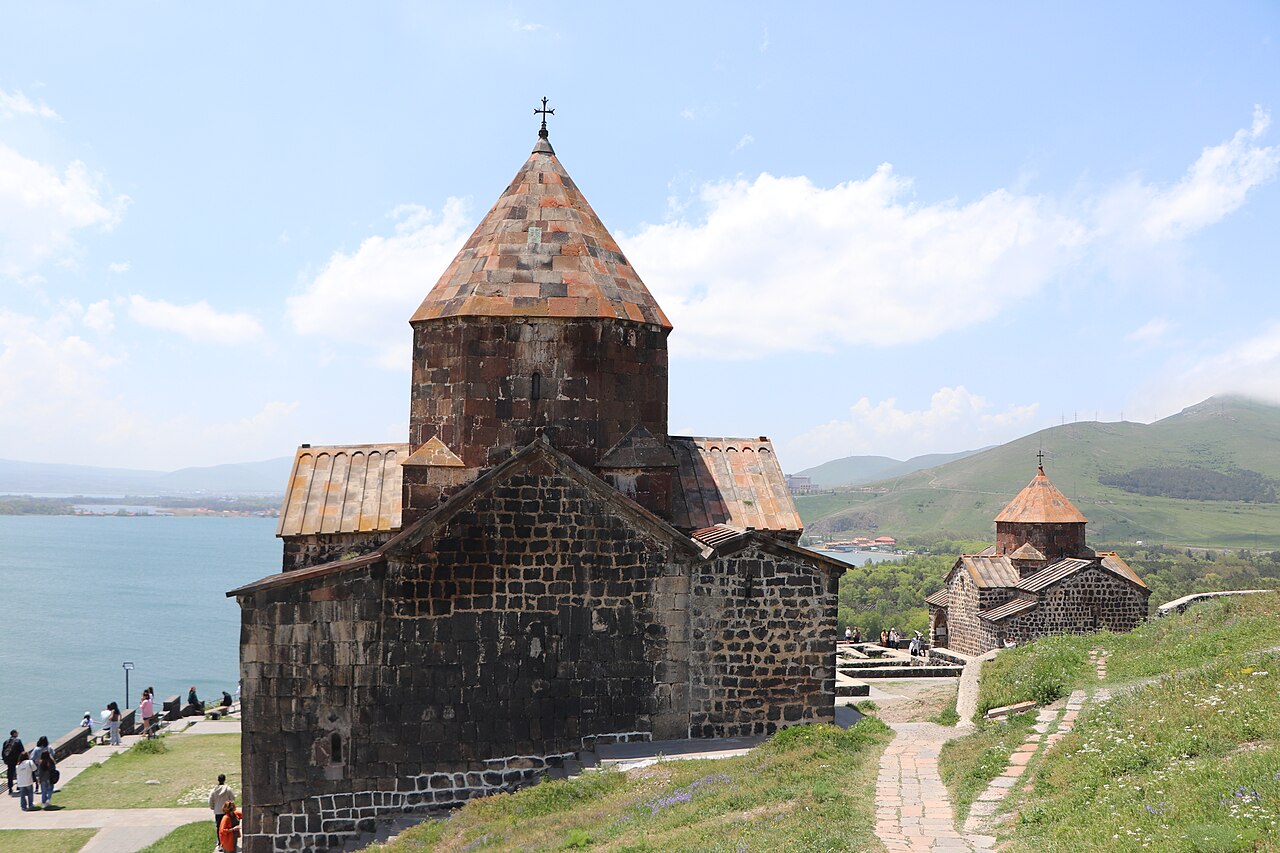
Armenian monastery on Lake Sevan's peninsula, once isolated on an island of penitential monks
Sevanavank (Սևանավանք) is a monastery on the peninsula of Lake Sevan, near the town of Sevan. The lake is a popular summer destination — Armenia is landlocked, and Sevan is the closest thing to a sea resort. The monastery's setting on the lake shore is beautiful.
It was built in the 9th century soon after Armenia freed itself from Arab rule. Originally it stood on an island, isolated and strict — monks from Echmiadzin who had transgressed were sent here as penance.
Two small churches remain: Sourb Arakelots (Holy Apostles) and Sourb Astvatsatsin (Holy Mother of God). During the Soviet era, Stalin ordered the lake level to be lowered to provide water and hydroelectric power; the island became a peninsula. The level dropped around 20 metres from its original height. After Stalin's death the project was stopped and partially reversed, but the peninsula remains. The eastern part is fenced off as a presidential residence.
No entry fee — visitors are expected to buy and light candles inside the churches. Because the area is a beach resort in summer, the dress code is notably relaxed compared to most Armenian churches.
Buses and marshrutkas to Sevan town run frequently from near Yeritasardakan metro station in Yerevan; the journey takes about an hour. From Sevan town, the monastery is about a 30-minute walk. A taxi from the town to the monastery costs around 1,000 AMD; be wary of higher offers.
The lake sits at approximately 2,000 metres above sea level — sun exposure is intense in summer. Wear sunscreen and a hat.
There are plenty of hotels, restaurants, and beach facilities along the lake shore, though the town of Sevan itself has limited options.
Guide
Books
The Caucasus: An Introduction by Thomas de Waal (2010) — De Waal is the best English-language writer on the modern South Caucasus. This short, lucid book covers the history, the conflicts, and the character of Armenia, Georgia, and Azerbaijan together. Read it before you go and the landscape will mean more.
Edge of Empires: A History of Georgia by Donald Rayfield (2012) — Ostensibly about Georgia, but the South Caucasus has always been one tangled history, and Rayfield's deep knowledge of the region illuminates Armenia just as much. Dense in places, but authoritative.
Black Garden: Armenia and Azerbaijan Through Peace and War by Thomas de Waal (2003) — De Waal's earlier and longer book on the Nagorno-Karabakh conflict. Understanding this conflict is close to essential for understanding modern Armenia — it shapes everything from politics to the national mood. Sober and fair-minded.
Armenia: Travels in the Land of Noah by Nicholas Holding (Bradt, 2011) — A conventional travel guide rather than narrative, but Holding writes well and knows the country. Useful for practical context on sites like Sevanavank.
Guide
Day Trips
The monastery pairs well with other sites around Lake Sevan and in the region. Most visitors come as a day trip from Yerevan, and with a car or a tour you can combine two or three stops in one day.
Noratus is the most compelling nearby destination — a field of several hundred Armenian khachkars (cross-stones) just south of Sevan town, the largest surviving collection in the world. It takes about 30 minutes to walk through. Roughly 10km from Sevan town.
Dilijan is a forest resort town in the mountains about 40km north — often called "the Swiss Armenia" for its wooded hills and cooler air. It has a well-preserved old quarter, a growing arts scene, and several good restaurants. Makes a fine second stop if you have a car.
Yerevan is the base for almost everyone visiting Sevanavank — 65km away, about an hour by marshrutka. The capital is worth several days on its own.
Guide
When to Go
June through September is when Sevanavank makes the most sense as a combined monastery-and-lake trip. July and August are peak season — warm, busy, full resort atmosphere along the shore. If you want to swim, this is the window, though the water stays cold at 2,000 metres.
May and October are quieter and often beautiful. October in particular has good autumn colour on the hills around the lake. The monastery is open year-round and sees few visitors in the off-season.
Winter is possible — the churches are accessible and there is something stark and striking about the monastery in snow — but the road from Sevan town can be icy, most restaurants and facilities along the shore will be shut, and the marshrutka frequency drops. Come prepared or join a tour.
Avoid peak summer weekends (Saturday and Sunday in July–August) if you want the monastery to yourself. Arrive early on those days if you cannot avoid them — the tour buses arrive mid-morning.