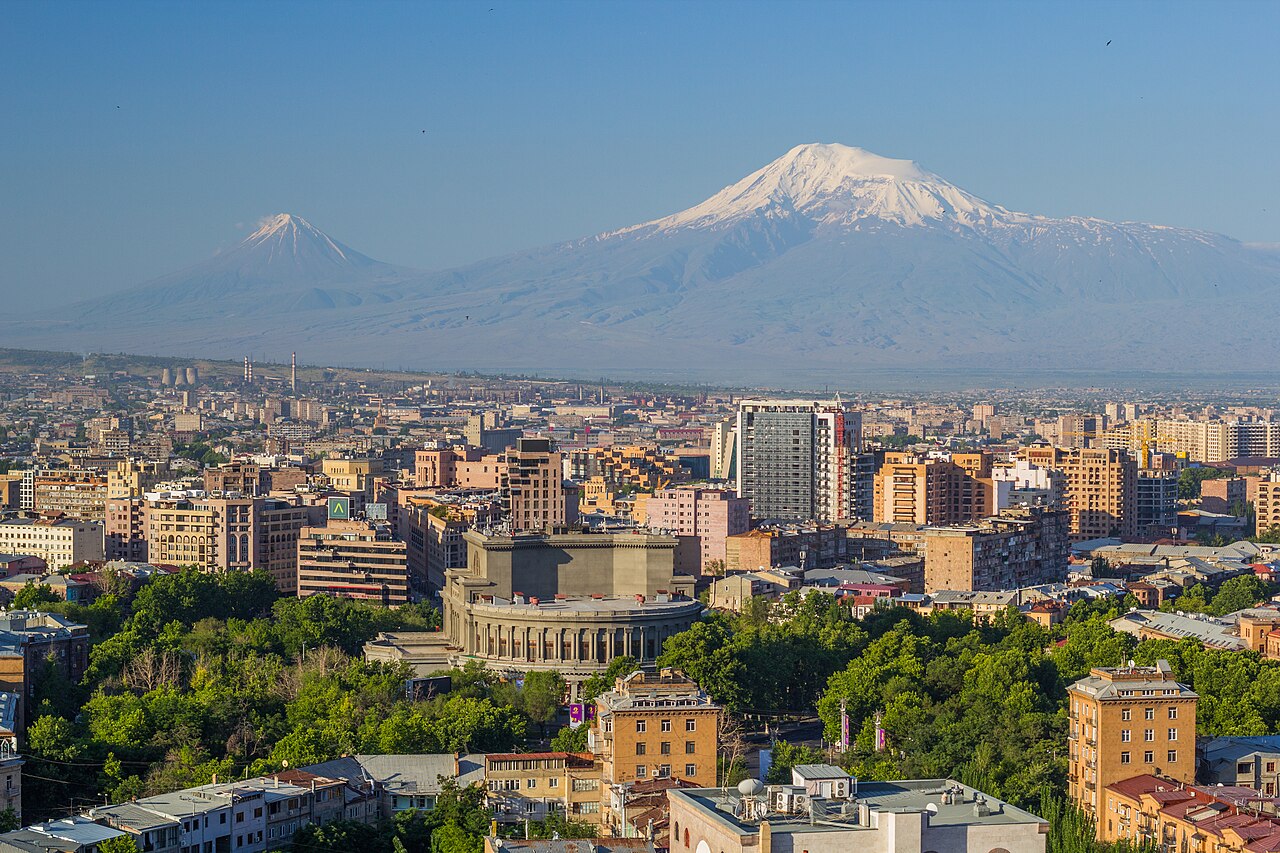
Yerevan is the capital of Armenia and one of the world's oldest continuously inhabited cities — older than Rome, founded in 782 BC as the Urartian fortress of Erebuni. For much of its history it was a provincial outpost of larger empires (Persian, Russian, Soviet); its modern face as a capital was largely invented in the 1920s by the architect Alexander Tamanian, who replanned the city around the pink-tufa-faced Republic Square, radiating boulevards, and the gigantic stairway of the Cascade.
The city is compact and walkable, with most of what visitors want to see concentrated in the Kentron district. Cultural life is unusually rich for the city's size — the Matenadaran holds one of the great manuscript collections of the world, the Cafesjian Center turns the Cascade into a sculpture museum, and small house-museums dedicated to Sergei Parajanov, Martiros Saryan, and Aram Khachaturian preserve the studios of the country's artistic giants. The Armenian Genocide Museum on the western ridge is the emotional counterweight to all of it.
Cafes and bars are at the centre of daily life. The Opera district fills with outdoor tables in summer; Saryan Street has become Yerevan's wine bar district; and the third-wave coffee revolution has long since arrived. The food has improved sharply over the past decade as well, both at the high end (Dolmama) and in cheerful mid-range places like Lavash and Tavern Yerevan.
With Yerevan as your base you can easily visit Echmiadzin, the Holy See of the Armenian Church; the Hellenistic temple of Garni; and the rock-cut monastery of Geghard — all comfortable day trips. On a clear morning, look up: Mount Ararat, on the Turkish side of a closed border, dominates the southern horizon, a reminder of the much larger Armenian world that this small republic carries on its shoulders.