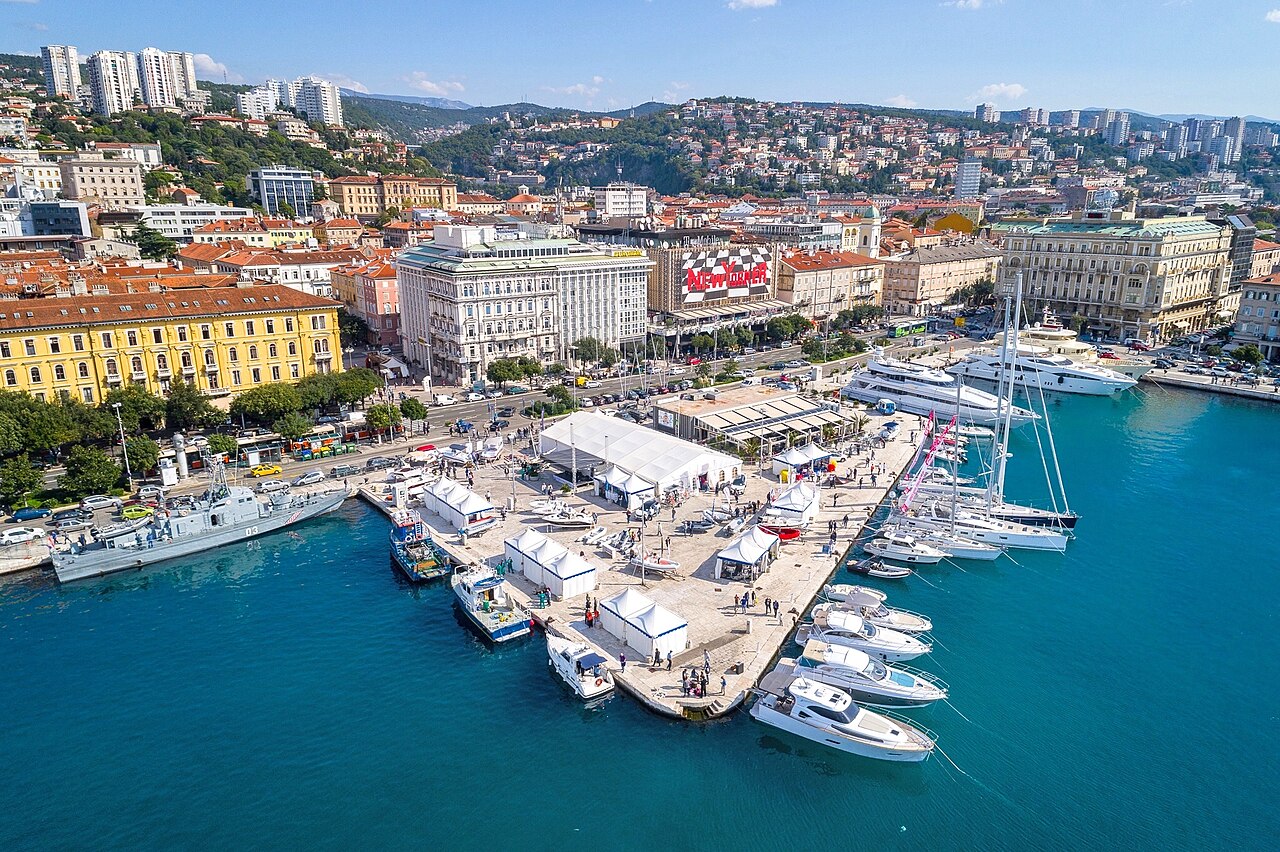
Rijeka is Croatia's third city and its main port, set at the head of the Kvarner Gulf where the Adriatic cuts deepest into the continent. It is a working city rather than a tourist showcase, which gives it a character quite different from the polished coastal towns further south. The Austro-Hungarian architecture, the industrial waterfront, and the gritty energy of the Korzo — the main pedestrian street — recall Trieste more than Dubrovnik.
The city has changed hands repeatedly: Habsburg, Hungarian, Italian, Yugoslav, and finally Croatian. This layered history shows in the architecture and in the city's open, multicultural atmosphere. Rijeka was European Capital of Culture in 2020, which brought investment in the waterfront and cultural spaces, though it remains refreshingly ungentrified.
The hilltop Trsat Castle and the pilgrimage church of Our Lady of Trsat are worth the climb for the views over the gulf; take the 561-step staircase from the Rječina riverbank and you pass votive chapels all the way up. The old town has a covered market, the round-hulled St. Vitus Cathedral, and the entrance to the Rijeka Tunnel, a wartime air-raid shelter turned cultural venue. Down at the harbour, the Torpedo Launch Station marks where the self-propelled torpedo was invented in 1866 — one of the stranger facts a port city can claim. The PEEK&POKE Computer Museum holds Europe's largest collection of vintage computers and gaming hardware, and everything is playable.
Rijeka is also the gateway to the Kvarner islands — Cres, Lošinj, Krk, and Rab — all reachable by ferry or bridge from the surrounding area. The annual Carnival in February is one of the largest in Europe.