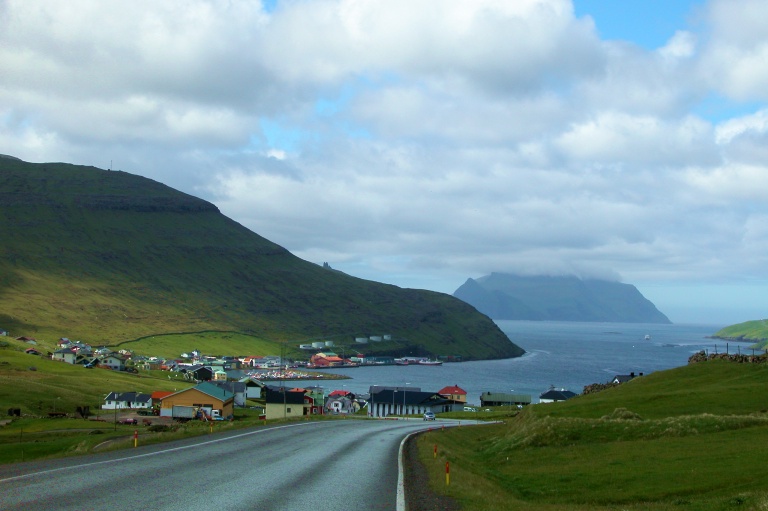
Sørvágur
©
Sørvágur

Sørvágur

Faroese village on Vágar, beside the airport, Mykines ferry, and trails toward lake-above-the-sea views.

Sørvágur is a quiet village of around 1,000 people on the western coast of Vágar, but its surroundings are among the most dramatic in the entire Faroe Islands. The Faroes' only airport sits on the edge of town. The harbour is the departure point for ferries to Mykines, the wildest of the island chain. And within a short walk lies the entrance to the trail that leads to Sørvágsvatn — the lake that appears, impossibly, to float above the sea.

The town itself is modest: a cluster of houses, a small church, the harbour, and the airport hotel. The appeal is entirely what surrounds it. West of Sørvágur, the road leads to Bøur and Gásadalur, two villages so scenically extravagant they have become the signature images of the Faroes — grass-roofed houses, sea stacks, waterfalls falling off the edge of the world. To the south, the lake Sørvágsvatn (also called Leitisvatn) sits above sea cliffs at an angle that plays tricks with the eye; the photograph of it has circled the internet so many times it is now one of the most recognised landscape images of northern Europe.

Most visitors pass through Sørvágur on their way somewhere else, and that is understandable. But the town makes a practical base — cheaper and quieter than Tórshavn, with easy access to Vágar's best scenery in every direction.

Guide

Day Trips

The villages west of Sørvágur are Vágar's showpieces. Bøur is 4 km down the road — a handful of grass-roofed houses, a white church, and a view across to Tindhólmur that photographers travel across the world to capture. From Bøur, a trail continues over the ridge to Gásadalur, where the Múlafossur waterfall falls directly off the cliff edge into the sea; the walk takes about an hour each way. Both villages are comfortable half-day trips from Sørvágur by car or bicycle.

For a longer day out, Tórshavn is an hour east — the capital's old harbour quarter at Tinganes, the National Museum, and a handful of good restaurants make it worth the drive.

Guide

Getting There

Sørvágur is the easiest place in the Faroes to reach — the airport is on its doorstep. Vágar Airport handles all international flights to the islands, with year-round service from Copenhagen (Atlantic Airways and SAS) and seasonal flights from Reykjavík, Edinburgh, Bergen, and other northern European cities. The crossing from Copenhagen takes around two and a half hours.

From the airport, Sørvágur is five minutes by car or taxi. Tórshavn, the capital on the neighbouring island of Streymoy, is about an hour by car via the sub-sea tunnel — a remarkable piece of infrastructure that runs under Vestmannasund and has transformed travel between the two islands. Regular buses (SSL) also run between Vágar Airport and Tórshavn, with a journey time of around an hour.

If you are arriving by the Smyril Line ferry from Denmark or Iceland, the ship docks at Tórshavn, from where you can drive or take the bus to Vágar. A rental car picked up at the airport is by far the most practical way to see Vágar's scattered attractions; distances are short but public transport to the trailheads is limited.

Guide

When to Go

The Faroe Islands have no bad season, but the reasons to visit Sørvágur change dramatically through the year.

Summer (June–August) is the peak for most visitors. The Mykines ferry runs daily, the puffins are nesting, the days are extraordinarily long (near-midnight twilight in June), and the hiking trails are at their most accessible. The downside is that this is also when Vágar is busiest — the Sørvágsvatn trail and Mykines ferry fill up, and accommodation needs booking well ahead. The weather is mild but rarely warm; expect temperatures of 10–15°C and pack for wind and rain regardless of the forecast.

Spring (April–May) and autumn (September–October) offer a reasonable balance: fewer visitors, the lake trail still walkable, and a good chance of the dramatic low-angle light that makes Faroese landscapes look their most spectacular. The Mykines ferry typically starts in late April or May and ends in September.

Winter (November–March) closes the ferry to Mykines and shortens the days to a handful of hours, but the islands take on a different kind of appeal — austere, atmospheric, and very quiet. The airport operates year-round, and the road to Bøur and Gásadalur is accessible in all but the worst weather.