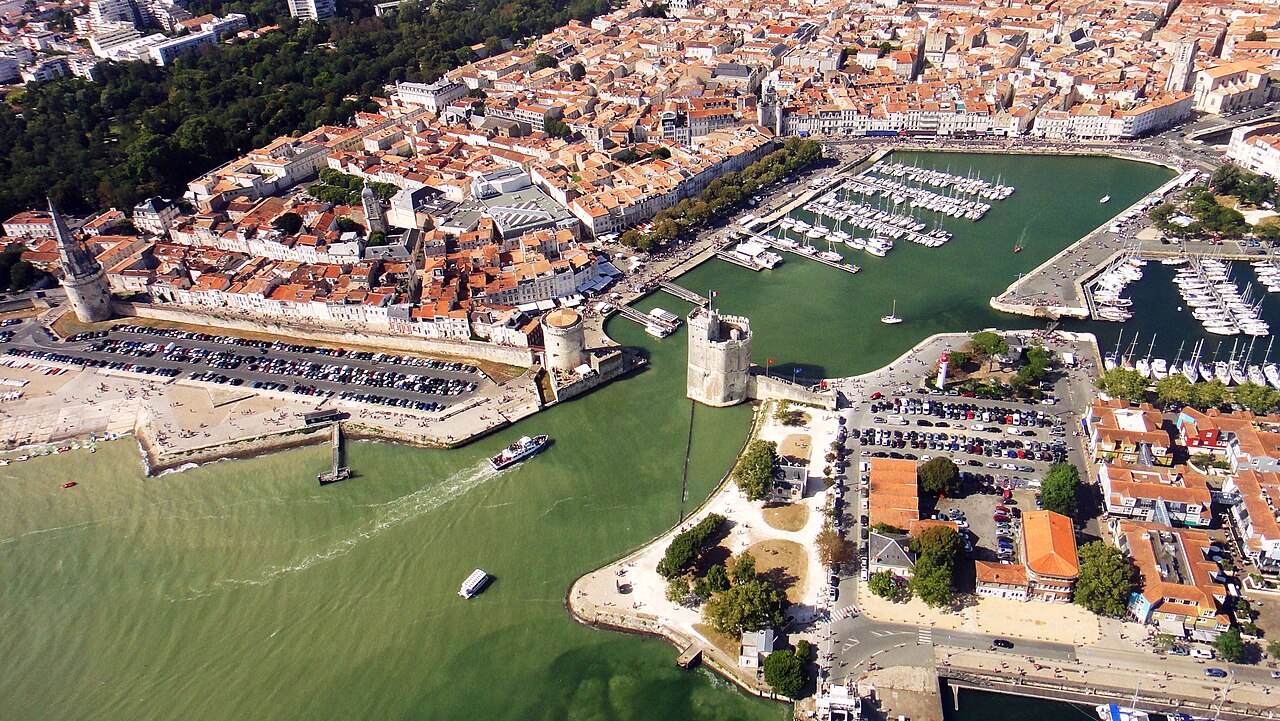
La Rochelle is one of the most attractive coastal towns in France — a handsome port city with a seventeenth-century waterfront, arcaded streets, and a rich maritime history. The Vieux Port, flanked by the medieval Tour Saint-Nicolas and Tour de la Chaîne, with the Grosse Horloge gateway behind, is the heart of the town and one of the most photographed waterfronts on the Atlantic coast.
The centre is compact and largely pedestrianised, with arcaded streets full of independent shops along the Rue du Palais. The Musée du Nouveau Monde, housed in a former ship-owner's mansion, documents La Rochelle's role in the transatlantic trade — including the slave trade in which the town was deeply implicated. The Hôtel de Ville is one of the finest Renaissance buildings in France. The Aquarium near the harbour is excellent and popular with families.
La Rochelle's history is dramatic — it was a Huguenot stronghold besieged by Cardinal Richelieu in 1627–28 from the Fort Louis built specifically for the purpose, an episode that features in Dumas's Three Musketeers. The town was also an important departure point for settlers heading to New France (Canada) — and one of France's most active slave-trade ports, a history confronted directly by the Musée du Nouveau Monde and the Statue of Toussaint Louverture near the waterfront. The Second World War left scars too: the U-boat pens at La Pallice on the western edge of the city are one of the largest surviving Nazi concrete structures, and the Bunker de la Rochelle hidden in the old town preserves a German command post. The Jardin des Plantes behind the natural history museum is one of the few shaded retreats in the centre on a summer afternoon.
Just south of La Rochelle is the Île d'Oléron, France's second-largest island, with long sandy beaches. The Île de Ré to the north is more fashionable and busier in summer.