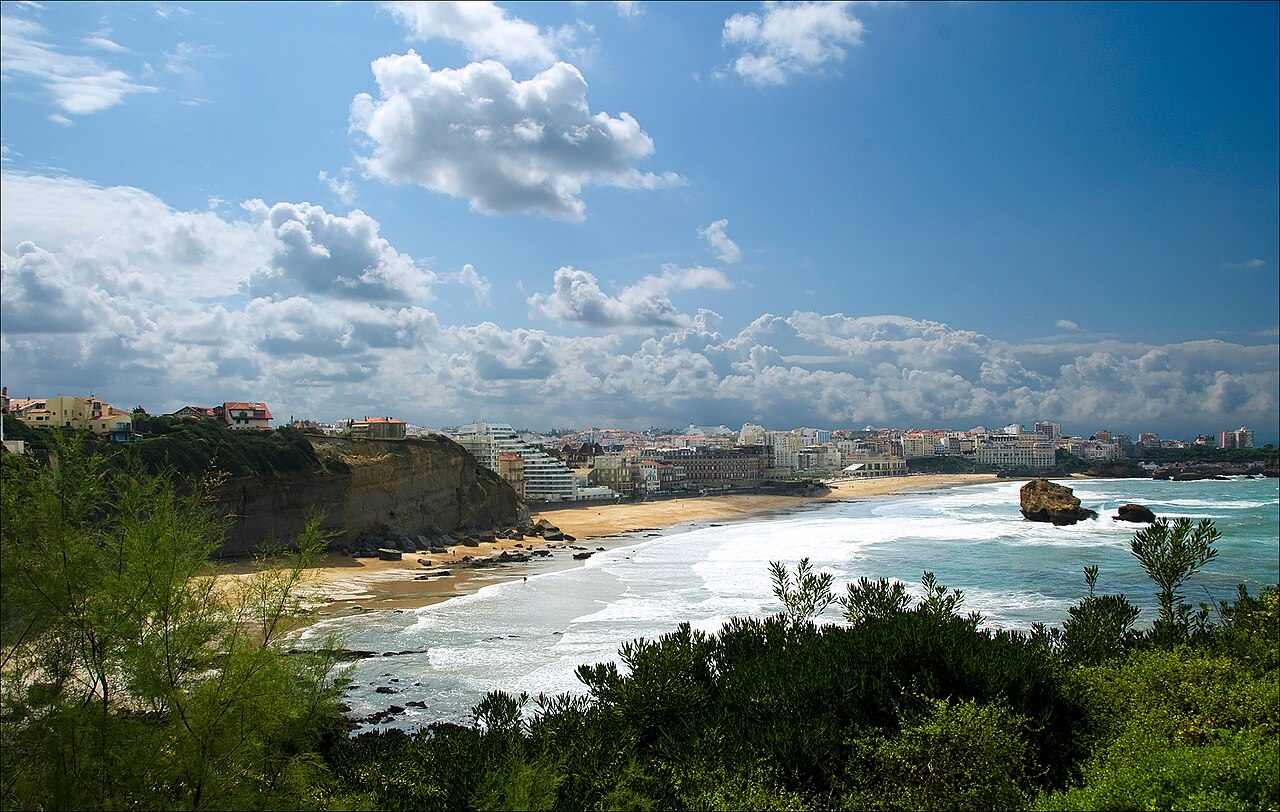
Biarritz is an elegant seaside resort on France's Basque coast, just 15 kilometres from the Spanish border. It was a sleepy whaling port until 1854, when Napoleon III's wife Empress Eugénie took a liking to the wild Atlantic beach and built a summer palace here. Overnight, Biarritz became one of the fashionable spots of the European belle époque: Queen Victoria, the Tsar of Russia, various Spanish and Dutch royals, and the wider European aristocracy followed Eugénie's lead, and the town filled with grand seafront hotels, a Russian Orthodox church, and the white-stone villas that still give Biarritz its distinctive mix of Basque and Second Empire architecture.
What saved Biarritz from becoming a museum of itself was the arrival of surfing. Peter Viertel, the American screenwriter working on a film adaptation of Hemingway's The Sun Also Rises, brought the first surfboard to Biarritz in 1956, and the combination of Atlantic swell, long sandy beaches, and a generation of French kids who couldn't get enough of it turned Biarritz into the birthplace of European surf culture. The Grande Plage in the middle of town is still the city's main beach and a classic intermediate wave; the Côte des Basques, just south, is the original Biarritz surf spot and where most people learn. Every summer, surf festivals and contests bring competitors and spectators from across Europe.
Beyond the beach, the town has more to offer than its reputation suggests. The Hôtel du Palais, the former imperial summer residence now a Belle Époque luxury hotel, still anchors the seafront. The Rocher de la Vierge, a rocky outcrop reached by a slender footbridge attributed to Gustave Eiffel, is the postcard view — statue of the Virgin on top, Atlantic waves smashing against the rocks below. The Musée de la Mer, in an art deco building above the Côte des Basques, has one of the better aquariums in France. And the Saturday-morning market at Les Halles is the best introduction to Basque food — jambon de Bayonne, sheep's milk cheese from Ossau-Iraty, and the piment d'Espelette that seasons everything on the local menu.
Biarritz is also a natural base for exploring the French Basque country. Bayonne, with its 14th-century cathedral and its status as the ham capital of France, is ten minutes north. The pretty harbour town of Saint-Jean-de-Luz is twenty minutes south. San Sebastián, across the border in Spain, is an hour's drive and worth a day. And the Pyrenees, visible on clear days from the beach, are an hour and a half inland.