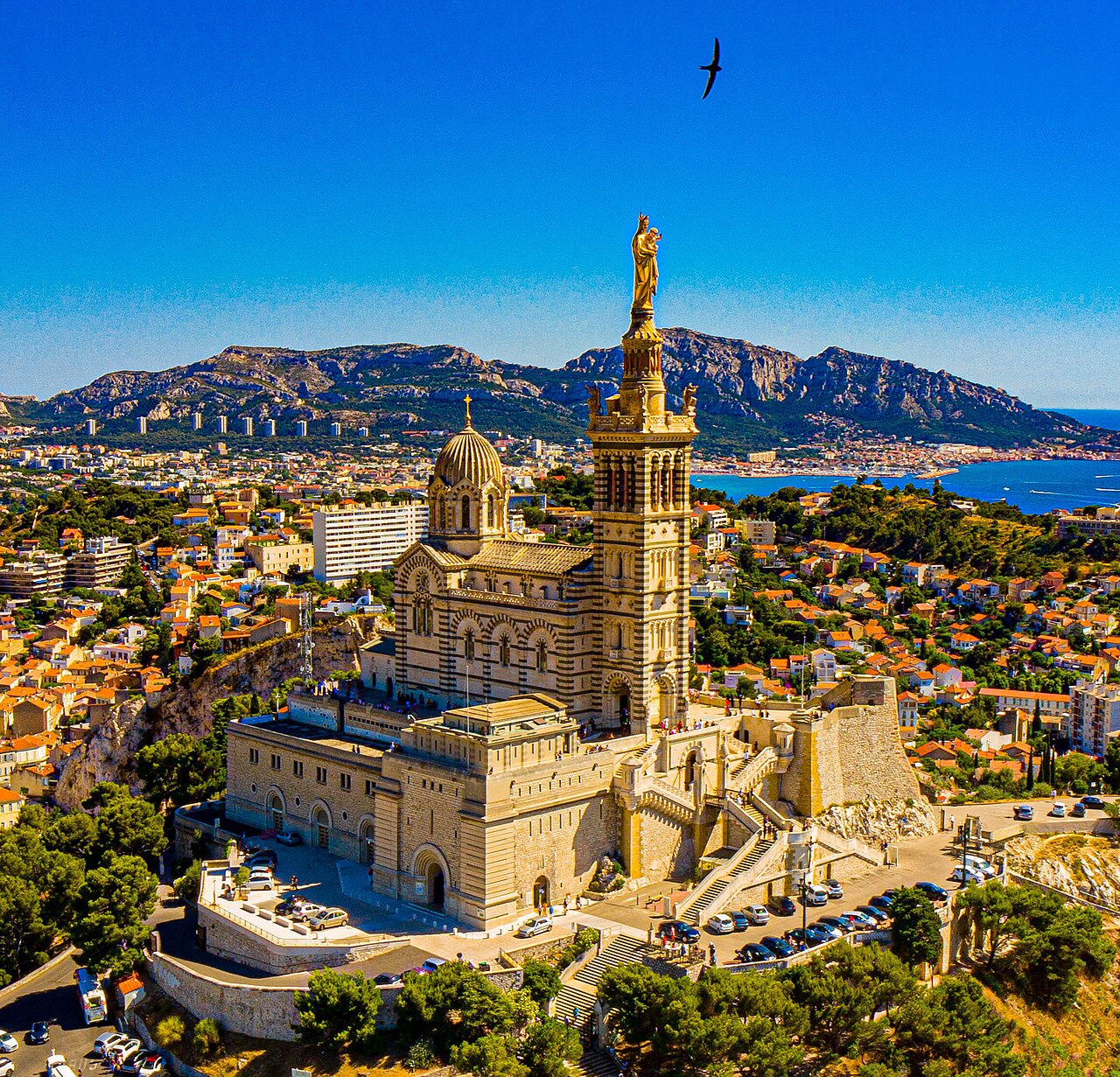
Marseille is France's oldest and second-largest city, founded by Greek sailors from Phocaea around 600 BCE. It sits in a dramatic setting on the Mediterranean coast, built around the Vieux-Port and climbing up the hills behind it. The golden statue of the Virgin Mary atop Notre-Dame de la Garde watches over the whole city from the highest point.
This is not the Paris of picture postcards. Marseille is raw, diverse, noisy, and unapologetically itself. The city's population is a mix of North African, Comorian, Armenian, Italian, and old Provençal communities, and that diversity shows up in the food, the street life, and the atmosphere. The Vieux-Port is the heart of the city — fishermen still sell the morning catch on the quay, and the surrounding streets are packed with restaurants serving bouillabaisse, the city's signature fish stew.
Beyond the port, the Panier quarter is the oldest neighbourhood, a tangle of steep streets with colourful shuttered houses and street art. The Cathédrale de la Major, an enormous Romanesque-Byzantine striped cathedral, sits at the edge of the Panier overlooking the sea. Across the harbour mouth, the MuCEM and Fort Saint-Jean are linked by a high footbridge. Further along the coast, the Corniche Kennedy runs for five kilometres above the water, with views out to the Frioul islands and the Château d'If — the island fortress made famous by Alexandre Dumas.
South of the city, the Calanques — dramatic limestone inlets with turquoise water — are one of the most spectacular stretches of coastline in France. You can hike, kayak, or take a boat trip to reach them. For a different kind of pilgrimage, Le Corbusier's Cité Radieuse sits in the south of the city — the foundational post-war housing block, still in everyday use.