Chambord
©
Chambord

Chambord

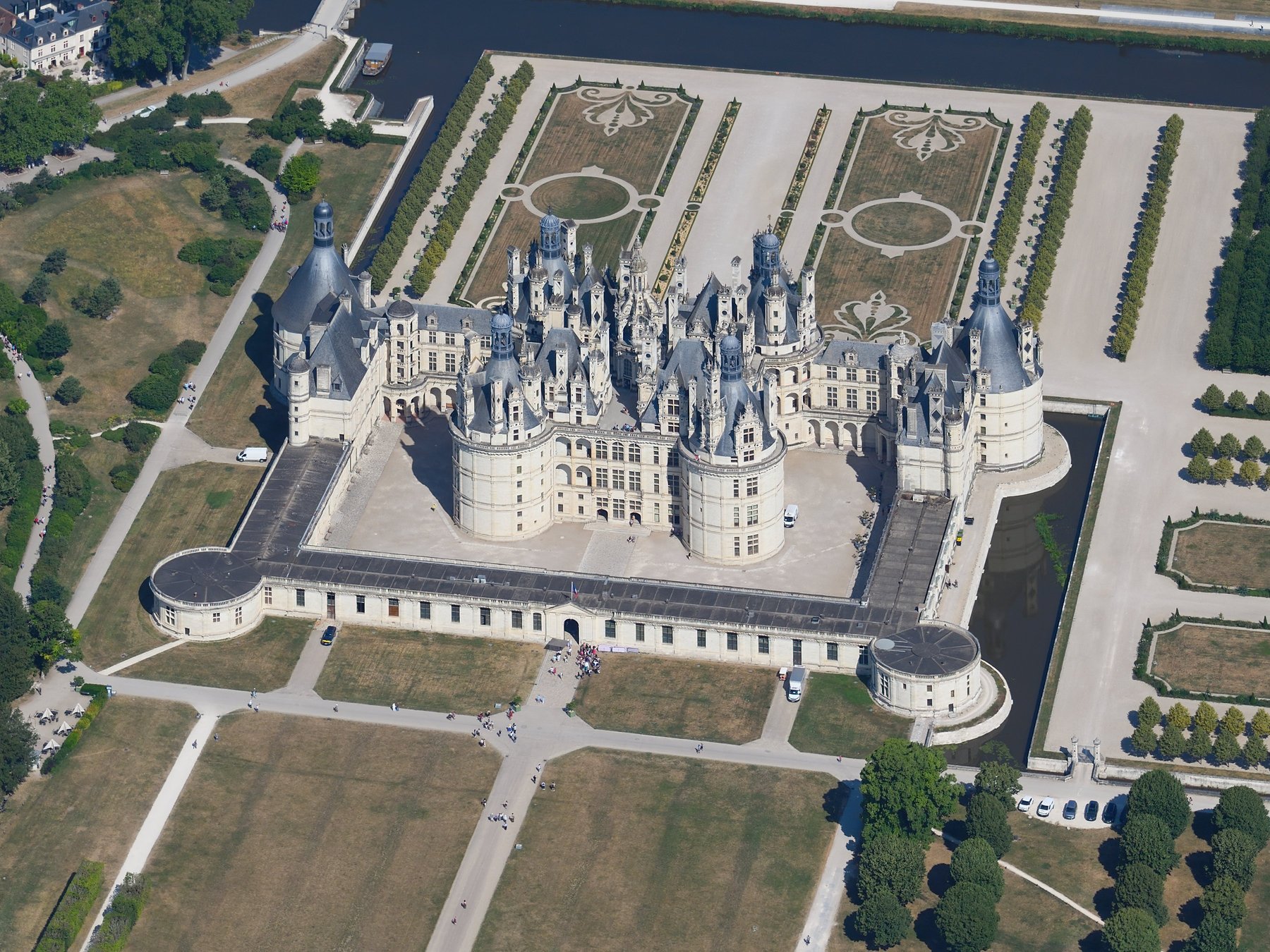
Royal Loire château in Sologne forest, all towers, chimneys, dormers, and a double-helix staircase.

Chambord is probably the second most famous chateau in France after Versailles, and arguably the more impressive of the two — a fantasy of towers, chimneys, and dormers rising from the flat Sologne forest. Begun in 1519 for King Francis I, the castle is square-shaped with a central keep connected to the outer wings by galleries. Inside the keep, a famous double-helix spiral staircase — widely attributed to Leonardo da Vinci — allows two people to ascend simultaneously without ever meeting.

The castle sits in the largest enclosed forest park in Europe, a national hunting reserve home to deer, wild boar, and abundant birdlife. Several footpaths through the estate are open to the public.

Top priorities for a visit: the double-helix staircase, the second-floor barrel-vaulted coffered ceilings, the rooftop terrace (the view over the estate is extraordinary), the apartments of Louis XIV, and the suite of Francis I.

Guide

Eating Out

There are a few small restaurants just opposite the chateau on the Place St. Michel. If you want more than just a snack you should go to ther restaurant of the hotel St. Michel which is pretty good.

Guide

Getting There

Chambord is easy to reach from Blois. From may to september there are buses and even special trains for the castle. Both buses and trains have irregular schedules.

It's best to avoid taking a special tour bus - if you are fit enough you would be much better of renting a bike for a day - the ride is pretty and you have the chance to see some of the forested domaine de Chambord.

Guide

Things to Do

Chambord is essentially a single sight — the chateau itself — but it is vast enough to fill a full day. The main areas to explore inside the castle:

The Keep — The central building, with its famous double-helix spiral staircase. The terraces on top give a panoramic view over the entire estate.

Francis I Suite — Francis moved his living quarters to the eastern wing, though he died before they were finished. The suite includes a king's hall taking up an entire floor, two cabinets, a bed chamber, and a small oratory.

Chapel — Linked to the keep by a gallery, this chapel was built by Louis XIV. It occupies two full floors and is surprisingly large.

Apartments of Louis XIV — In the keep. Two quarters were combined by partitioning the north vestibule, following the etiquette that required the royal suite to be at the centre of the main facade.

Museum of the Comte de Chambord — On the first floor, containing memorabilia of the last private owner of the chateau.

Museum of Hunting — Francis I was as passionate about hunting as about building. The museum covers the history of hunting in the region, with tapestries, paintings, sculptures from the 16th to 18th centuries, and hunting weapons.