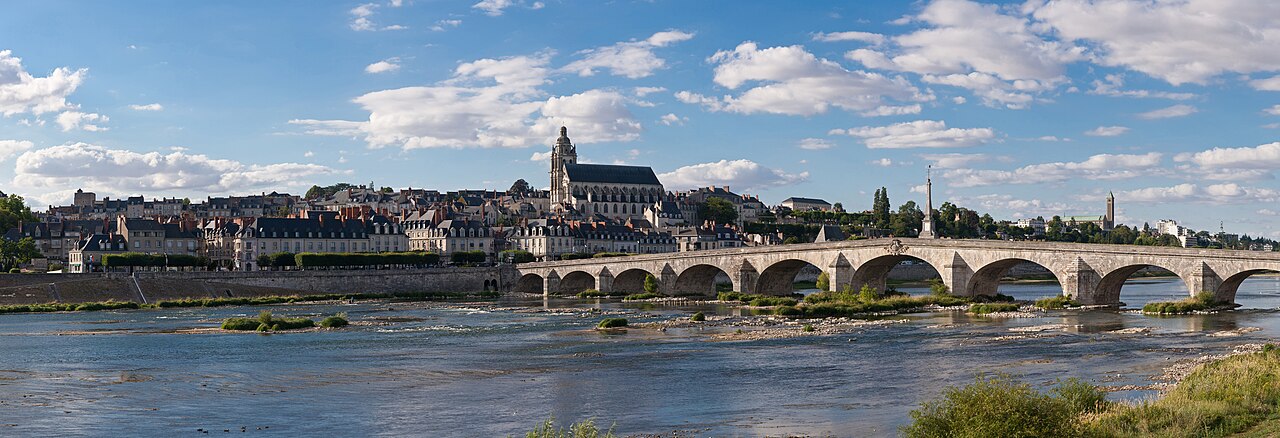
Blois sits halfway between Orléans and Tours on the north bank of the Loire. Seen from across the river, the city is a tier of pale houses with red-tile roofs climbing to two hills — one crowned by the cathedral, the other by the royal château.
In the 11th century Blois became the most important town in the region. A stone castle was built to protect the town along with walls that followed the headland. At the end of the 14th century the county was sold to Louis of Orleans, son of Charles V, who lived in the castle for 25 years and attracted a small court of scholars and poets. His grandson Louis XII became king of France in 1498 and moved the court here — the small town became a royal town and capital of the kingdom. Under Louis XII and François I the city grew quickly, but after a defeat at Pavia in 1525, François I never returned, and his successors only made short visits.
That short royal moment is why Blois remains a small, walkable town. The two unmissable sights are the Château Royal de Blois — four wings in four architectural styles around a single courtyard — and the Maison de la Magie opposite, dedicated to the local-born conjuror Robert-Houdin, whose name Houdini took. Between the two is a small square with restaurants and terraces.
Walk up to the Cathédrale Saint-Louis for Jan Dibbets's modern stained glass and the view from the Jardins de l'Évêché behind it. The monumental Escalier Denis-Papin connects the lower and upper towns, and the Pont Jacques-Gabriel is worth crossing for the postcard view back. The unusual Fondation du Doute — a Fluxus art collection in a former convent — provides the counterweight to the château across the road.
Most visitors use Blois as a base for the surrounding châteaux: Chambord, Cheverny, Chaumont, and Chenonceau are all easy day trips.