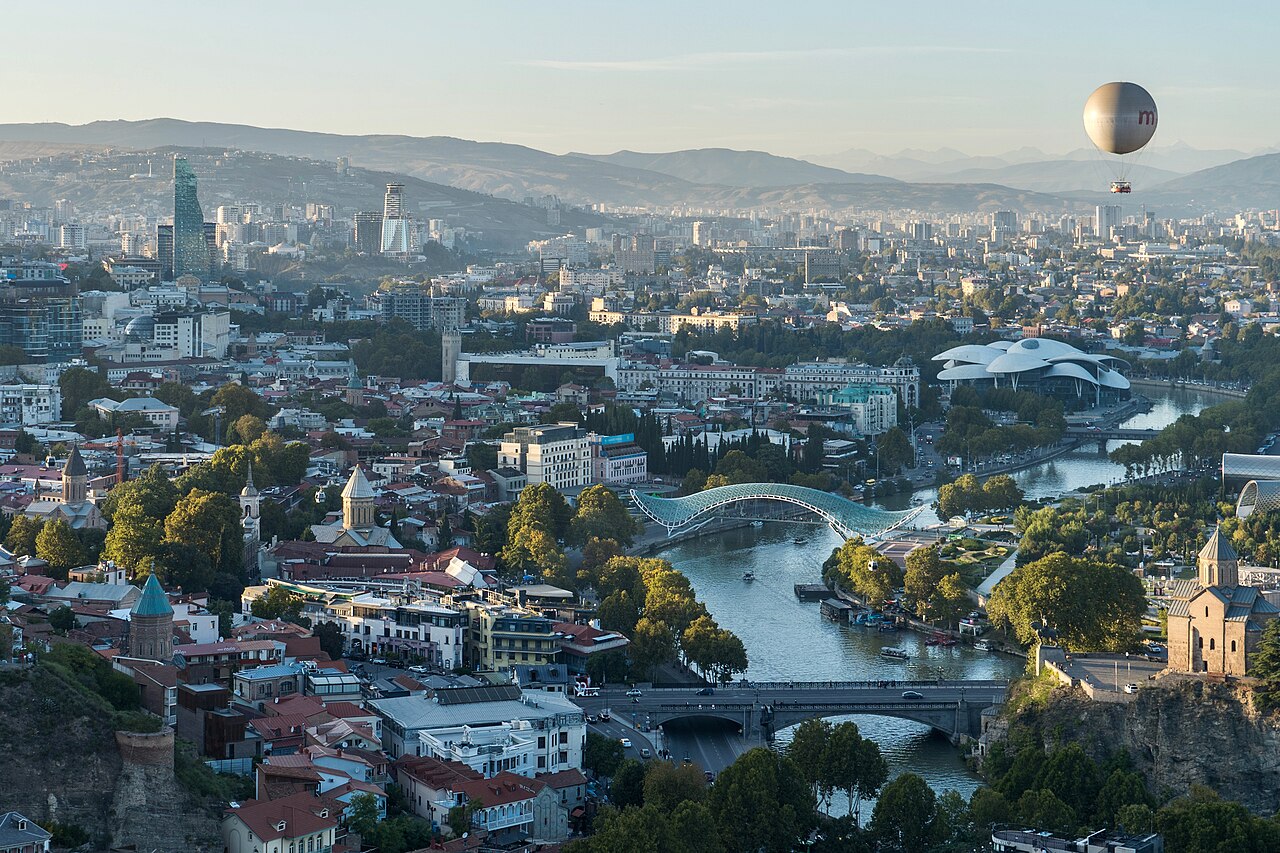
Georgia's capital Tbilisi lies in the centre of eastern Georgia, in the foothills of the Trialeti mountain range. According to Georgian legend it was founded in the 5th century by King Vakhtang Gorgasali, who while hunting shot a pheasant which fell into a warm spring and was either boiled or healed, depending on which version you hear. Either way, the king was inspired to found a city on the spot, and the name derives from the Georgian word tbili, meaning warm. Although the city has been destroyed and rebuilt some 29 times, the layout of the Old Town is largely intact, with narrow alleys and big crooked houses built around interior courtyards.
The city is divided by the Mtkvari River. On the east bank stands the Old Town (Kala), where medieval churches crowd together between the Narikala Fortress on the hill and the steaming domes of the Sulphur Baths at the foot. On the west bank, Rustaveli Avenue — Tbilisi's grand 19th-century boulevard — runs from Freedom Square past the parliament building, opera house, and National Museum to Rose Revolution Square. The newer districts spread westward from there across the hills.
Tbilisi has a polyglot, tolerant character rooted in centuries of trade. The old city still has Armenian churches, a synagogue, a Shia mosque, and Georgian Orthodox cathedrals within walking distance of each other. The food is excellent — Georgian cuisine deserves to be far better known outside the region. The wine is extraordinary. The nightlife has developed into something genuinely European, and cheap enough to make visitors from Western Europe feel rather pleased with themselves.
The climate is continental. Summers are hot and dry (over 35°C in July and August). Winters are cold, with occasional snow. Spring and autumn are the best times to visit — mild, clear, and less crowded.