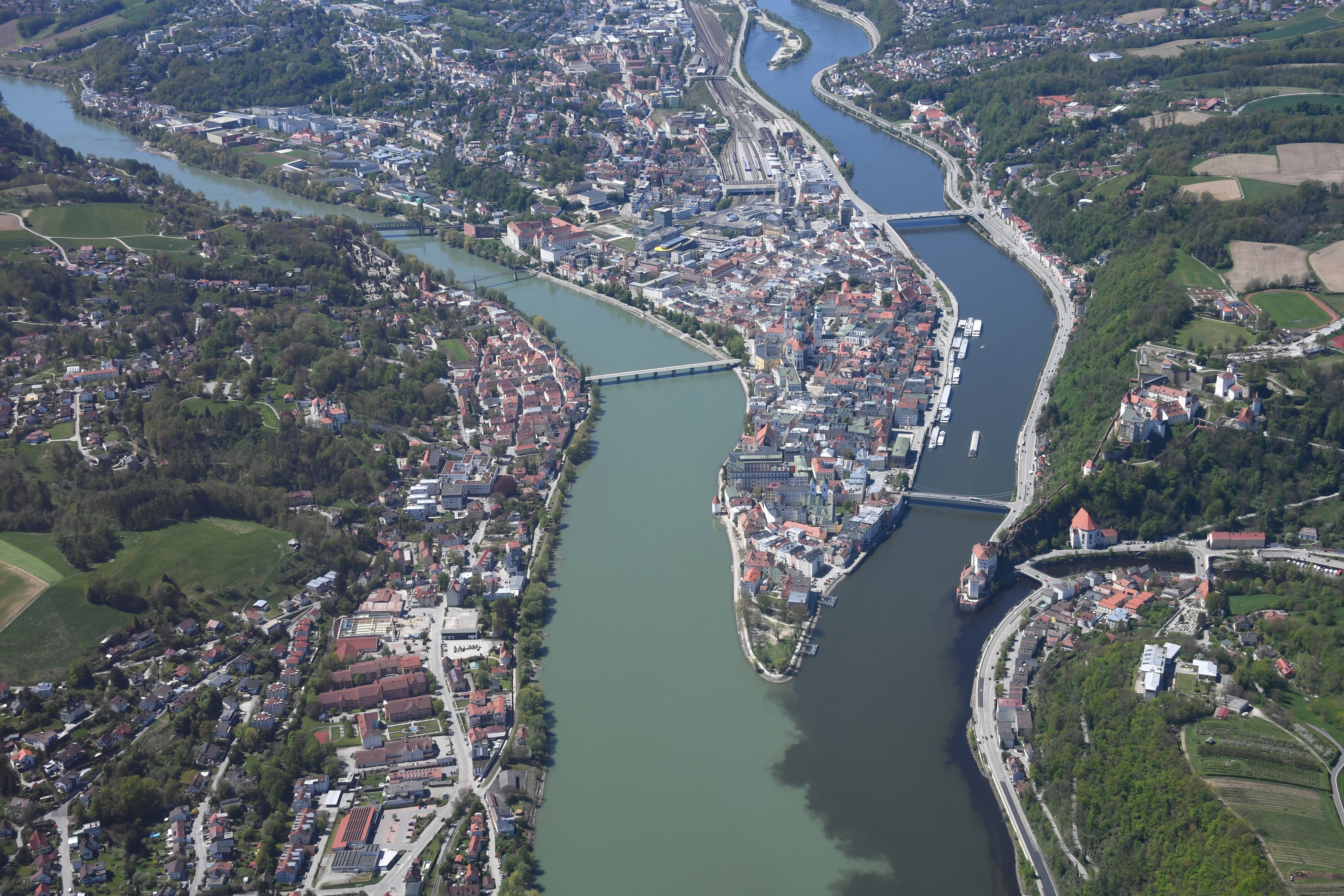
Passau sits at the confluence of three rivers — the Danube, the Inn, and the dark little Ilz — on a narrow peninsula at the eastern tip of Bavaria, just before the Austrian border. Human settlement here dates to prehistoric times; the Romans called it Batavis. For nearly a thousand years it was ruled by prince bishops who made it the seat of the largest diocese in the Holy Roman Empire, and the Baroque city they built after the catastrophic fire of 1662 is one of the most beautiful in Bavaria.
The old town is compact and dramatic — stone lanes rising steeply from the riverbanks, the great dome and towers of St. Stephan's Cathedral dominating the skyline, and at the pointed eastern tip of the peninsula, the Dreiflüsse-Eck where the rivers meet in three visibly different colours. Above it all, the medieval citadel of Veste Oberhaus offers the panoramic view that makes Passau's geography suddenly legible.
The city is a stop on the classic Danube cycling route from Passau to Vienna, one of the most popular cycling holidays in Europe. It is also a major embarkation port for river cruises, which means the old town can feel busy and transient in summer. Stay the night and it empties out — the day-trippers leave and the place recovers its quiet character. The Glasscherbenhaus, a mosaic-covered folk art villa above the town that most visitors never find, is worth the uphill walk for anyone interested in the eccentric edge of Bavarian piety.