Donauwörth
©
Donauwörth

Donauwörth

Bavarian Romantic Road town at the Wörnitz-Danube confluence, rebuilt around its photogenic Reichsstrasse.

Donauwörth sits where the Wörnitz meets the Danube, making it one of the more substantial stops on the Romantic Road. It is a working Bavarian town rather than a museum piece — rebuilt after heavy Second World War bombing but done carefully, so the old streets still feel like themselves.

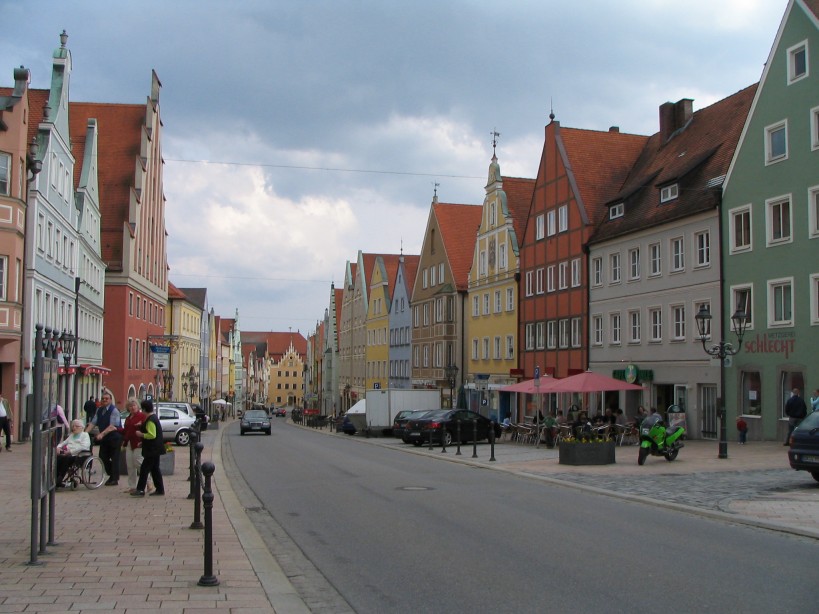
The Reichsstrasse, the long main street, is one of the most photogenic in the region: colourful gabled houses line both sides as it climbs to the late-Gothic Liebfrauenmünster, whose tower offers a good view over the river confluence below. At the top of town, the Benedictine abbey church of Heilig Kreuz is worth the short detour.

The Käthe-Kruse-Puppen-Museum is an unexpected pleasure. Käthe Kruse (1883–1968) revolutionised the toy industry by making soft, lifelike dolls instead of the rigid porcelain figures common at the time, and the museum in a former monastery traces her life and work with genuine warmth. Even visitors indifferent to dolls tend to find it oddly compelling.

If you are passing through in late July, the Schwäbischwerder Kindertag is worth timing a visit around. Hundreds of local children dress in period costume and re-enact scenes from the town's history in a pageant that has been running for over a century.

Guide

Bars and Cafes

Coffee and cake culture is strong in this part of Bavaria, and Donauwörth follows the pattern: a Konditorei on the Reichsstraße is the natural midday stop. Evening drinking is quiet — this is not a university town — but the Gasthöfe keep reasonable hours.

Guide

Day Trips

Donauwörth's position at the junction of the A7 and the Romantic Road makes it a convenient base for a cluster of destinations that are individually worth a detour.

Harburg (10 km north) — Harburg Castle rises on a rocky spur above the Wörnitz valley and is one of the best-preserved medieval castles in Germany. Unlike many German castle ruins, Harburg was never significantly destroyed and has been continuously inhabited: it remains in the hands of the Oettingen-Wallerstein princely family, who have owned it since the 18th century. The interior rooms — including the treasury, the torture chamber, and the great hall — can be visited on guided tours. The village below the castle has a couple of quiet places to eat.

Nördlingen (45 km north, about 45 minutes by regional train) — Nördlingen is one of only three towns in Germany where the complete medieval wall circuit survives intact and can be walked in its entirety. The wall encloses a nearly perfect circle, because the town was built inside a meteor crater — the Nördlinger Ries, created around 15 million years ago — and the impact geology gave a naturally circular depression to build in. From the tower of St. George's church you can see the crater rim forming the horizon in every direction. The town itself is quieter and less polished than Rothenburg, which is part of its appeal.

Augsburg (30 minutes by train) — Augsburg is a proper city with a serious Roman and Renaissance heritage. The Fuggerei, the world's oldest surviving social housing complex (built 1516, still inhabited, rent still set at one Rhine guilder per year in nominal terms), is the most unusual sight. The town hall and the Maximilianstraße are the grand set pieces. Half a day is enough for a focused visit; a full day covers most things.

Guide

Eating Out

Donauwörth is a working Bavarian town, and eating here means Gasthof cooking: roast pork, dumplings, river fish from the Danube and Wörnitz, and cold-weather soups that make sense in a place that gets proper winters. There is no restaurant scene to speak of, but the traditional options are solid.

Guide

Getting Around

The old town is compact enough to cover entirely on foot. The Reichsstraße, Heilig-Kreuz-Kirche, the Käthe-Kruse museum, and the Danube promenade can all be reached within a ten-minute walk of each other, and there is no practical reason to use any other transport within town.

The train station is about fifteen minutes on foot from the Reichsstraße, which is manageable with a normal travel bag. There is a bus network serving the wider municipality, but visitors staying in the centre will not need it.

For day trips to Harburg, a car is the most convenient option — the castle is set above the village and not well served by public transport. Augsburg and Nördlingen are both on the same rail line and easily reached without a car.

Guide

Getting There

Donauwörth is on the A7 motorway, the main north-south artery through this part of Bavaria, and is straightforwardly reached by car from either Augsburg (around 45 km south) or Nördlingen (around 35 km north). The B2 national road also passes through, connecting it to Augsburg and the Munich area.

By train, the town sits on the regional line between Augsburg and Treuchtlingen, with onward connections to Nördlingen via a branch line. Journey time from Augsburg Hauptbahnhof is roughly 30 minutes on a direct regional train. From Munich, the simplest route is to change at Augsburg; allow around 90 minutes total. There is no direct ICE service, but the regional connections are frequent enough that Donauwörth works as a day trip from Munich or Augsburg or as an overnight stop between the two.

The Romantic Road bus (Romantische Straße Busreise) stops here in season, running between Füssen in the south and Rothenburg ob der Tauber or Würzburg in the north. This is the most atmospheric way to link the Romantic Road towns if you are making a dedicated tour of the route, though the schedule is inflexible and the journey times are slow.

Guide

When to Go

Donauwörth is a year-round town without strong seasonal peaks. Summer brings the best weather for walking the Reichsstraße and sitting by the Danube, and the late-July Schwäbischwerder Kindertag pageant — in which hundreds of local children dress in historical costume and re-enact scenes from the town's past — is one of the more charming local festivals on the Romantic Road. It has been running for well over a century and draws a genuinely local crowd rather than a tourist one.

Spring and autumn are quieter and often more pleasant for visiting the churches and museum: the light is good, the Romantic Road coach tours are thinner on the ground, and accommodation is easier to come by. Winter is cold and can be grey, but the Christmas market on the Reichsstraße is modest in scale and not yet overwhelmed by visitors the way larger Bavarian markets have become.

Avoid the town in late February if you are sensitive to the anniversaries of difficult history: the bombing raids of February 25, 1945 that destroyed much of Donauwörth are still remembered locally.