Corfu (Kerkyra) is the northernmost of the Ionian Islands, lying in the Adriatic off the coast of Albania. Its position at the entrance to the Adriatic made it strategically important for centuries: the Venetians held it for four hundred years (1386–1797), leaving a deep imprint on the architecture of Corfu Town, the language, and the food. After Venice came the French and then the British (1814–1864), who built roads, introduced cricket, and planted the esplanade. Greece took possession in 1864.
Corfu Town is one of the finest Venetian-era towns in the Mediterranean, with the Old Fortress and New Fortress guarding the approaches, a French-built Liston arcade and esplanade, and the dense Campiello old town of narrow Venetian lanes. The Church of Saint Spyridon houses the mummified patron saint whose relics are said to have saved the island from plague, famine, and Ottoman invasion. The Museum of Asian Art in the British-built Palace of St Michael and St George is one of the best collections in Europe.
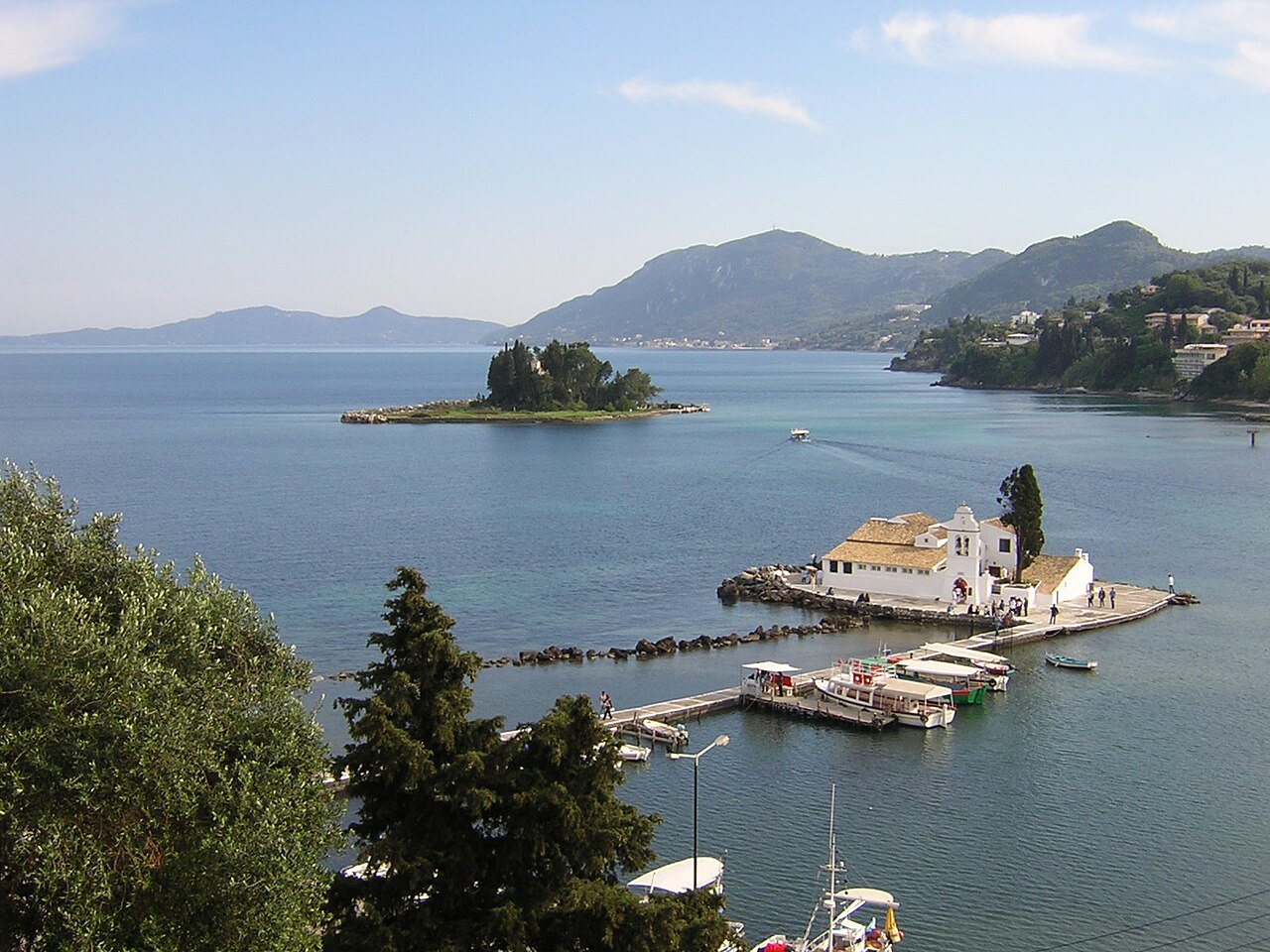
Beyond the town, the island is lushly green — unusually so for Greece — with olive groves, cypress trees, and low hills. The Achilleion Palace south of town was built by Empress Sisi of Austria and gives panoramic sea views. Palaiokastritsa on the west coast is the best swimming spot with the bonus of a clifftop monastery. The Old Perithia village in the north, largely abandoned and being slowly restored, is the island's most atmospheric inland excursion. Pontikonisi (Mouse Island), accessible by boat from Kanoni, provides the classic postcard view. Day trips to the Albanian site of Butrint and the small island of Paxos are popular. The island receives very large numbers of British tourists in summer — Gerald and Lawrence Durrell both wrote about living here in the 1930s.