High Balkan lake region where Greece, Albania, and North Macedonia meet amid pelicans and Byzantine remains
The Prespa Lakes sit in the far north-west corner of Greece at 850 metres, where the borders of Greece, Albania and North Macedonia converge. There are two lakes: the larger Macro Prespa (259 km²) is shared by all three countries; the smaller Micro Prespa is almost entirely Greek. Both are protected as a transboundary national park.
This is one of the most important wetlands in the Balkans. The lakes support one of Europe's largest breeding colonies of Dalmatian Pelicans alongside pygmy cormorants and some 260 bird species in total. The surrounding mountains are among the last places in Europe where brown bears, wolves, and chamois share the same landscape.
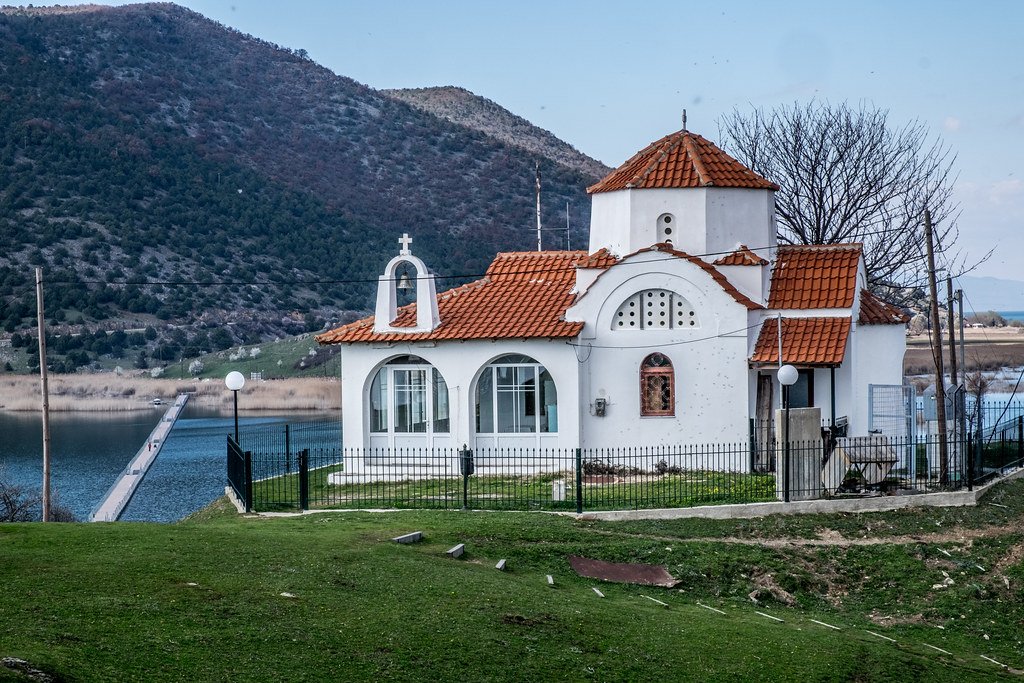
The human history goes back to Byzantine times. Churches, hermitages, monasteries, and rock paintings from the 10th century onwards are scattered among the fifteen villages of the municipality. The island of Agios Achillios in Micro Prespa — reached by a long wooden pontoon bridge from Psarades — holds the ruins of a 10th-century basilica and hosts the annual Prespia Festival each August. The village of Agios Germanos is the most practical base, with a visitor centre, a hotel, and the best tavernas.
This is not a destination for people who want infrastructure. There is no public transport between villages, though buses connect to Florina (50 km away). A car is essential. Come for the birds, the hiking, the Byzantine ruins, and the genuine remoteness — a corner of Greece that feels nothing like the islands.
Guide
Getting Around
A car is the only practical way to get around. There is no public transport between the fifteen villages of the municipality, although buses connect to Florina (50 km) — the nearest city and the jumping-off point for most visitors.
The villages divide historically between Upper Prespa (Psarades, Vrondero, Pili, Agios Achillios) and Lower Prespa (Agios Germanos, Laimos, Plati, Kallithea, Lefkona, Karies, Oxia, Mikrolimni). Distances between them are considerable. Vrondero, at the far end of the region, is the only village in Prespa with no view of the lake.
Most villages have a small shop and a kafeneion. Supermarkets and petrol stations exist but are not numerous — fill up and stock up before arriving.
Guide
When to Go
Spring (April–May) and early autumn (September–October) are the best times to visit. The pelicans arrive in spring and the light on the lakes is at its finest. Summers bring warmth but also crowds at the festivals and occasional heat. Winter is cold at 850 metres — roads can be icy.
Prespia Festival takes place on the last weekend of August on the island of Agios Achillios in Micro Prespa. One of the more significant cultural events in the northern Balkans, it draws audiences from Greece and the neighbouring countries for music, theatre, and outdoor performances against the backdrop of the Byzantine basilica ruins.
Festival of Beans (August, at Koula between the lakes): the Prespa bean is a locally prized variety, and this festival celebrates it with tastings and traditional dancing.
Village festivals (panigiri) are held throughout the summer to celebrate patron saints — each village has its own date, with live music, dancing and food in the village square.