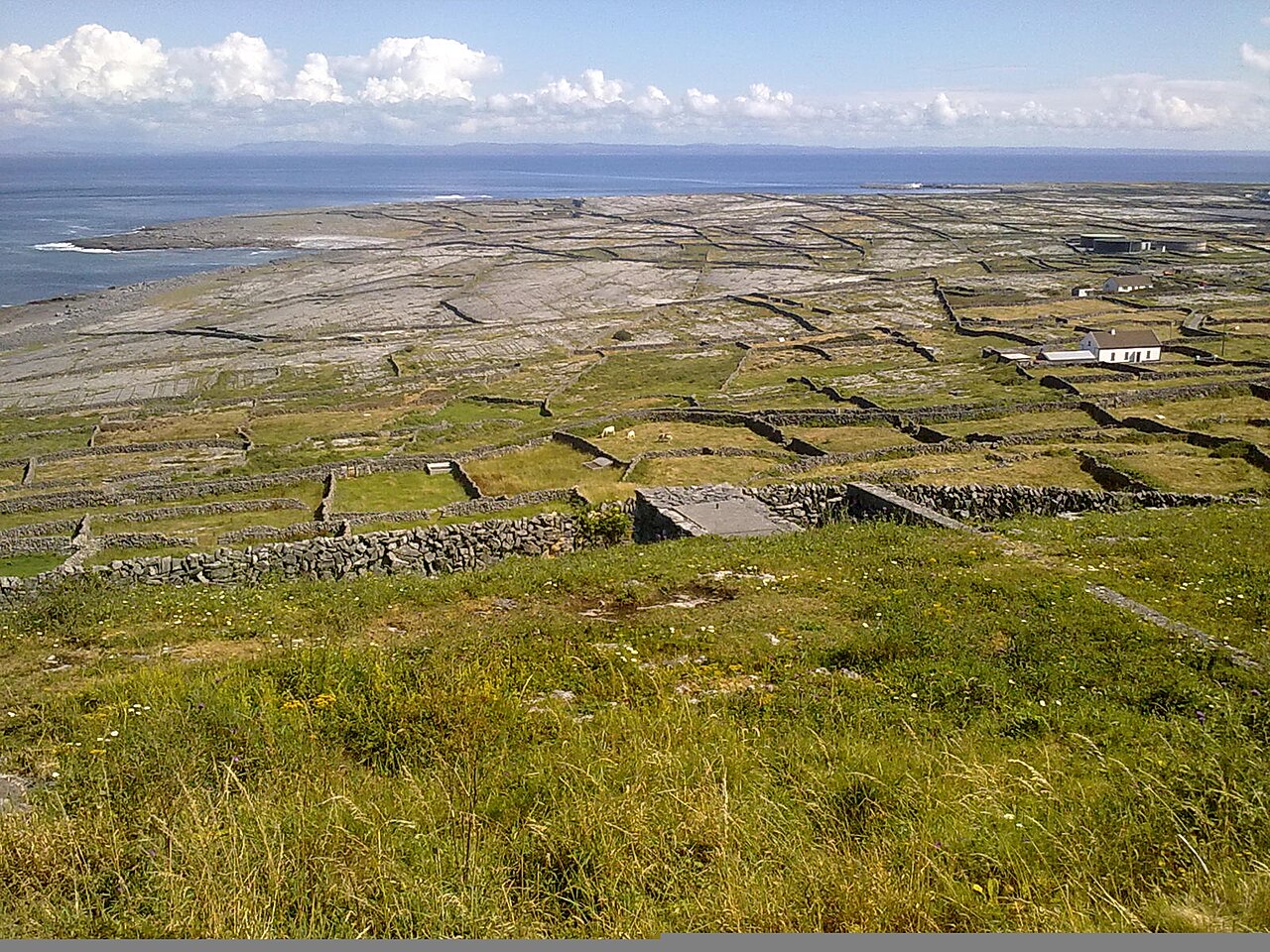
Inis Meáin is the middle and least visited of the three Aran Islands, sitting in Galway Bay off Ireland's west coast. About five kilometres long and two and a half wide, it is home to roughly 200 Irish-speaking inhabitants and remains one of the most authentic Gaeltacht communities in the country.
Where Inis Mór draws day-trippers and Inis Oírr charms with its compactness, Inis Meáin rewards with solitude. The landscape is a maze of dry-stone walls enclosing tiny fields, limestone pavement cracked open by wildflowers, and cliffs dropping into the Atlantic on the southern edge. The playwright John Millington Synge spent his summers here in the early 1900s, sitting on a stone ledge above the cliffs now known as Cathaoir Synge (Synge's Chair), watching the big seas roll in from America. His time on the island inspired The Aran Islands and The Playboy of the Western World.
The island's two great stone forts are its headline sights. Dún Chonchúir, a massive oval fort on the island's highest point, offers views across all three islands and the Connemara mountains beyond. Dún Fearbhaí, smaller and unusually square, sits on the eastern cliffs facing Inis Oírr. Both date somewhere between the Iron Age and early medieval period — nobody knows precisely.
Life here moves at its own pace. There are two pubs, two small shops, and a handful of places to eat. Traditional music sessions happen in summer, and the island's festivals — the currach racing weekend in late July, the Synge weekend in August — are genuine community events rather than tourist attractions. The Inis Meáin Knitting Company, founded in the 1970s, produces high-end knitwear sold internationally, and you can buy it from the factory shop.