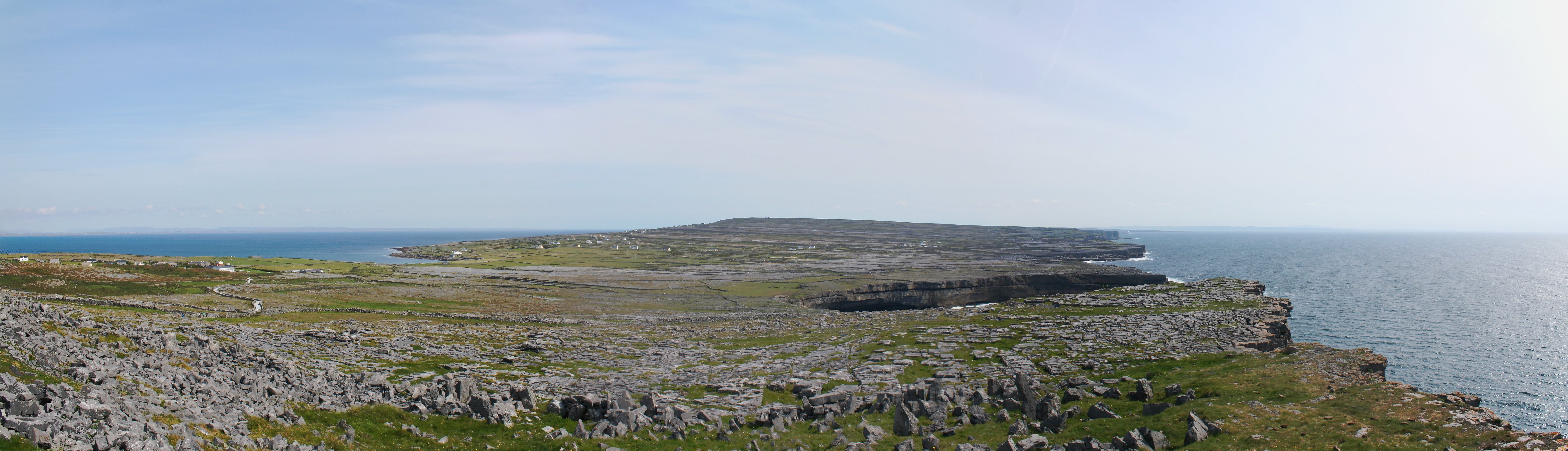
Inis Mór is the largest of the three Aran Islands, lying off the coast of County Galway at the mouth of Galway Bay. It is a slab of karst limestone nine miles long, windswept and treeless, crisscrossed by thousands of stone walls and scattered with some of the most impressive prehistoric and early Christian ruins in Ireland. Irish is the first language here.
The great draw is Dún Aonghasa, a massive semi-circular stone fort perched on the edge of a 100-metre cliff. It dates from the late Bronze Age (roughly 1100–800 BC) and consists of four concentric walls with a band of chevaux-de-frise — jagged stones set upright in the ground — as an outer defence. Standing at the cliff edge with the Atlantic below is one of the most dramatic experiences in Ireland. Nearby, Poll na bPéist — a perfectly rectangular natural pool carved into the cliff edge — is one of the strangest geological features in the country.
Beyond Dún Aonghasa, the island rewards those who slow down. Cycling is the standard transport — bikes are rented at Kilronan, the main village where the ferry lands. Dún Dúchathair on a clifftop promontory, the Seven Churches monastic site in the northwest, and the tiny Teampall Bheanáin oratory are among the smaller sites scattered across the limestone. Kilmurvey Beach on the sheltered north side has clear water and fine sand. The island's pubs provide traditional music most evenings in summer.