Reggio di Calabria sits on the toe of Italy's boot, facing Sicily across the Strait of Messina with the Aspromonte mountains rising behind it. It is one of the oldest Greek colonies in the western Mediterranean, founded as Rhegion in the eighth century BC, and the Museo Nazionale della Magna Grecia holds proof of that ancient world in the form of the Riace Bronzes — two life-sized Greek warrior statues recovered from the sea in 1972 that are among the finest works of ancient art anywhere on earth.
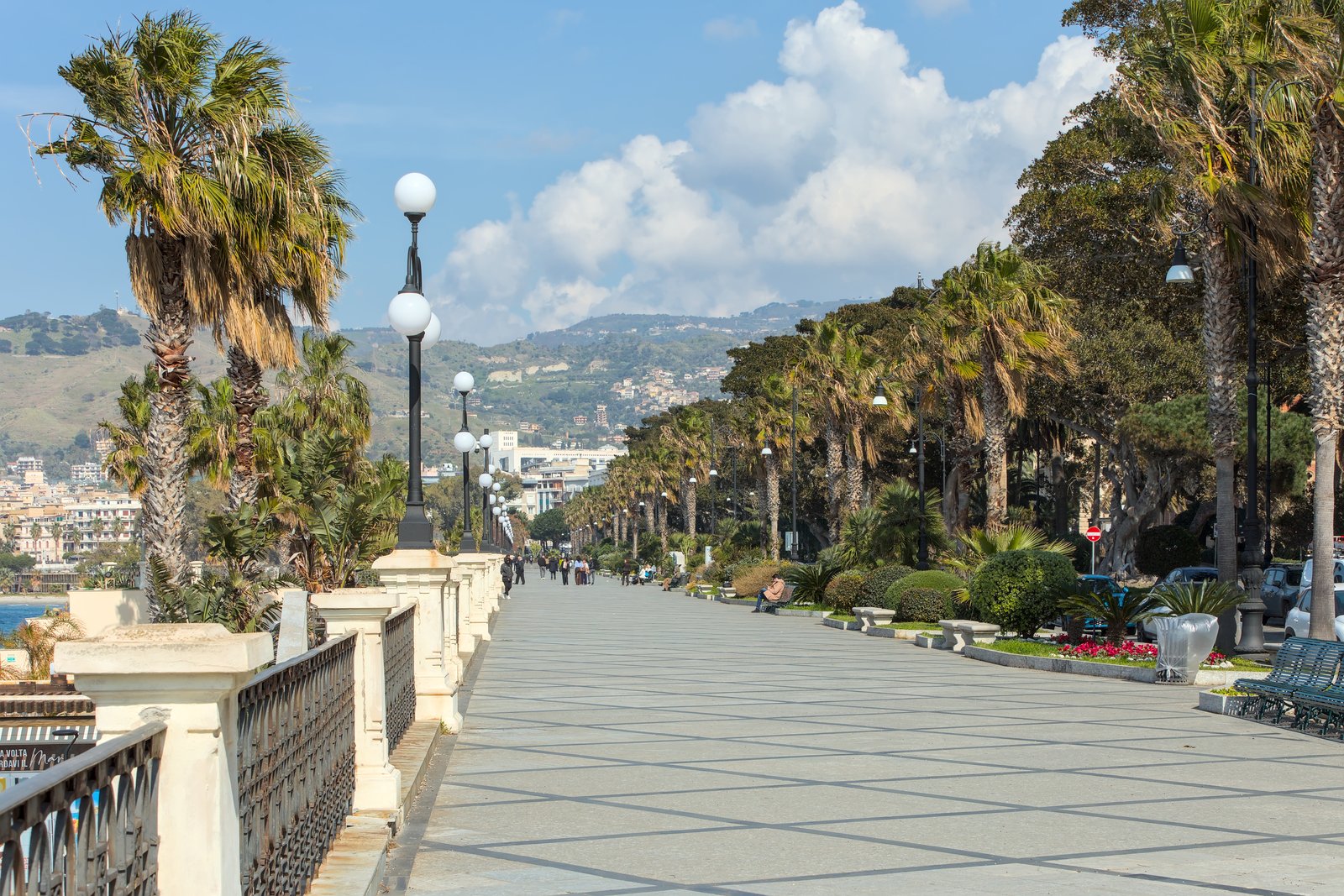
The city itself has had an eventful modern history: the catastrophic 1908 earthquake levelled it almost entirely, so the buildings you walk past are mostly early twentieth-century constructions in a tidy grid laid out after the disaster. The seafront — the Lungomare Falcomatà, stretching for kilometres along the Strait — is genuinely lovely, a broad promenade lined with palms and oleanders with views across to Sicily and, on clear days, to the slopes of Etna. Locals consider it the finest waterfront in Italy, a claim not entirely without merit.
The Castello Aragonese, down at the southern end of the old town, is a fifteenth-century fortification that now functions as a museum for local history. The cathedral on Corso Garibaldi was rebuilt after 1908 in Romanesque Revival style. Reggio is best used as a base for exploring the Aspromonte national park and the beaches of the southern Calabrian coast, but the Riace Bronzes alone justify the journey.