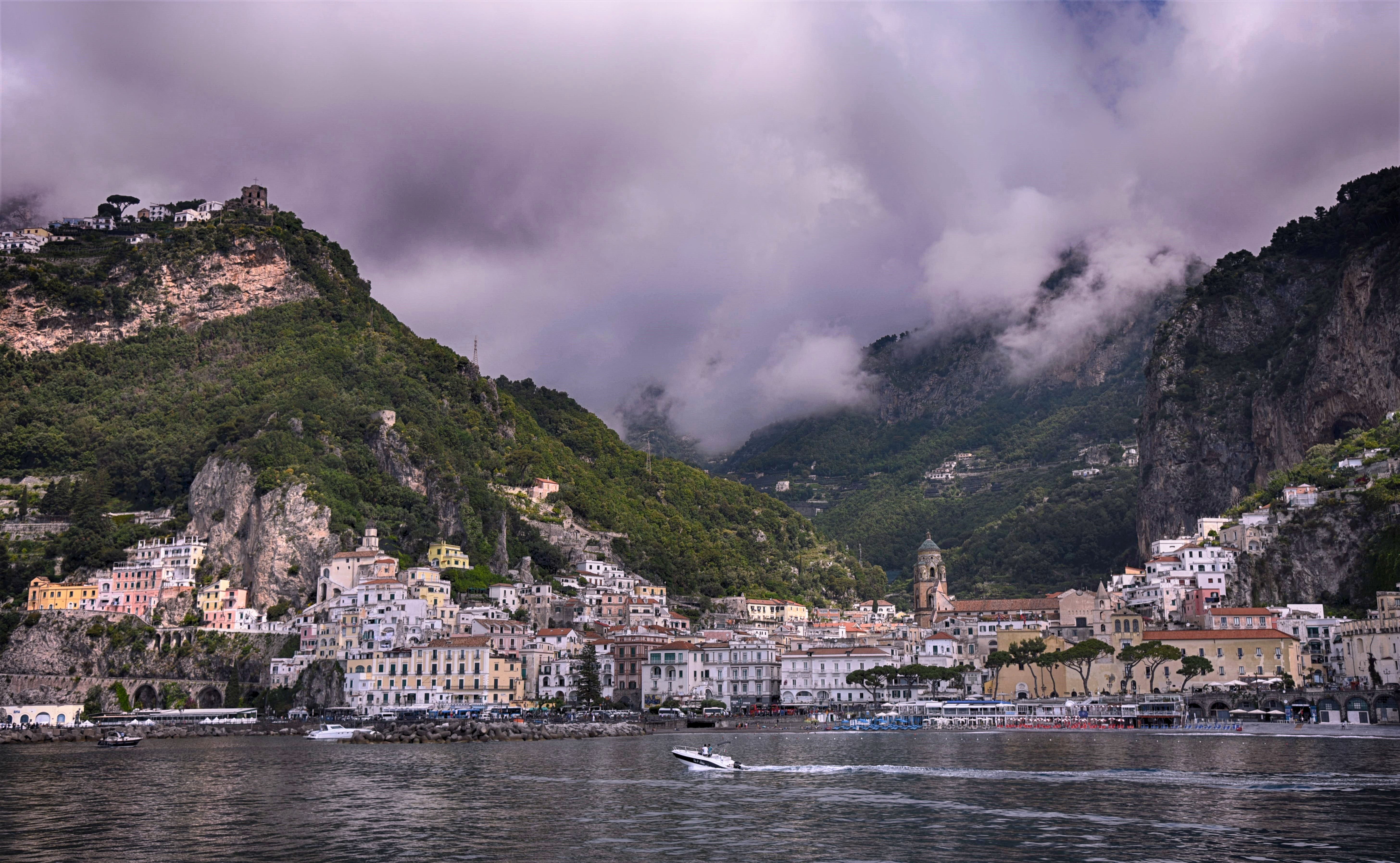
Cliff-hung Campanian coast where pastel towns and lemon terraces line the southern Sorrento peninsula.
Europe > Italy > Campania > Amalfi
The Amalfi Coast takes the southern side of the Sorrento peninsula and does something extraordinary with it: a corniche road cut into cliffs that plunge straight into the sea, connecting a series of towns that seem to defy gravity. The road itself is an experience — hairpin bends, one-lane tunnels, buses somehow squeezing past each other above a hundred-metre drop.
Positano, with its pastel buildings stacked up the cliff face, is the most-photographed town on the coast. Ravello, perched 350 metres above the water, has the finest gardens and the quietest atmosphere — the Villa Rufolo and Villa Cimbrone are the principal sights. Furore, accessible from the coast road, is the smallest — "the town that never existed," they call it, its walls now covered in murals by artists invited to paint the village.
Amalfi itself was once one of the four great maritime republics of medieval Italy — alongside Genoa, Venice, and Pisa — with a population of 70,000 at its peak. The Normans sacked it in 1131 and an earthquake in 1343 finished what the Normans started. The Amalfi Cathedral, with its striped 13th-century façade and magnificent Arab-Norman cloister, is what remains of the medieval republic's ambitions. Atrani, just 500 metres east of Amalfi, is a quieter and cheaper alternative base that most visitors miss. Today the town is a comfortable resort that makes a better base than Positano for exploring the coast — more affordable, and with a functioning piazza rather than a beach full of sunbeds.
The Path of the Gods (Sentiero degli Dei) is the finest hiking trail on the coast, running along a high ridge between Agerola and Nocelle above Positano with views that make the sweat worthwhile.
For less expensive accommodation and a different pace, consider using Sorrento, Maiori, or Salerno as a base and visiting Amalfi as a day trip by bus or ferry.
Guide
Books
Positano by John Steinbeck (1953) — The original Harper's Bazaar essay that put the Amalfi Coast on the international tourist map. Only a few pages long, it captures something true about the place — its unreality, its charm, its capacity to haunt. Find it collected in anthologies of Italian travel writing.
The Amalfi Coast by Gae Aulenti — A coffee-table book but an unusually good one, tracing the history and architecture of the coast towns from the medieval republic to the present. The architectural analysis of the Arab-Norman style is the most useful part for visitors wanting to understand what they're looking at.
The Gallery by John Horne Burns (1947) — Set in Naples and Campania during the Allied occupation of 1943–44, this is one of the finest American novels to come out of World War II. It captures southern Italy's poverty, beauty, and disorder with an honesty that contemporary travel writing rarely achieves.
Ravello by Stephen Parkin — A short, scholarly history of the hilltop town and its medieval heyday as a prosperous commercial outpost of the Amalfi Republic. Useful background for anyone spending time in Ravello.
Guide
Eating Out in Amalfi
Food on the Amalfi Coast is serious business. The cuisine leans on the sea — fresh-caught fish, octopus, anchovies, and the local colatura di alici (anchovy sauce) that adds depth to simple pasta dishes. The coast's lemons are among the best in Italy and show up in everything from limoncello to pasta sauces.
Furore, a few kilometres up the coast, has become known for fine dining thanks to the restaurants at the Furore Inn — not cheap, but worth a meal if you're staying in the area.
La Volpe Pescatrice (The Fishing Vixen) at the Furore Inn has a terrace with sweeping views over the Gulf of Salerno. Seasonal fish dishes. Address: Piazza Sant'Elia, Furore. Tel: +39 0898 304711.
Lido del Faro, Anacapri. Seafront terrace restaurant known for its risotto and the local "totani e patate" (cuttlefish with potatoes). Tel: +39 081 837 1798.
Guide
Getting There
By ferry: In summer (April–October), high-speed ferries run from Naples (Mergellina or Beverello piers) to Amalfi in about 90 minutes, and from Salerno in about 35 minutes. This is the most pleasant way to arrive — you approach the coast from the sea and see it as it was meant to be seen.
By bus: SITA Sud buses run frequently from Salerno (about 75 minutes) and Sorrento (about 90 minutes) along the SS163 coastal road. The journey is spectacular but slow — traffic jams are common in summer. Buy tickets in advance in summer.
By car: The nearest autostrada exits are at Salerno (A3) and Vietri sul Mare. From there it is about 30 km along the coast road to Amalfi. Parking in Amalfi itself is extremely limited — the car park below the main piazza charges a steep hourly rate, and alternatives are scarce in high season. Consider leaving the car in Salerno or Sorrento and taking the bus or ferry.
The nearest airports are Naples Capodichino (NAP), about 80 km from Amalfi. Salerno Costa d'Amalfi airport (QSR) is much closer but currently serves limited routes.
Guide
When to Go
May and June and September and October are the best months. The weather is warm (20–25°C), the sea is swimmable from May onwards, the crowds are manageable, and accommodation is reasonably priced relative to peak season. The spring wildflowers on the slopes above the road are an added bonus in April–May.
July and August are extremely busy. The roads clog with cars and tourist buses, the beaches are packed, and accommodation prices are at their highest. If you must visit in summer, consider staying in Ravello or Atrani rather than Amalfi or Positano — both are less overwhelmed. The evenings are more pleasant than the midday.
November through March is quiet and some places close. The coast in winter light can be beautiful, and the fishing villages have their character back. Rainfall can be heavy, and the occasional closure of the coast road due to rockfall or flooding is a real possibility. Come in December or January if you don't mind taking the risk — you'll have the coast largely to yourself.
The Ravello Festival runs throughout July and August and is a reason to visit if you enjoy classical music on an extraordinary stage.