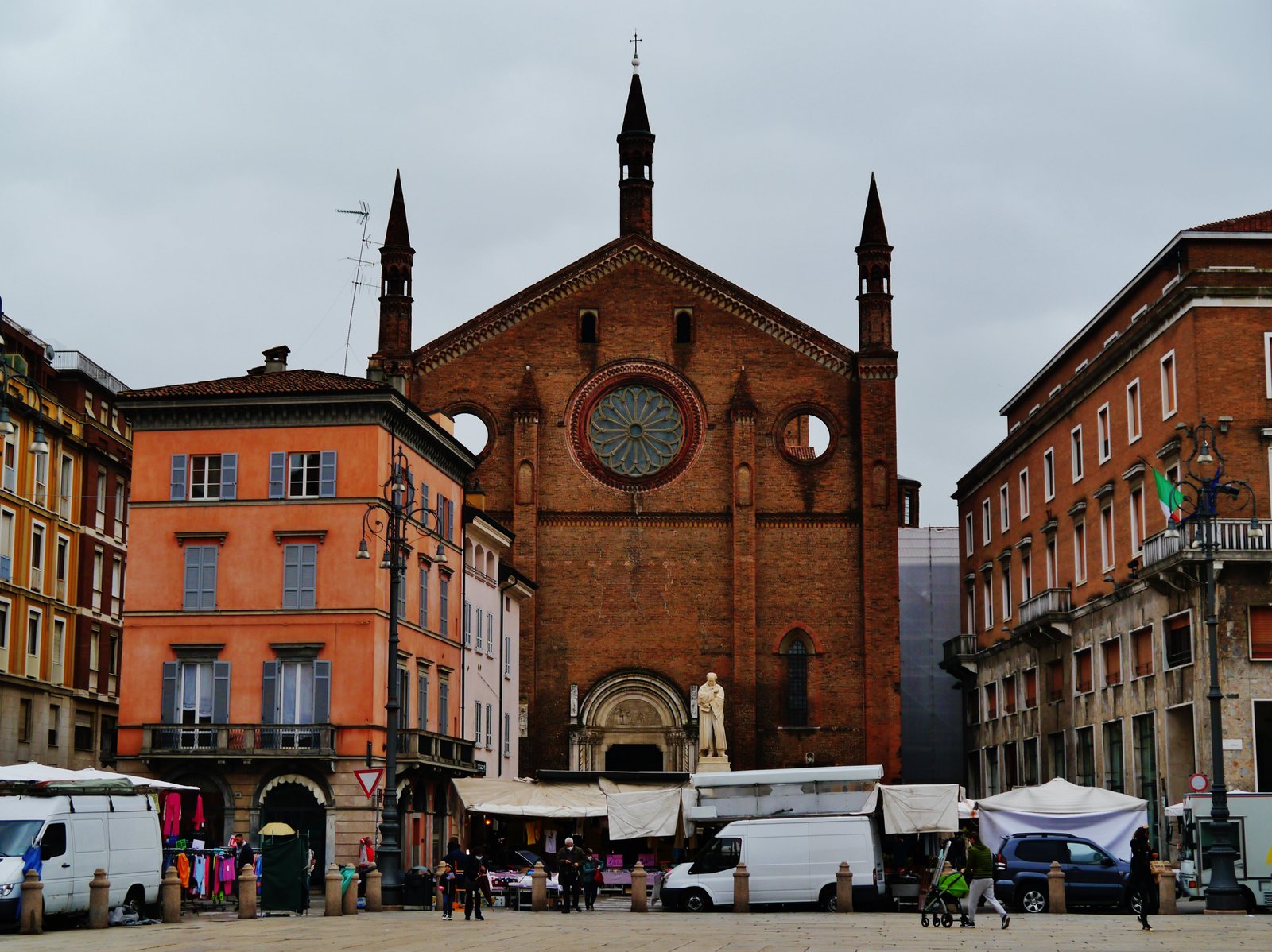
Piacenza is a city in Emilia-Romagna, on the south bank of the Po at the point where the river descends from the Alps and the Apennines converge. It is the westernmost city in Emilia — closer to Milan than to Bologna — and has a character distinct from the other Emilian cities: more compact, less known, with a medieval and Renaissance core of considerable quality that most tourists bypass entirely. Piacenza was a Roman colony (Placentia) and later one of the key cities of the Lombard League; in the 16th century it became the seat of the Farnese duchy.
The Piazza dei Cavalli — named for the two magnificent equestrian statues of the Farnese dukes that stand there — is the civic heart, with the Gothic Palazzo Gotico facing it. The Piacenza Cathedral nearby is one of the finer Lombard Romanesque churches in the region, with 12th-century frescoes by Guercino in the cupola. The huge unfinished Palazzo Farnese houses the city's main museum, which includes the Etruscan Liver of Piacenza — a bronze model of a sheep's liver used for divination, one of the most unusual objects in Italian archaeology.
The churches of Piacenza are remarkably numerous and good. San Sisto was the original home of Raphael's Sistine Madonna (the painting now in Dresden was made for this church). Santa Maria di Campagna has a frescoed dome by Pordenone of extraordinary quality. The Galleria Alberoni on the southern edge of the city contains good Italian paintings including a Magnasco and a rare trompe l'oeil still life by Baschenis.
Piacenza's food is its own: it has its own protected salumi (coppa piacentina, pancetta piacentina, salame piacentino), its own wine (Gutturnio Classico from the hills to the south), and its own pasta traditions. The city is large enough to have good restaurants but small enough that they're mostly aimed at locals rather than tourists — always a good sign.