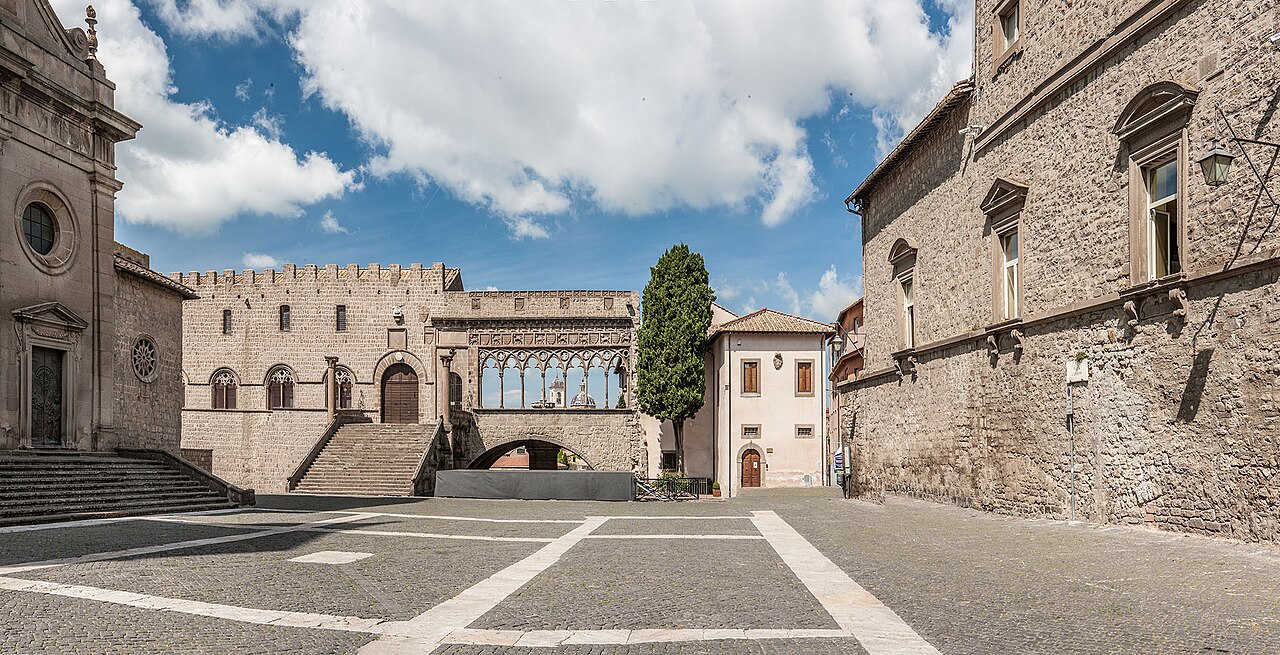
Viterbo is a medieval walled city about 100 km northwest of Rome, perched on a volcanic plateau between the lakes of Bolsena and Vico. For a turbulent stretch in the 13th century it was literally the seat of the papacy — popes fled Rome's factions and held court here, conducting five conclaves within its walls. That history gave Viterbo the title it still wears proudly: the City of Popes.
The medieval character survives almost intact in the San Pellegrino quarter, one of the finest preserved medieval districts in all of Italy. Stone towers, external staircases, arched walkways across the street, and dark narrow lanes converging on intimate piazzas — it looks much as it did in the 13th century. The Gothic Palazzo degli Alessandri sets the tone from the main square; the 11th-century San Pellegrino church and the old Ospedale dei Pellegrini pilgrim hospice crowd in nearby.
The absolute centrepiece is the Papal Palace, the Palazzo dei Papi, completed in 1266 to house the relocated papal court. The open Gothic loggia overlooking the valley is one of the most beautiful architectural achievements of medieval Italy. It was here that the cardinals convened after the death of Clement IV in 1268 — and then failed to agree for 33 months. Exasperated, the Viterbese locked the prelates in, removed the roof, and cut their rations to bread and water until Gregory X was finally elected in 1271. The episode gave the world the word "conclave" (from Latin cum clave, "with a key").
Beyond the Papal Palace, the city rewards exploration: the Romanesque Cathedral of San Lorenzo beside it, the Rocca Albornoz fortress housing the national museum, the Church of Santa Maria della Verità with its beautifully frescoed cloister, and a network of medieval fountains of which the Fontana Grande is the grandest. Viterbo also sits at the edge of Etruscan territory — the surrounding countryside holds necropolises and ancient roads that predate Rome itself.
The thermal baths at Terme dei Papi, just outside the walls, have been in use since antiquity; you can still soak in the same sulphurous hot springs that medieval pilgrims used to relieve their aching feet.