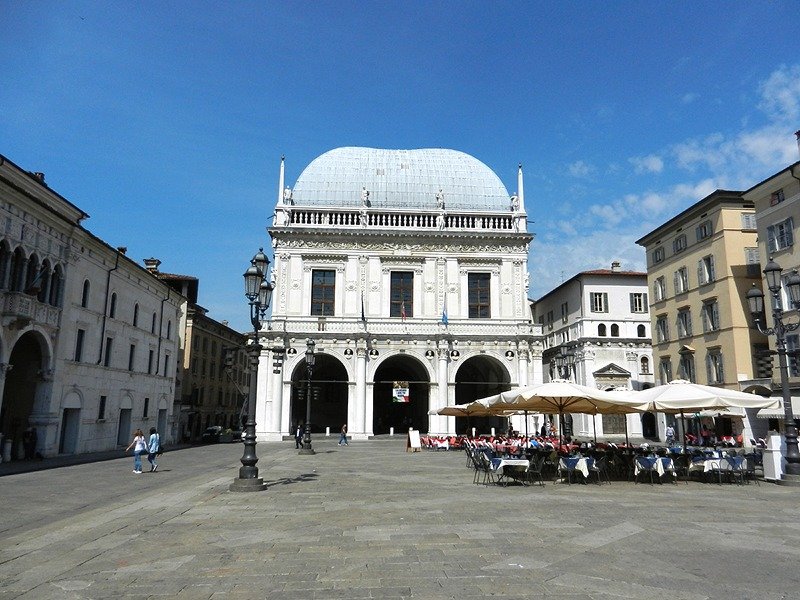
Brescia is Lombardy's second city after Milan — an old Roman, medieval and industrial town of about 200,000 people halfway between Milan and Verona, and a short drive from the southern shore of Lake Garda. Most travellers skip it, which is a pity, because the compact historic centre has one of the best-preserved Roman quarters in northern Italy and a distinct Venetian atmosphere (Brescia spent four centuries under the Serenissima's rule).
The two things to see are the monumental complex of Santa Giulia, a former Benedictine monastery that now houses the city museum and contains frescoes, Lombard gold, Roman mosaics and the beautifully painted Nun's Choir, and the adjacent Capitolium — a 1st-century Roman temple complex reconstructed under Vespasian, now a UNESCO World Heritage Site along with the rest of the archaeological park. Add the two cathedrals on Piazza Paolo VI (the old Romanesque "Duomo Vecchio" and the baroque "Duomo Nuovo") and a walk up to the Castello on Cidneo hill for the view over the red-tile roofs, and you have a very satisfying day. Brescia also makes a good base for day trips to Lake Garda, Lake Iseo and the Franciacorta wine country.