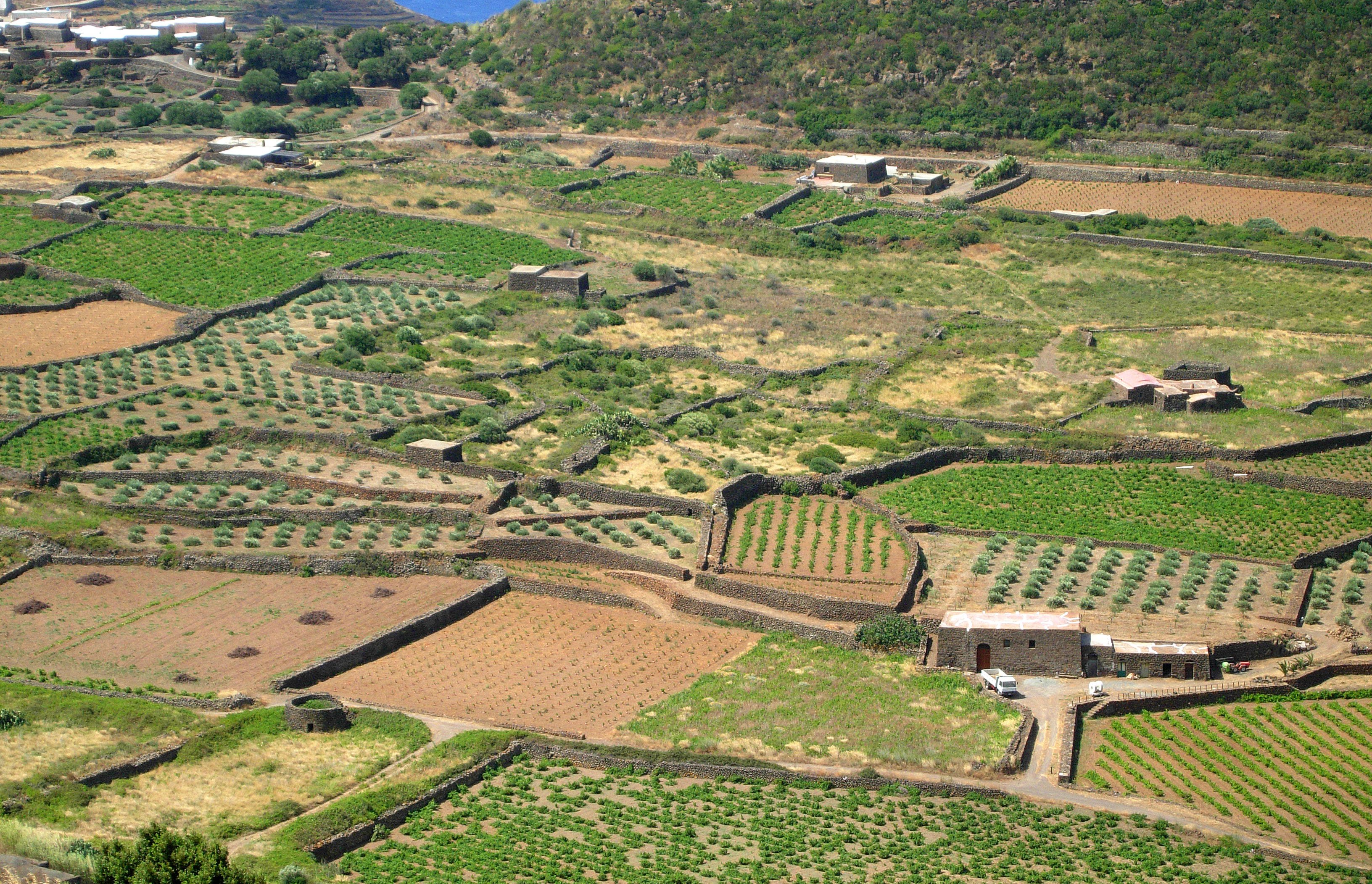
Pantelleria is the strange and beautiful volcanic island that sits in the Strait of Sicily, closer to Tunisia than to Sicily itself. Black lava cliffs, almost no beaches, hot springs that steam up from the sea floor, dry-stone walls dividing terraces of zibibbo vines and capers — it has a singular landscape that has very little in common with the rest of Italy. The wind blows almost constantly, and the name, from the Arabic Bint al-riyāḥ, means "daughter of the wind."
The island is one of the southernmost points in Europe, sixty-eight kilometres from the Tunisian coast and a hundred from Sicily. It was settled by Phoenicians, ruled in turn by Carthaginians, Romans, Byzantines and — for more than four centuries — Arabs, who left behind the dammusi, the squat whitewashed houses with thick lava-stone walls and domed roofs that are unique to the island. Eleven villages and a scatter of dammusi make up the population today, with the main town of Pantelleria on the north-west coast around the harbour. Most of the town was flattened during the Allied bombing of 1943, and only the Castello Barbacane survives intact from before the war.
Visitors come for the coastline — wild, deeply indented, with the marine grottoes and coves you reach by boat or by climbing down lava paths. They come for the hot springs, which bubble up at Lago di Venere, in the natural sauna at Bagno Asciutto, and where the sea heats up at Gadir. They come for the food — couscous, capers, the sweet passito di Pantelleria dessert wine made from sun-dried zibibbo grapes — and for the Bronze Age tombs at the Sesi outside Mursia, eerie corbelled mounds left by a vanished culture.
The island is roughly oval and can be circled by car in about an hour, but the back roads, the hike up Montagna Grande, and the time spent paddling around the coast easily fill a week. You get here either by plane from Palermo, Trapani or Catania (about forty minutes), or by overnight ferry from Trapani (around five to six hours). The wind can ground flights, so don't plan to leave the day before an onward connection.