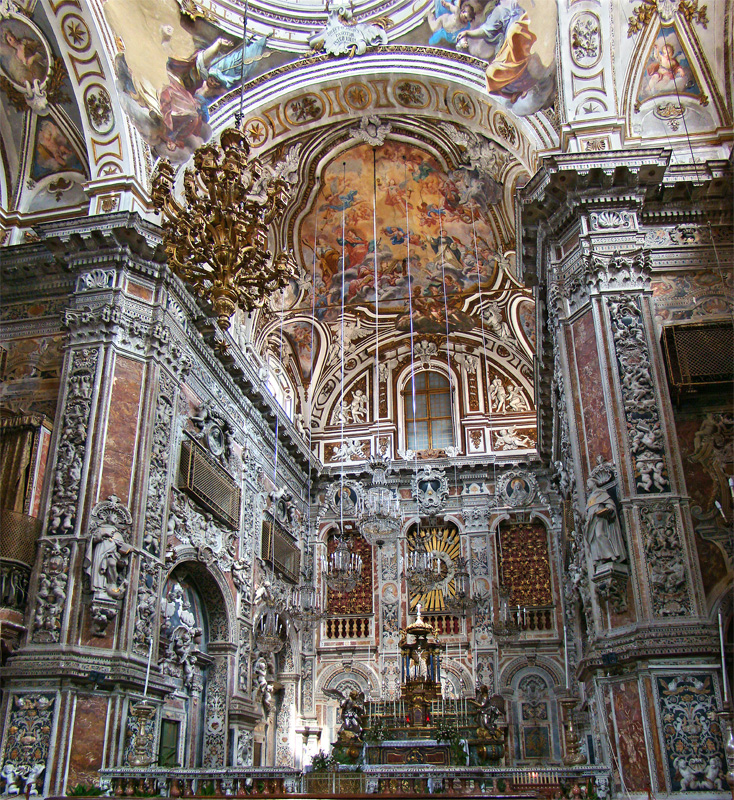
Palermo is the capital of Sicily and its largest city, set in the Conca d'Oro — a wide bay between the sea and a ring of limestone mountains, with Monte Pellegrino rising dramatically to the north. It is fast, brash, and unlike anywhere else in Italy. The mix of Arab and Norman influences is one of the city's strangest and most rewarding surprises, visible in buildings from the 11th and 12th centuries that blend Islamic geometry with Christian iconography.
Originally a Phoenician colony, Palermo passed through Carthaginian, Roman, Byzantine, Arab, Norman, Hohenstaufen, and Spanish hands, each leaving their mark. Under Arab rule it rivalled Constantinople, holding 300 mosques and becoming an emirate. The Normans made it the capital of their Sicilian kingdom, and under Frederick II it became the greatest city in Europe, famed for its court and its learning. The Arab-Norman architecture of that era is UNESCO-listed and has no parallel anywhere in Europe.
Today the long history means there is an enormous amount to see, though the city as a whole is still catching up on decades of neglect. The Palazzo dei Normanni and its Cappella Palatina are an absolute must. The Baroque Quattro Canti, the Catacombs of the Capuchins, and the Monreale Cathedral above the city are all essential. The historic centre is dense and walkable, organised around four districts — the Kalsa, Albergheria, Capo, and Vucciria — each with its own market and character.
Between sights, lose yourself in the street markets of La Vucciria, Ballarò, and Capo, where the food is extraordinary and the atmosphere is pure theatre. The food culture — arancine, panelle, sfincione, pasta con le sarde, cassata — is one of the strongest reasons to visit, descended from a thousand years of Arab, Jewish, Spanish, and Sicilian cooking piled on top of each other.
Palermo has rough edges. Parts of the centre are in serious disrepair, the traffic is aggressive, and the petty crime risk is higher than in northern Italian cities. But it has been improving steadily and is considerably safer than it was twenty years ago. The city repays the effort of engaging with it seriously. Mondello beach, 11 km north, is connected by bus and worth an afternoon in summer.