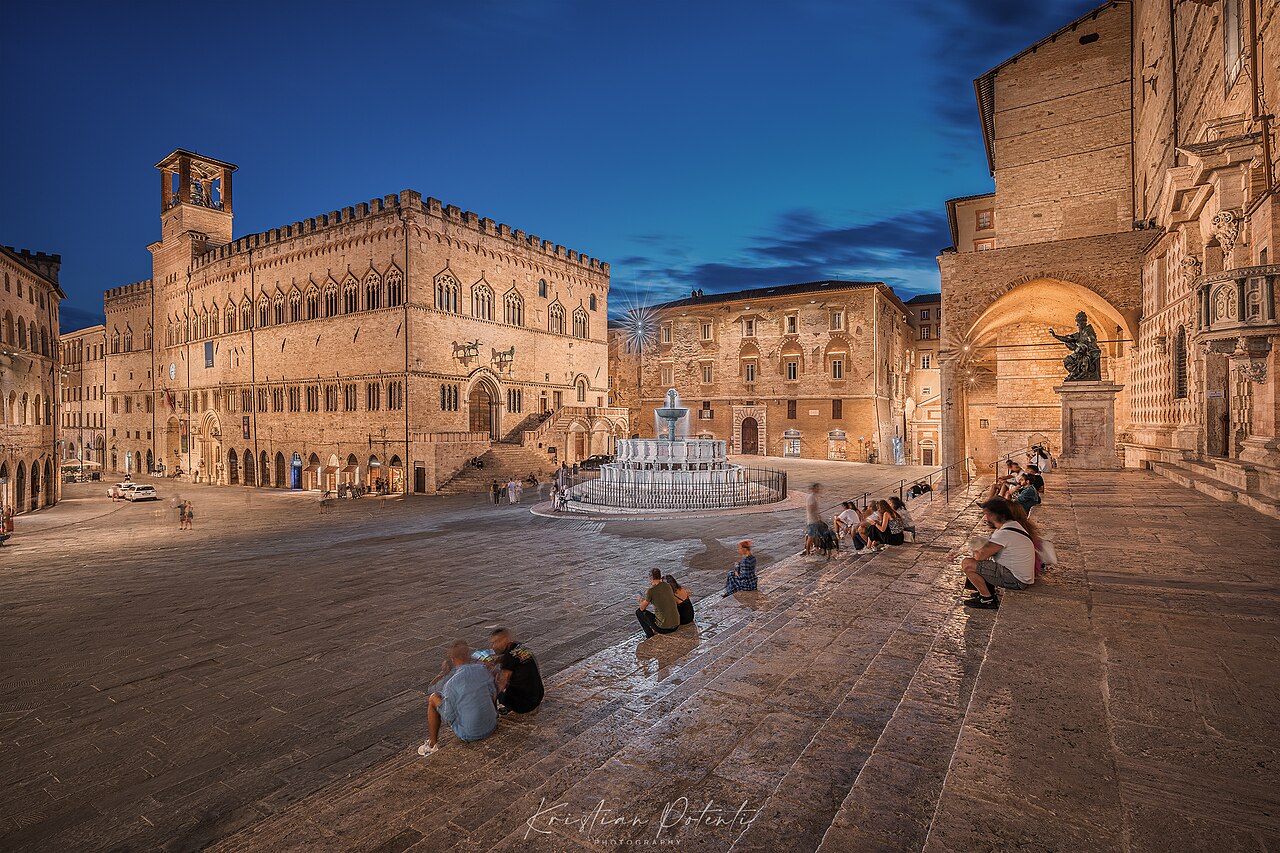
Perugia sits on a high ridge in the heart of Umbria, its medieval streets and arched stairways spilling down the hillside in every direction. The old city is compact and almost entirely pedestrianised, centred on the long corso that runs between Piazza IV Novembre and Piazza Italia — lined with Gothic palaces, medieval towers, and the kind of bars where students and professors share tables without ceremony.
The city has two identities that coexist easily. Up on the hill is the ancient centre: Etruscan walls, the 13th-century Fontana Maggiore, the Palazzo dei Priori housing the Galleria Nazionale dell'Umbria, and the Cattedrale di San Lorenzo. Down in the valley is a modern city of 170,000, home to the Perugina chocolate factory — maker of the famous Baci pralines — and two universities that keep the city young and international year-round.
Perugia has a violent past it wears lightly. For centuries it was notorious for the Battaglia de' Sassi, a ritual stone-throwing battle between neighbourhood factions that produced regular casualties. In 1538 Pope Paul III ended the city's independence and built the Rocca Paolina fortress directly on top of the houses of its leading families. The fortress was demolished at Italian unification in 1860, and its underground remains are now a public passage connecting the lower city to the upper — a daily shortcut used by commuters as well as visitors. Beneath the nearby streets, the Etruscan Well descends 37 metres into the bedrock, cut in the 3rd century BCE.
When to go: July brings Umbria Jazz, one of Europe's great jazz festivals, which takes over the city's piazzas and historic venues for ten days. October brings the Eurochocolate festival. Both draw big crowds — book accommodation well ahead.