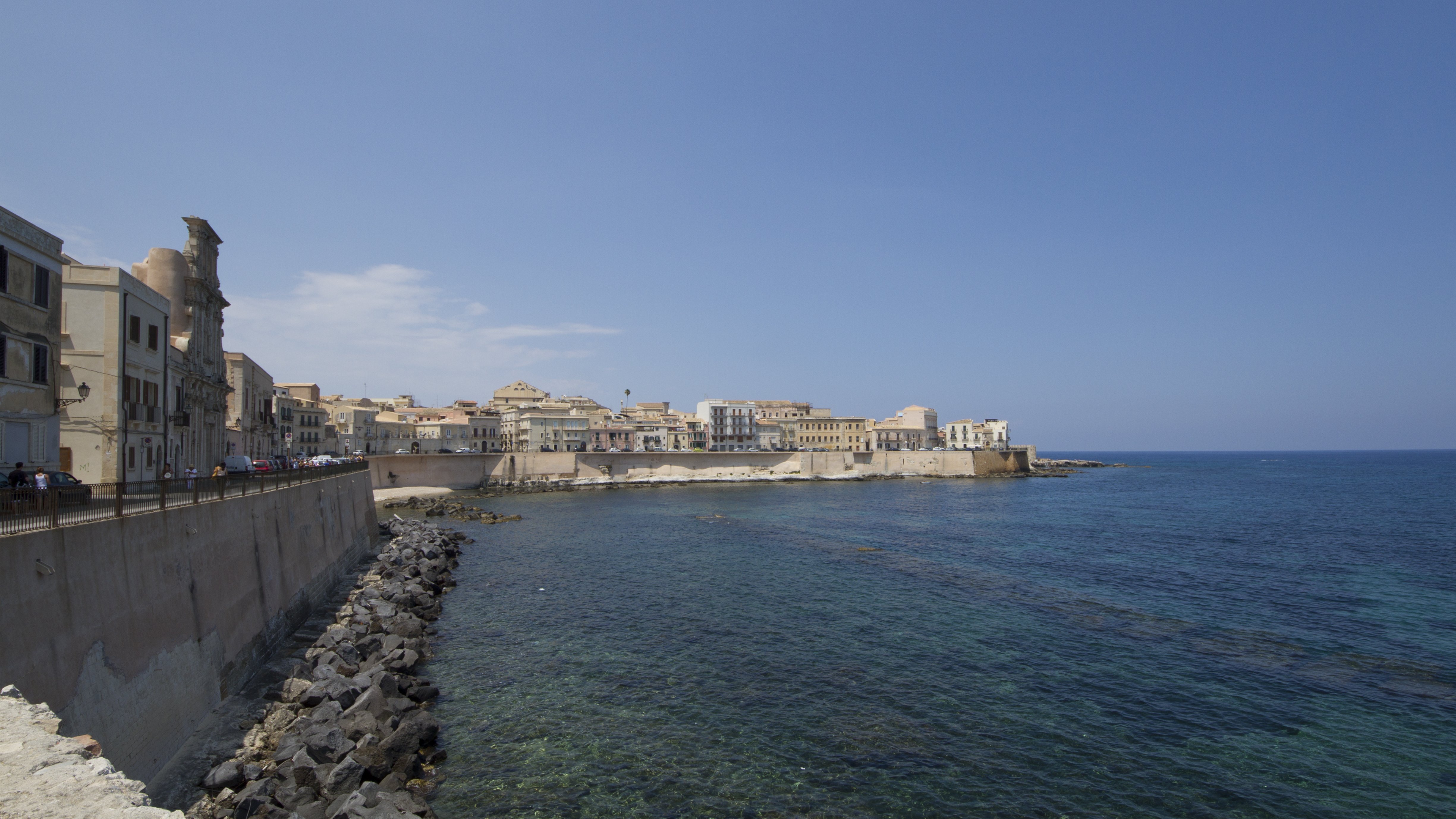
Siracusa was for a short period the main rival of Athens, the capital of one of the most powerful states in the ancient Mediterranean. It has been continuously inhabited since, which explains why some of the ancient remains can be hard to spot amid the later layers.
The city divides into two zones. The island of Ortigia — connected to the mainland by two short bridges and almost entirely pedestrian — holds the Baroque old town, the cathedral (built into a 5th-century BC Greek temple to Athena), the Fountain of Arethusa where a natural freshwater spring opens near the sea, and the Bellomo Palace gallery with its Caravaggio. The mainland zone — the Neapolis Archaeological Park — holds the Greek Theatre, the Ear of Dionysius with its extraordinary acoustics, the Roman amphitheatre, and nearby, the Museo Paolo Orsi, the best archaeological museum in Sicily.
The Temple of Apollo, at the entrance to Ortigia, is the oldest surviving Doric temple in the western world. The Castello Maniace stands at the southern tip of the island where the sea crashes on three sides. Plan for at least two full days — one for Ortigia, one for the archaeological park.