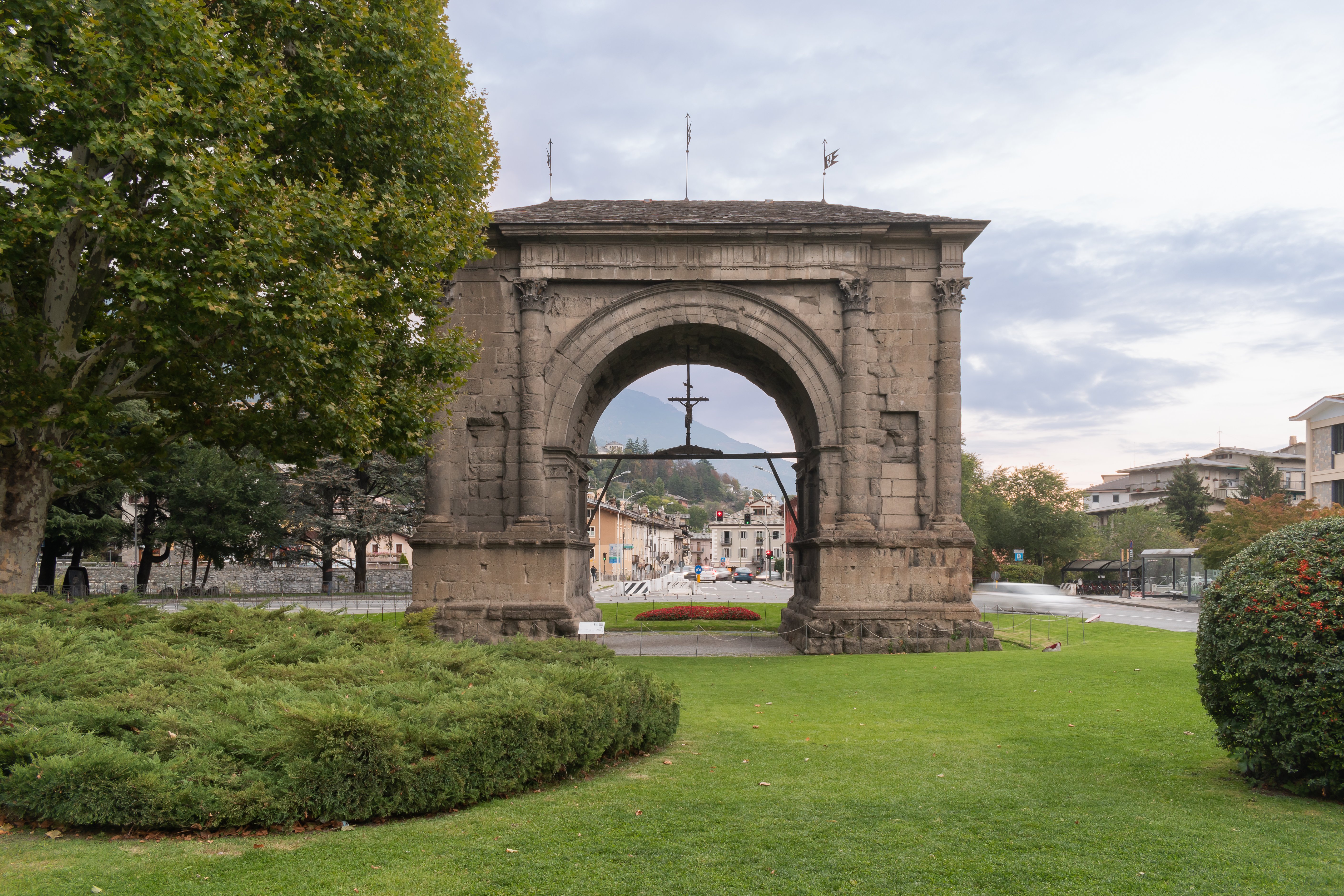
Aosta sits at the confluence of the Dora Baltea and Buthier rivers, ringed by mountains and guarded by the passes to France through the Mont Blanc tunnel and to Switzerland through the Gran San Bernardo. The Romans recognised the strategic value immediately: in 25 BC they founded Augusta Praetoria on a previous Salassi tribal settlement, and what they built has survived remarkably well.
The Porta Praetoria — the original main gate of the Roman town — still stands almost complete, a double arch of granite that frames the narrow via Sant'Anselmo behind it. The Arco di Augusto marks the eastern entrance to the Roman town and has stood in place for over two thousand years. The Roman theatre retains its tall north facade, and the rectangular town walls, largely intact, give a clear sense of the original Roman grid. For a small city, the concentration of Roman remains is extraordinary — on a par with anything south of the Alps.
The medieval layer sits on top: the Collegiate church of Sant'Orso with its 11th-century cloister and treasury of carved wooden choir stalls, the Norman towers of the Lebbroso and Bramafam, and the Cathedral with its neoclassical facade concealing an 11th-century structure inside. The main square, Piazza Chanoux, is a pleasant place to stop — the arcaded Palazzo del Municipio on one side, the Alps all around.