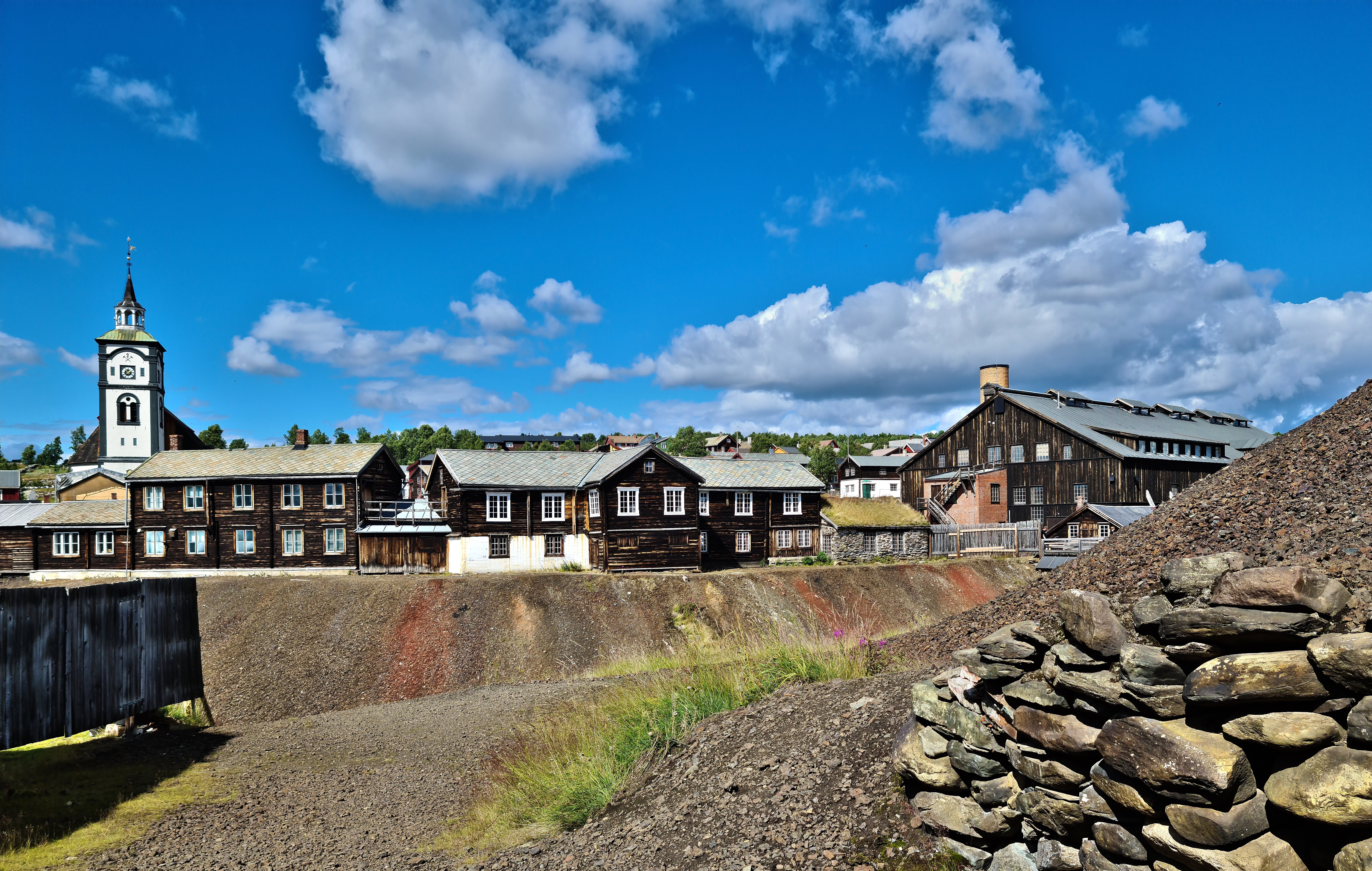
Norwegian mining town of dark timber houses, copper smelters, and grass-roofed buildings near Sweden.
Røros is a small mining town in the mountains south of Trondheim, near the Swedish border. Copper was discovered here in 1644, and for over three centuries the mines drove the town's economy. The result is a remarkably well-preserved wooden town — rows of dark-timbered houses, grass-roofed smelter buildings, and slag heaps stretching into the surrounding plateau. The entire town centre is a UNESCO World Heritage Site.
The Smelting Works is the industrial core of the heritage site — a massive stone hall where copper ore was processed for three centuries, now an evocative museum. Guided tours to the Olavsgruva copper mine run regularly and take you deep underground, where the temperature is a constant 5°C regardless of the season above. The Røros Church, built in 1784, has an interior that looks like stone and marble until you tap the columns — all of it is wood, painted with extraordinary skill by craftsmen who clearly enjoyed the illusion.
The wooden town itself is the main attraction. Walking Bergmannsgata and the lanes leading down toward the mine works gives a vivid sense of life in an 18th-century industrial settlement. The buildings are still inhabited, which prevents the place from feeling like an open-air museum. The slag heaps at the western edge of town — black mountains of copper waste — are part of the World Heritage landscape and stranger and more dramatic than any postcard shot.
The surrounding Røros plateau is beautiful in both summer and winter — wide, open, and very cold. The town hosts the Røros Market (Rørosmartnan) in February, one of the oldest traditional markets in Norway, and a well-attended Christmas market in December. The Røros Museum manages the historic sites and can advise on what's open on any given day.
Guide
Books
Johan Falkberget — An-Magritt (1920s). Falkberget grew up in Røros and his historical novels set in the mining community are the definitive fictional account of the place. An-Magritt follows a young woman through the harsh world of 17th-century Røros; the landscape and social conditions are drawn from deep familiarity. Widely considered a classic of Norwegian literature, though translations into English are hard to find.
Johan Falkberget — The Fourth Night Watch. Another Falkberget novel set in the Røros copper country, this one focusing on a lay preacher navigating the religious and social conflicts of the mining community. The Norwegian title is Nattevakt. Falkberget is the writer most associated with Røros; reading him before or after visiting gives the place an entirely different resonance.
Per Olov Enquist — The Visit of the Royal Physician. Not set in Røros, but covers the same 18th-century Nordic world — the Enlightenment, the monarchy, and the lives of ordinary people caught in systems beyond their control. Useful background for understanding the era that shaped the town.
Guide
When to Go
Røros has two distinct seasons. Summer (late June to August) is green, mild, and long-lit — the plateau is beautiful with wildflowers, walking and cycling are easy, and the mine and museum have full opening hours. The Røros Market (Rørosmartnan) in February is one of the oldest and largest traditional markets in Norway, drawing traders and visitors from across Scandinavia for a week of outdoor commerce, horse-drawn sleigh transport, and genuine winter atmosphere.
Winter is cold — temperatures regularly drop below −20°C — but the town looks extraordinary under snow and the northern light is clear and blue. The Christmas market in December attracts visitors who find the dark timber buildings and candlelit streets particularly atmospheric at that time of year. The shoulder seasons (May, September, October) are quieter and some services are reduced, but the town itself is always worth visiting.