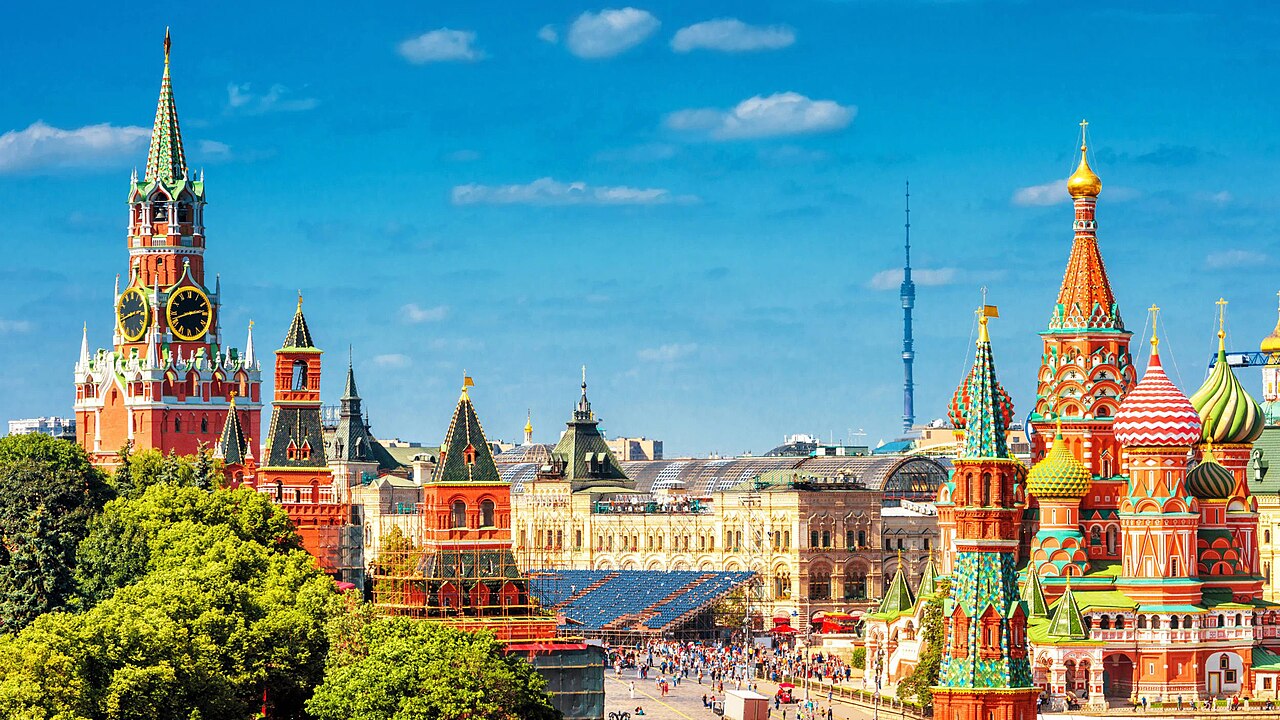
Moscow is the beating heart of the Russian world — a medieval fortress-city that grew into the capital of the tsars, the seat of Soviet power, and today one of the largest and most expensive metropolises on earth. For all its scale, the centre is surprisingly compact, arranged as a series of concentric ring roads radiating out from the Kremlin and Red Square. An afternoon on foot covers the essentials; a week is not enough for everything the city contains.
Red Square is the ceremonial heart: the candy-coloured onion domes of St Basil's Cathedral at one end, Lenin's Mausoleum and the crenellated red walls of the Kremlin along one side, the State Historical Museum at the other. Inside the Kremlin walls are five of Russia's greatest cathedrals, the enormous Tsar Bell and Tsar Cannon, and the Armoury Palace with the Romanov crown jewels, Fabergé eggs, and centuries of royal carriages.
Beyond Red Square, the Tretyakov Gallery holds the greatest collection of Russian painting (Rublev's icons through to 20th-century avant-garde), the Pushkin Museum of Fine Arts balances it with European painting, and the contemporary Garage Museum in Gorky Park is the city's most interesting modern space. The Bolshoi Theatre is more than worth the price of a ticket — Russian ballet and opera, performed in the hall where half of that repertoire was first staged.
The Moscow Metro is itself an attraction: the stations on the circle line are underground palaces with marble, mosaics, and Soviet-era sculptures. Ride it for the stations alone — Komsomolskaya, Novoslobodskaya, and Mayakovskaya are particularly extraordinary.
The neighbourhoods are sharply different. The Arbat is the oldest pedestrianised quarter, good for strolling and street performers; Patriarshiye Prudy is the literary district where Bulgakov set The Master and Margarita; Gorky Park has been transformed into an open-air cultural space with outdoor cinema, installations, and cycling paths along the river; Red October, a former chocolate factory, is now a cluster of galleries and restaurants.
Winters are long and genuinely cold — December to March, regularly −15°C or lower — but the city is beautiful in snow, and the museums, theatres, and underground spaces keep you warm. Summer (June–August) is the best time for strolling and outdoor cafés. Travellers should note that visa requirements for Russia have been complicated for Western passport-holders in recent years; check current rules before planning a trip.
Destinations in Russia
See also St Petersburg, Kazan, Irkutsk, and Kizhi.