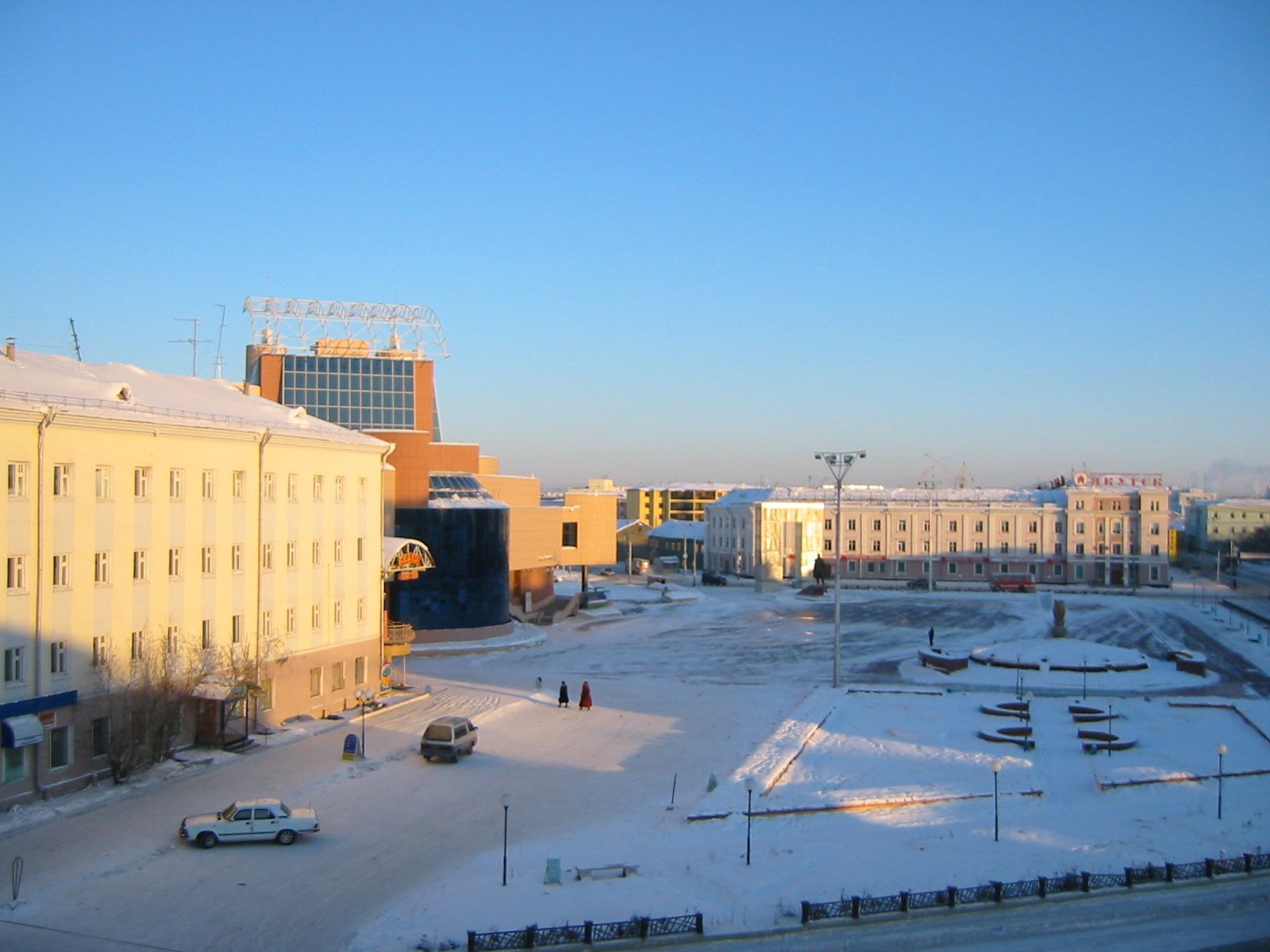
Yakutsk is the coldest city on earth. The capital of the Sakha Republic in eastern Siberia, it regularly sees temperatures below minus 40 C in winter, and the surrounding permafrost never fully thaws. Yet nearly 300,000 people live here, and have done for centuries — making it one of the most extraordinary examples of human adaptation anywhere.
The city sits on the western bank of the Lena River, one of the great rivers of Siberia, which serves as a major transport artery in summer and freezes solid enough to drive across in winter. Yakutsk is a working city of apartment blocks built on stilts above the permafrost, steam rising from heating pipes, and a surprising cultural life centered on the Sakha Republic's indigenous Yakut people, who make up about a third of the population.
The Sakha Republic itself is vast — stretching from the Stanovoy Ridge in the south to the Henrietta Islands in the Arctic Ocean. It shares a surprising amount with Alaska: enormous undeveloped landscapes of tundra and taiga, an economy built on natural resources (gold, diamonds, oil, natural gas), and a cultural diversity that includes the Yakut, Evenki, Dolgane, Chukchi, and Yukaghiri peoples.
Yakutsk has a university (founded 1956), a branch of the Russian Academy of Sciences, and sister city agreements with Fairbanks (Alaska), Guirin (China), Muroyama (Japan), and Darmstadt (Germany). The connection with Fairbanks makes particular sense — the two cities share a latitude, a climate, and an outlook shaped by surviving at the edge of the habitable world.