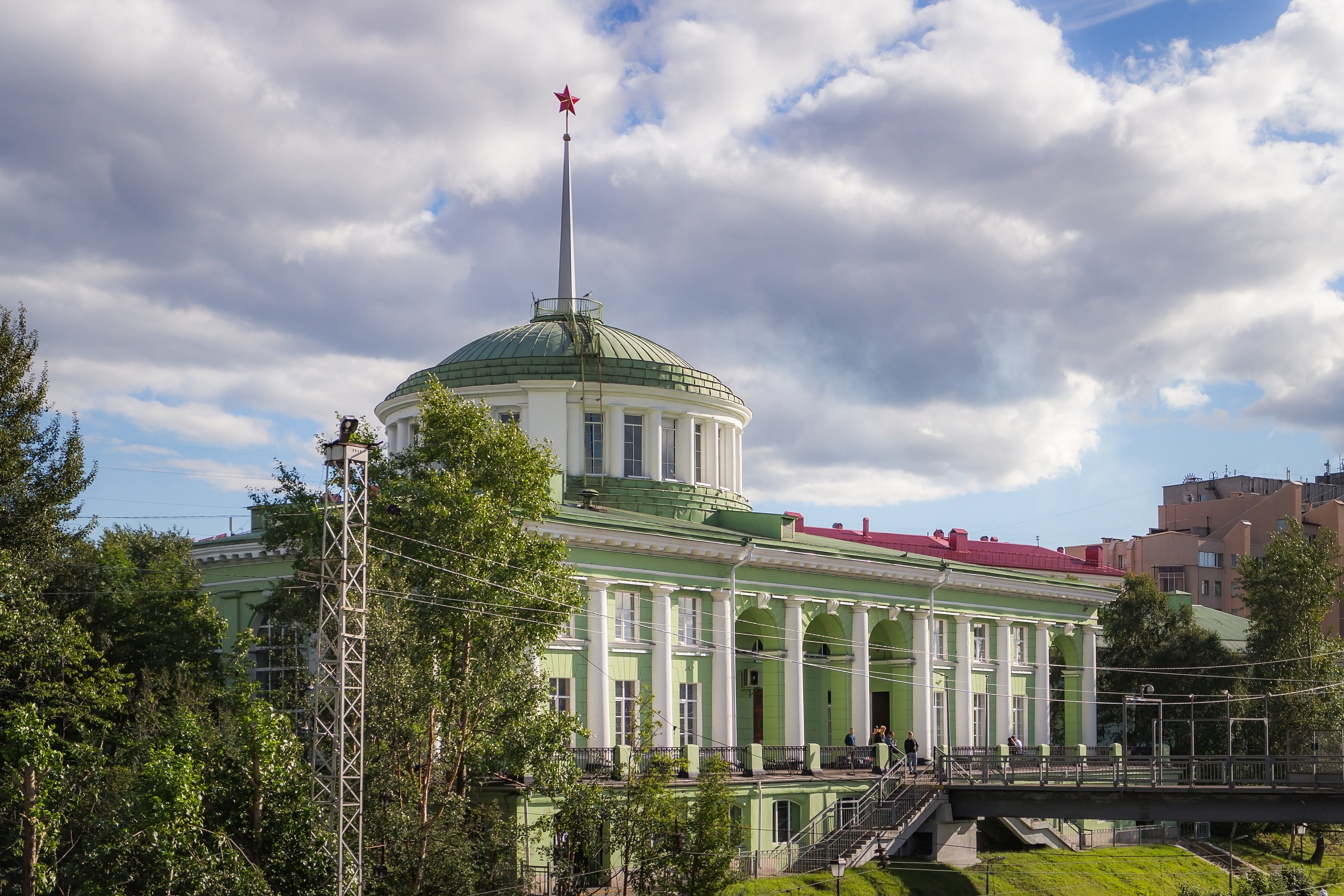
Murmansk is the largest city above the Arctic Circle, a major Russian seaport on the Barents Sea coast of the Kola Peninsula. Founded in 1916 as Romanov-on-Murman (renamed after the Revolution), the city owes its existence to the warm currents of the Gulf Stream, which keep the harbour ice-free year-round — an unusual feature at this latitude.
The city's economy runs on fishing, shipping, and the Russian Northern Fleet. It is not a conventionally beautiful place — decades of Soviet industrial construction saw to that — but the setting is dramatic. The Kola Peninsula is covered with thousands of lakes and dense forests, and from Murmansk you can experience the polar day in summer (continuous sunlight from late May to mid-July) and the polar night in winter (continuous darkness from early December to mid-January).
The main landmark is the Alyosha Monument, a massive Soviet-era statue of a soldier overlooking the city and the Kola Bay. The nuclear icebreaker Lenin, the world's first nuclear-powered surface vessel, is moored in the harbour and open as a museum. The compact city centre converges on Five Corners square, and on the northern edge of town Lake Semyonovskoye is the closest thing to a city park — complete with an oceanarium and the much-loved Cat Semyon statue.