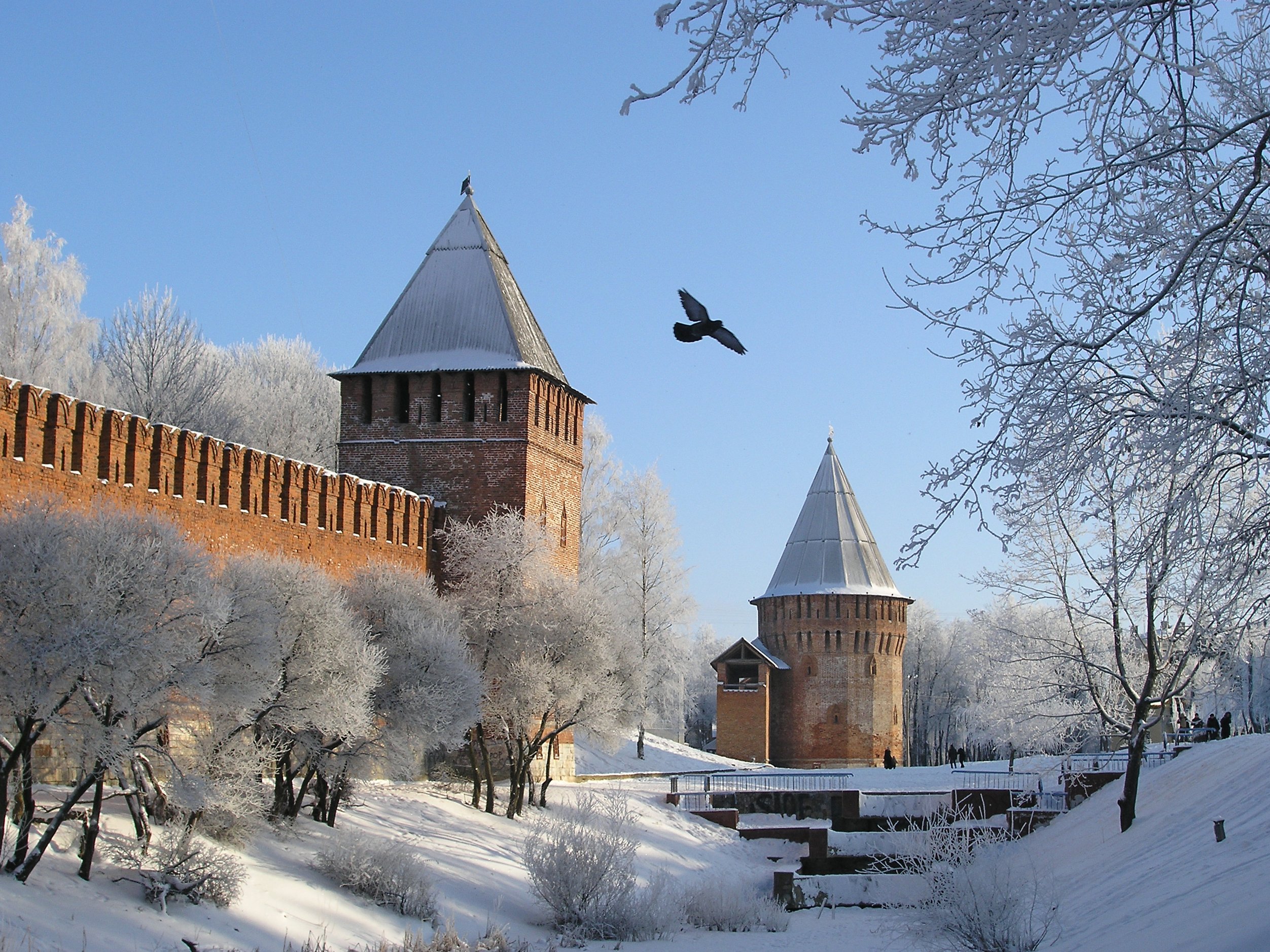
Smolensk
©
Smolensk

Smolensk

Ancient Russian city on the upper Dnieper, marked by massive red-brick walls and repeated sieges.

Smolensk is one of Russia's oldest cities, sitting on the upper Dnieper River about 360 kilometres west-southwest of Moscow, close to the border with Belarus. Its position on the main east-west route across the European plain has made it a place of strategic importance — and catastrophic destruction — across twelve centuries. Smolensk has been sacked, besieged, burned, and fought over more times than almost any other city in Russia, and this history of violence is embedded in its landscape of fortifications, churches, and memorials.

The Smolensk Kremlin — more precisely the defensive city wall built in the early 17th century — is the city's defining landmark: a massive red-brick fortification nearly seven kilometres long with towers spaced along its entire length, one of the most impressive surviving medieval military structures in Russia. Within and around this wall, the city accumulated centuries of religious architecture: the Dormition Cathedral crowns Cathedral Hill with Baroque grandeur, while a scattering of small Romanesque-influenced churches built in the 12th and 13th centuries are among the oldest surviving religious buildings in Russia.

Smolensk suffered terribly in both 1812, when Napoleon's army fought a major battle here during the invasion, and in 1941-1943, when the German occupation reduced much of the city to ruins. The famous Katyn Forest, site of the Soviet massacre of Polish officers in 1940, is 20 kilometres to the west — a fact that gives the city a particularly heavy layer of historical weight. The 2010 Smolensk air disaster, in which the Polish president and 95 others died in a crash near the Katyn memorial site, added another.

Despite all this, Smolensk is a working city with a genuine character: the Dnieper divides it into halves connected by bridges, the old city wall provides a dramatic walking route, and the concentration of medieval and early modern architecture is extraordinary for a city this far from the tourist trail.

Guide

Getting Around

The historic city centre is relatively compact and walkable, though the city is divided by the Dnieper River and the kremlin wall creates its own navigation. The main sights — the kremlin wall, the Dormition Cathedral, the central museums — are within a twenty-to-thirty-minute walk of each other. The older churches on the far side of the Dnieper require crossing one of the bridges.

Local buses and trolleybuses are inexpensive and cover most of the city. Taxis (including Yandex taxi) are cheap by Western standards and useful for reaching the more distant sights. The Katyn Forest memorial, 20 kilometres west, requires a car or organised tour.

Guide

Getting There

Smolensk is on the main railway line between Moscow and Minsk/Warsaw (the Moscow–Brest line), and has excellent train connections to Moscow. The journey by fast train (Sapsan or Lastochka) takes about 3 hours 30 minutes; slower trains are cheaper but take longer. The railway station is in the northern part of the city, about two kilometres from the kremlin wall.

By car, Smolensk is about 360 kilometres from Moscow on the M1 federal highway. The drive takes 4-5 hours depending on traffic on the Moscow approach. There is no significant domestic air service to Smolensk; the airport at Smolensk South was largely used for military and charter purposes. International travellers typically arrive via Moscow.

Guide

Things to Do

Smolensk's appeal lies almost entirely in its history, and the physical record of that history is extraordinary. Start with the Smolensk Kremlin Wall — walk the surviving sections and climb the towers for the best views of the Dnieper and the city. The Dormition Cathedral on Cathedral Hill is the architectural centrepiece, its Baroque facades and golden domes rising above the kremlin wall.

For a deeper understanding of the city's layered religious history, visit the Church of the Immaculate Conception (Catholic, Jesuit, from the Polish period) and the Choral Synagogue (a surviving trace of the city's Jewish community). The Church of Saints Peter and Paul is one of the oldest standing buildings in Russia, a 12th-century Romanesque-influenced church on a hill across the Dnieper. The Smolensk State Museum provides essential context for understanding the city's military and cultural history.

Guide

When to Go

Smolensk is best visited in summer — May through September — when the parks along the kremlin wall are in full leaf and the weather is warm enough for comfortable outdoor exploration. July and August are the warmest months (around 20-22°C), and the long summer evenings make it pleasant to walk the wall and the Dnieper embankment.

Winter is cold (January averages around -5°C to -8°C) and snowy, but the kremlin wall and towers covered in snow can be beautiful. The historical sights are open year-round. Spring (April-May) sees the lilacs and lindens that line many streets come into bloom. There are no major festivals that make one season significantly better than another for visitors, but summer is by far the most comfortable.