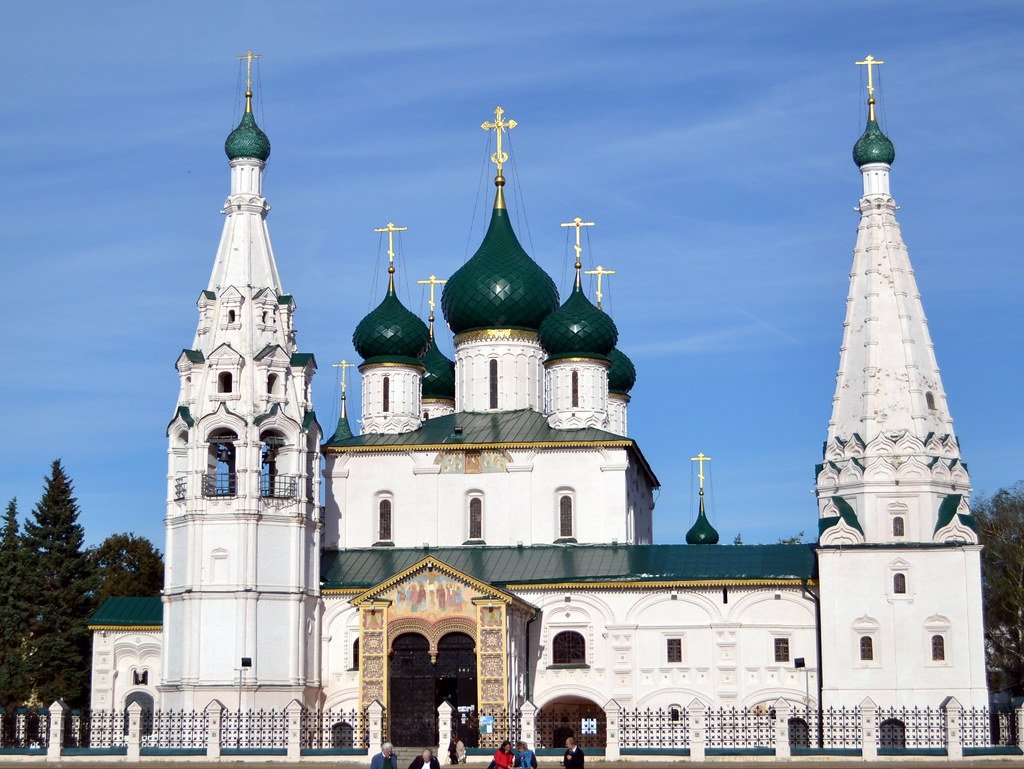
Golden Ring city at the Volga and Kotorosl rivers, rich in frescoed 17th-century churches.
Yaroslavl sits at the confluence of the Volga and Kotorosl rivers, about 250 kilometres northeast of Moscow. Said to have been founded in 1010 by Prince Yaroslav the Wise, the historic centre is now a UNESCO World Heritage Site and one of the most rewarding stops on Russia's Golden Ring.
In the 17th century, Yaroslavl was Russia's second-largest city. During the Polish occupation of Moscow in 1612, it briefly served as the de facto capital. That period of prosperity left behind some of the finest churches and monasteries in the Golden Ring — notable for their vivid frescoes and the distinctive "Yaroslavl type" church architecture with red brick and brightly coloured tile exteriors.
The Church of Elijah the Prophet on Sovetskaya Square is the most famous sight, its interior entirely covered in 17th-century frescoes by master iconographers. The Spaso-Preobrazhensky Monastery is where the Igor Tale — one of the great works of medieval Russian literature — was discovered in 1795. The Yaroslavl Art Museum on the Volga embankment holds one of Russia's finest collections of medieval icons.
The city also has the Volkov Theatre, the oldest professional drama theatre in Russia, founded in 1750. Yaroslavl is a university town with about a dozen institutes of higher learning, which keeps the atmosphere lively. Public transport is well developed, with frequent trolleybuses, trams, and buses. There are two major train stations with daily services to Moscow and St Petersburg.
Guide
Getting There
By train is the most comfortable way to reach Yaroslavl from Moscow. The journey takes around three hours on fast trains from Yaroslavl station (Komsomolskaya Square, Moscow). Several express and semi-fast services run daily; some continue to Vologda or to the Trans-Siberian route eastward. The main Yaroslavl station is Yaroslavl-Moskovsky, about 3 km south of the historic centre.
By bus from Moscow is slower (4–5 hours) and cheaper; buses leave from Shchyolkovskaya bus station. From St Petersburg, there are overnight buses and occasional train connections via Vologda.
By river is the most romantic option in summer: several cruise companies run Volga cruises that stop at Yaroslavl as part of the Moscow–St Petersburg route.
No commercial airport serves Yaroslavl for international flights; the nearest hub is Sheremetyevo or Domodedovo in Moscow.
Guide
When to Go
May through September is the best time to visit Yaroslavl. The Volga riverbank and parks are at their best in June and July, the church museums are all open, and the days are long. July can be warm and humid. Spring brings mud but also freshness — by late May the riverbanks are green and pleasant.
Winter (November to March) is authentic Golden Ring travel — churches draped in snow, the Volga occasionally iced over — but many of the outdoor attractions lose their appeal and the Church of Elijah the Prophet closes to protect the frescoes. Temperatures regularly drop to -15°C or below.
The Yaroslavl International Film Festival (in September in odd years) is Russia's oldest film festival, established in 1991. The city fills with Russian film industry figures and the screenings are open to the public.