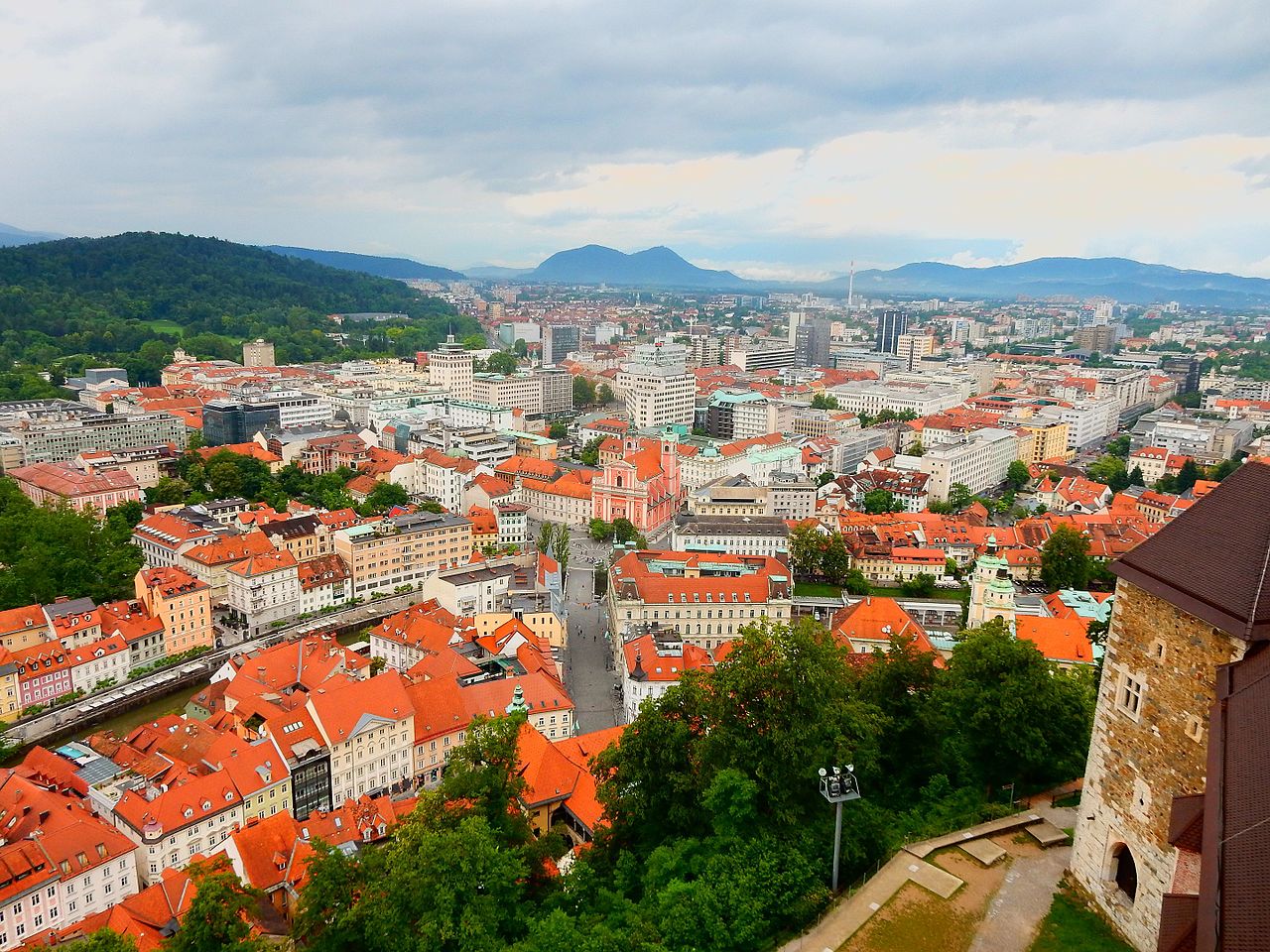
Ljubljana is Slovenia's capital and largest city, with a population of around 300,000. It has the feel of a small Central European city that happens to be a national capital — compact, walkable, and genuinely pleasant without trying too hard. The Ljubljanica River flows through the old town, lined with outdoor cafes. A castle sits on the hill above.
The old town is the main draw. It runs east from the Triple Bridge along the right bank of the river, through a grid of Baroque churches, arcaded streets, and well-preserved medieval buildings. The work of local architect Joze Plecnik (1872–1957) is everywhere: the Triple Bridge extensions, the covered market by the river, the National and University Library. It gives the city a distinctive modernism you won't find elsewhere in Central Europe.
Ljubljana Castle watches over the old town from its hill, reached by funicular or a short walk up through the trees. Prešeren Square, with the pink Franciscan Church behind it, is the social heart of the city. The Ljubljanica riverfront — lined with cafes and crossed by the Dragon Bridge and Butchers' Bridge — is where people gather in warm weather.
Beyond the old centre, Tivoli Park provides extensive green space, the National Museum and National Gallery hold the country's main collections, and Metelkova — a former army barracks turned cultural squat — provides alternative nightlife. Plečnik's house in the Trnovo neighbourhood is the most intimate introduction to the architect who shaped the city.
Ljubljana makes an excellent base for exploring Slovenia. Within two hours by car you can reach the Julian Alps, the Adriatic coast, the Karst caves at Postojna, and Lake Bled. If you have a single day in the city, you can see all the main sights comfortably on foot.