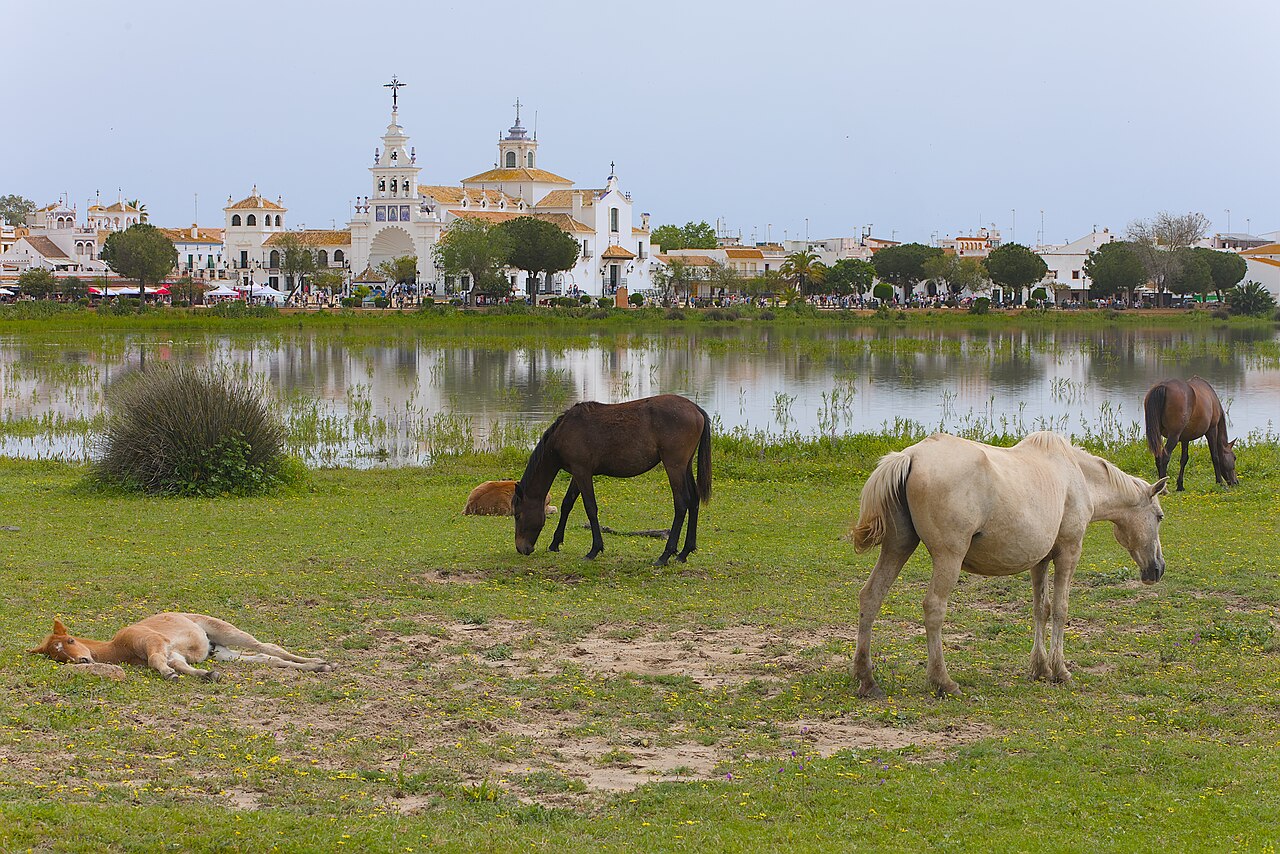
El Rocío is one of the strangest and most compelling villages in Spain. For most of the year it is almost a ghost town — wide sandy streets, rows of whitewashed hermandad houses locked up and waiting, and only a few hundred permanent residents. Then, at Pentecost, a million pilgrims arrive in covered wagons and on horseback for the Romería de El Rocío, one of the largest religious pilgrimages in the world. The village becomes a city overnight, then empties again within days.
The focus of all this devotion is the Hermitage of El Rocío, a whitewashed baroque church at the edge of the marshes housing the Virgen del Rocío — Our Lady of the Dew. The image, a small medieval figure, has been venerated here since the thirteenth century.
Even outside the romería, El Rocío is worth visiting for the setting alone. The village sits directly beside a permanent lagoon at the edge of the Doñana National Park, and flamingos, spoonbills and herons feed in the water just beyond the wooden boardwalk at the end of the village. Semi-wild marsh horses wander the sandy lanes as if the village were their paddock — which, in many ways, it is. The roads are deliberately kept unpaved, and the whole place has a quality that is hard to name: sacred, wild, and slightly suspended in time.