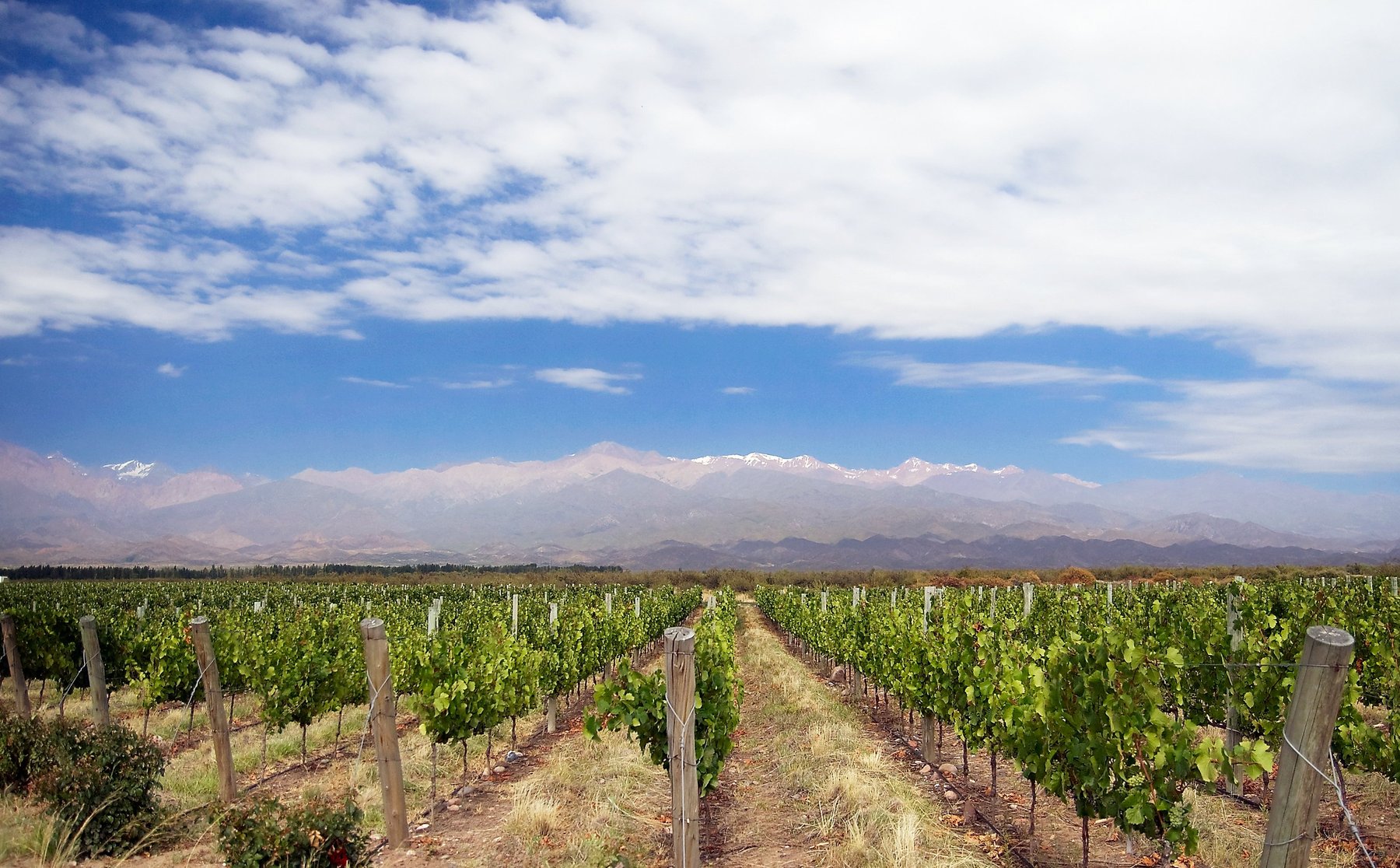
Mendoza is the wine capital of Argentina, a sun-drenched city at the foot of the Andes that draws visitors as much for its outdoor adventure as for its world-class Malbec. Set at 760 metres above sea level, it sits roughly 200 km from Santiago across the mountains, and the proximity to the Andes shapes almost everything about it — the climate, the irrigation channels that water its vineyards, and the easy access to some of South America's finest high-altitude terrain.
The city was founded in 1561 and rebuilt after a catastrophic earthquake in 1861, which explains why historic architecture is sparse but the street grid is wide and deliberate. Tall sycamores line the avenues, and a network of acequias (irrigation ditches) runs alongside the footpaths, giving the city centre a leafy, unhurried character. Plaza Independencia, the central square, is ringed by four smaller plazas — each with its own character — and the Teatro Independencia, a neoclassical opera house from 1925, faces it from the north edge. The Ruinas de San Francisco and Museo Fundacional tell the story of what was lost in that earthquake. The Parque San Martín, a vast Beaux-Arts park on the western edge of the centre, is the focal point for weekend life, and Cerro de la Gloria at its summit gives the city's best views of the Andes.
Around Mendoza stretch the major wine-producing valleys. Maipú, closest to the city, is best explored by bicycle between bodegas. Luján de Cuyo, Argentina's first demarcated wine appellation, produces the benchmark high-altitude Malbec. The Uco Valley, 100 kilometres south in the Andean foothills at 900 to 1,200 metres, is the region's most ambitious frontier — its extreme day-night temperature swings producing wines of distinctive concentration and freshness. The harvest festival, the Fiesta de la Vendimia, fills the city each March with parades, concerts, and theatrical spectacle.
Beyond the vines, the Andes offer white-water rafting on the Mendoza River in the Potrerillos canyon, skiing at Las Leñas in winter, and the perpetual draw of Aconcagua, the highest peak in the Western Hemisphere at 6,961 metres. The road northwest toward the mountain passes Puente del Inca, a natural mineral-encrusted arch at 2,744 metres that ranks among the most visually striking geological formations in the Andes. Nightlife centres on Calle Arístides Villanueva, the main bar and restaurant strip.