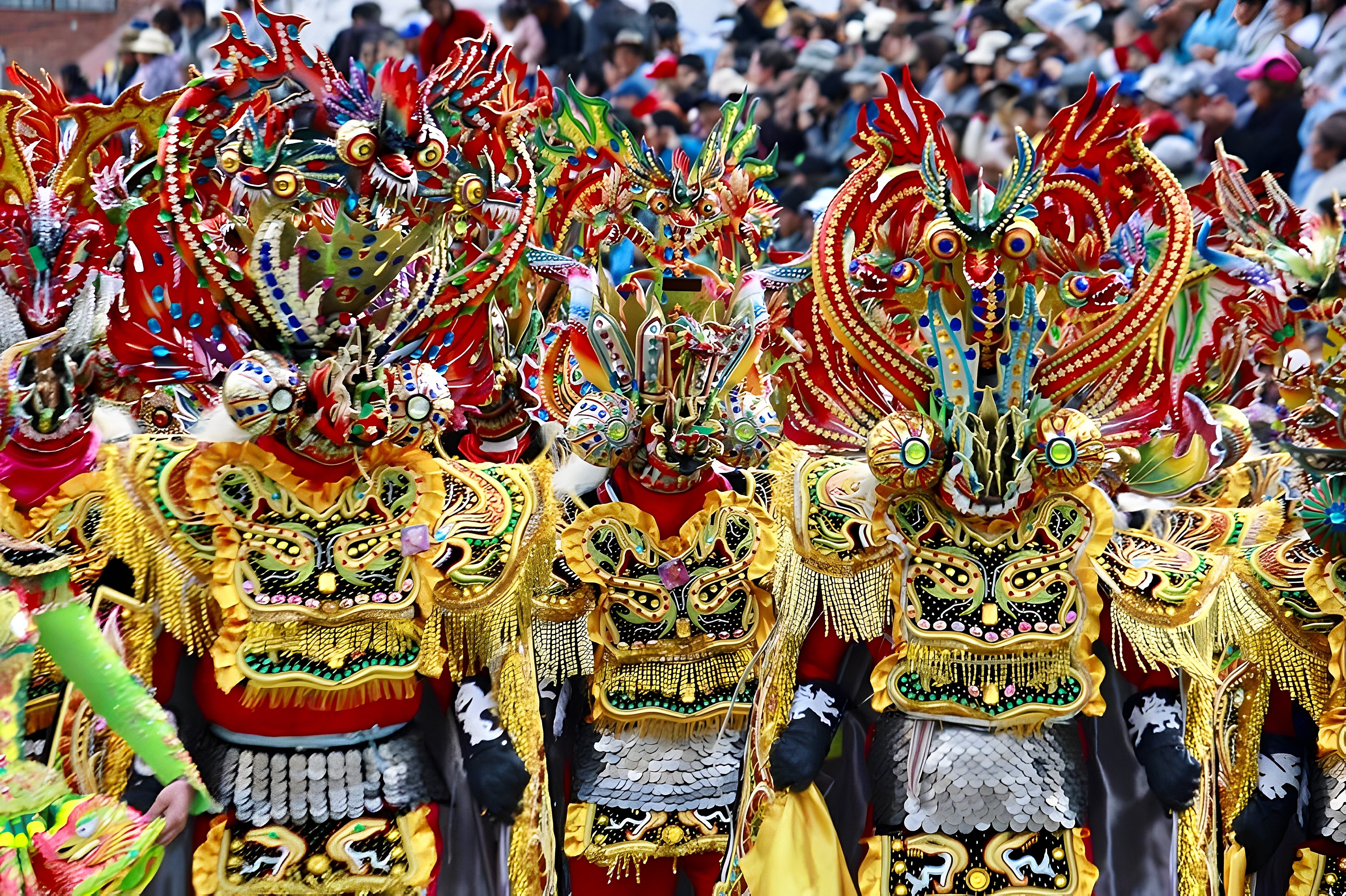
High-altitude Bolivian mining city on the altiplano, transformed each year by its Diablada carnival.
Oruro is a high-altitude mining city on the Bolivian altiplano, sitting at over 3,700 metres. It is not, honestly, a place most travellers would visit outside of one extraordinary week each year — but that week makes it unmissable.
The Carnaval de Oruro, held in February or early March, is one of the most spectacular folk festivals in South America and a UNESCO Masterpiece of the Oral and Intangible Heritage of Humanity. The centrepiece is the Entrada, a parade lasting up to eleven hours in which thousands of dancers perform the Diablada (Dance of the Devils) and other traditional dances through the streets in elaborate, fantastical costumes, all in honour of the Virgen del Socavón — the Virgin of the Mines. If you plan to attend, book accommodation months in advance; the city fills completely.
Outside carnival season, Oruro is a scrappy, windswept mining town with a certain raw appeal. The Santuario del Socavón, built into a hillside above a former mine shaft, is worth a visit, and the mining museum underneath it gives a sobering sense of the tin and silver extraction that built — and impoverished — this city. The eccentric Casa Cardozo Velásquez, filled with thousands of hand-carved stone spheres, is worth a detour for the genuinely curious.
Guide
Getting There
Oruro has a small airport (ORU) with limited domestic service. The most reliable connection is by bus from La Paz, which takes about three hours along a good paved road. Buses depart regularly from the main terminal in La Paz; the journey is straightforward and the road passes through dramatic altiplano scenery.
By bus from Cochabamba, the journey is about four hours. Sucre is roughly six hours away. Minibuses and shared taxis run alongside the scheduled buses and are faster if you don't mind a more cramped ride.
Trains connect Oruro to Villazón on the Argentine border — a long, beautiful journey across the altiplano that takes about twelve hours and goes through some of the emptiest terrain in Bolivia.
Guide
When to Go
The answer for most visitors is simple: come for Carnaval, which falls on the Saturday before Ash Wednesday (usually February or early March). This is when Oruro transforms from a scrappy mining city into one of the greatest festival destinations in South America. Book accommodation months ahead — the city fills completely.
Outside carnival season, Oruro is at its most bearable between October and April, when the altiplano gets some rain and temperatures are slightly less punishing. The dry winter months (May through September) bring bitter cold at night — the city sits at 3,700 metres and winter nights can drop below freezing. The thin air affects most visitors; altitude sickness is common on arrival and takes a day or two to pass. Don't plan to do much on your first day.