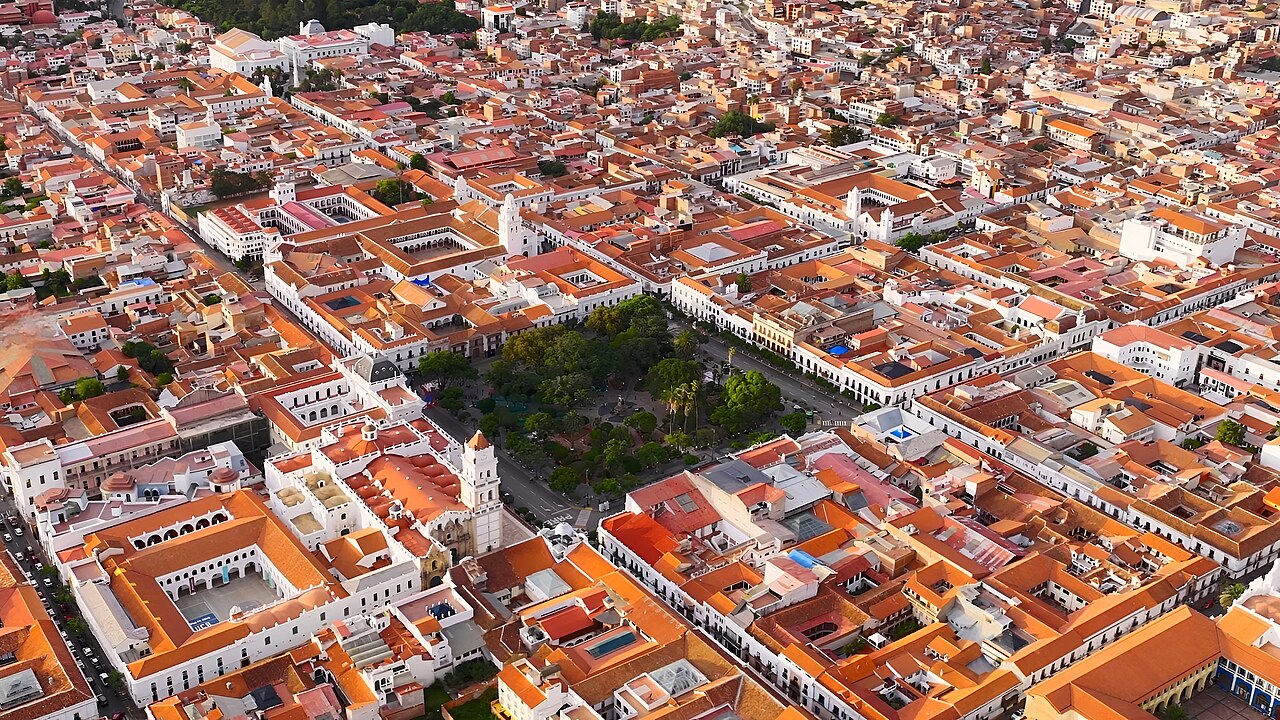
Sucre is Bolivia's constitutional capital and one of the most beautiful cities in South America. Founded in 1538 as La Plata and later renamed, it became the seat of the Audiencia de Charcas and played a central role in Bolivian independence — the country's declaration was signed in the Casa de la Libertad in 1825. In 1991 UNESCO declared the city a World Heritage Site, recognizing its exceptional collection of colonial architecture.
The city is known as the White City for good reason: a local ordinance has long required that buildings in the historic centre be painted white, and the rule has stuck. Walking through the old town, you pass whitewashed facades, ornate baroque churches like the Metropolitan Cathedral and La Merced, and grand arcaded plazas with an almost uniform elegance. The climate helps too — at around 2,750 metres in the Andean foothills, Sucre enjoys mild temperatures year-round, warm days and cool nights.
Beyond the architecture, Sucre has a lively student population (the Universidad de San Francisco Xavier is one of the oldest universities in the Americas) and a relaxed, friendly character that sets it apart from La Paz. The food is good, the coffee is decent, and the surrounding countryside is spectacular. Climb to the Mirador de la Recoleta at sunset, visit the ASUR textile museum for indigenous weaving, and don't miss the extraordinary dinosaur tracks at Cal Orck'o — the largest such site in the world. A day or two here can easily stretch into a week.
In the vicinity of Sucre you will find Tarabuco village, where every Sunday there is a colorful traditional market drawing Jalq'a and Tarabuco weavers in full ceremonial dress. The handicraft center at Jatun Yampara preserves ancient weaving techniques and is worth a visit for anyone interested in Andean textile traditions. Day trips also lead out to the Maragua crater and the surviving pre-Inca paving of the Chataquila trail.