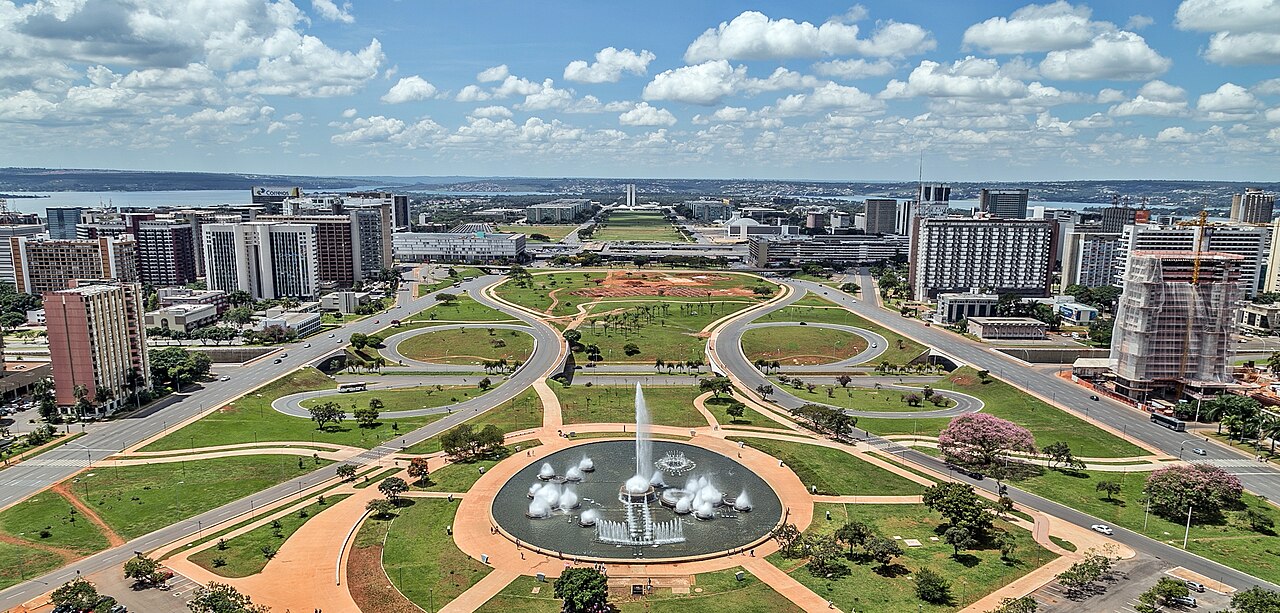
Brasília is Brazil's purpose-built capital, a city that exists because someone decided it should. Inaugurated in 1960, it was designed by urbanist Lúcio Costa and architect Oscar Niemeyer as a modernist utopia — a city shaped like an aeroplane when seen from above, with monumental government buildings, sweeping concrete curves, and vast open spaces where most capitals would have narrow streets.
The result is unlike anywhere else in Brazil. Brasília is impressive rather than charming — the scale of the architecture, the symmetry of the Esplanada dos Ministérios, and Niemeyer's Cathedral are genuinely striking. The Three Powers Plaza at the end of the Eixo Monumental brings the National Congress, the Palácio do Planalto, and the Supreme Federal Court into one ceremonial sweep, with the Itamaraty Palace just to one side. But it is a city built for cars, not pedestrians, and the rigid zoning means nightlife, restaurants, and daily life happen in numbered blocks rather than organic neighbourhoods. If you are coming from Rio de Janeiro or São Paulo, the contrast is stark.
That said, Brasília rewards anyone interested in twentieth-century architecture, and the eating scene is surprisingly diverse — settlers from across Brazil and the world brought their cuisines along. Beyond the monumental axis, Lake Paranoá, the Dom Bosco Sanctuary of stained blue glass, and the TV Tower for the city panorama are the next priorities. The residential wings — Asa Sul and Asa Norte — give the truer feel of Costa's Pilot Plan as a place to live, while Lago Sul on the lakeshore holds the embassies and the best restaurants.