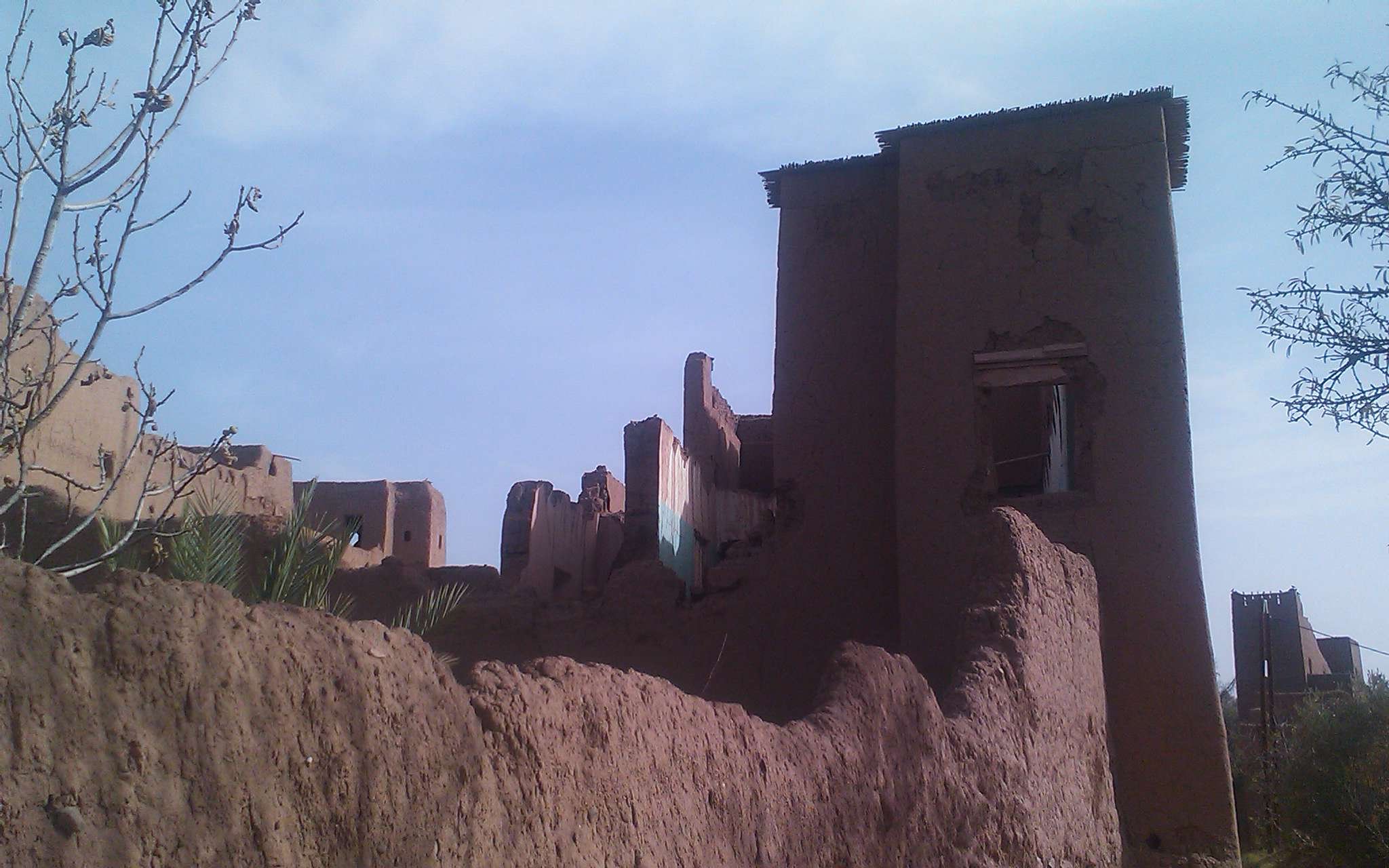
Dadès Valley town at the centre of Morocco's damask rose-growing country.
Kelaa M'Gouna sits at the heart of Morocco's rose-growing country, a small town in the Dadès Valley about 95 km east of Ouarzazate. The surrounding hillsides and valley floors are planted with thousands of damask rose bushes — Rosa damascena — brought here centuries ago, possibly along trade routes from Persia. Every May the Rose Valley turns pink and fragrant.
The town itself is modest, but the landscape around it is the point. The valley is threaded by the Mgoun River and flanked by red-ochre kasbah walls and Berber villages. Beyond the roses, it sits at the meeting point of the Dadès and M'Goun valleys, which makes it a base for trekking into the M'Goun massif — home to Jebel M'Goun (4,071 m), Morocco's second-highest peak.
The Rose Festival (Moussem des Roses) takes place each May, usually over a long weekend, and draws crowds from across Morocco. There is a rose queen election, a parade, music, and stalls selling rose water, rose oil, and rose-petal jam. If you can time a visit to coincide with it, do — it is genuinely festive and not yet overwhelmed by tourism.
Outside festival season, Kelaa M'Gouna is quiet. The cooperative rose distilleries on the edge of town produce rose water and essential oils; a few will let you watch the distillation process in season.
Guide
Getting There
Kelaa M'Gouna sits on the N10 highway, the main road through the Draa-Tafilalet region linking Ouarzazate to Er-Rachidia. It is about 95 km east of Ouarzazate and 53 km west of Tinghir.
Buses and shared taxis run from Ouarzazate several times a day. The journey takes around two hours by bus and slightly less by grand taxi. From Marrakech, the most comfortable approach is to take a bus to Ouarzazate (around four hours over the Tizi n'Tichka pass) and then continue on to Kelaa M'Gouna.
There is no airport. The nearest is Ouarzazate, which has limited scheduled services from Casablanca and Marrakech, and occasional charter flights in season.
Guide
When to Go
The obvious time to visit is May, when the roses are in bloom and the festival takes place. The valley is genuinely spectacular in mid-May when the flowering peaks, and the festival itself, usually over a long weekend, adds to the atmosphere.
For trekking in the M'Goun massif, June through September is best — the high passes are snow-free and the alpine meadows are green. Avoid July and August in the valley itself, where temperatures can exceed 40°C. March and April see some lingering snow at altitude but are pleasant in the valley.
Winter (December to February) is cold at this elevation (around 1,450 m) and snow can close the higher passes. The town remains open and guesthouses operate year-round, but trekking options are limited.