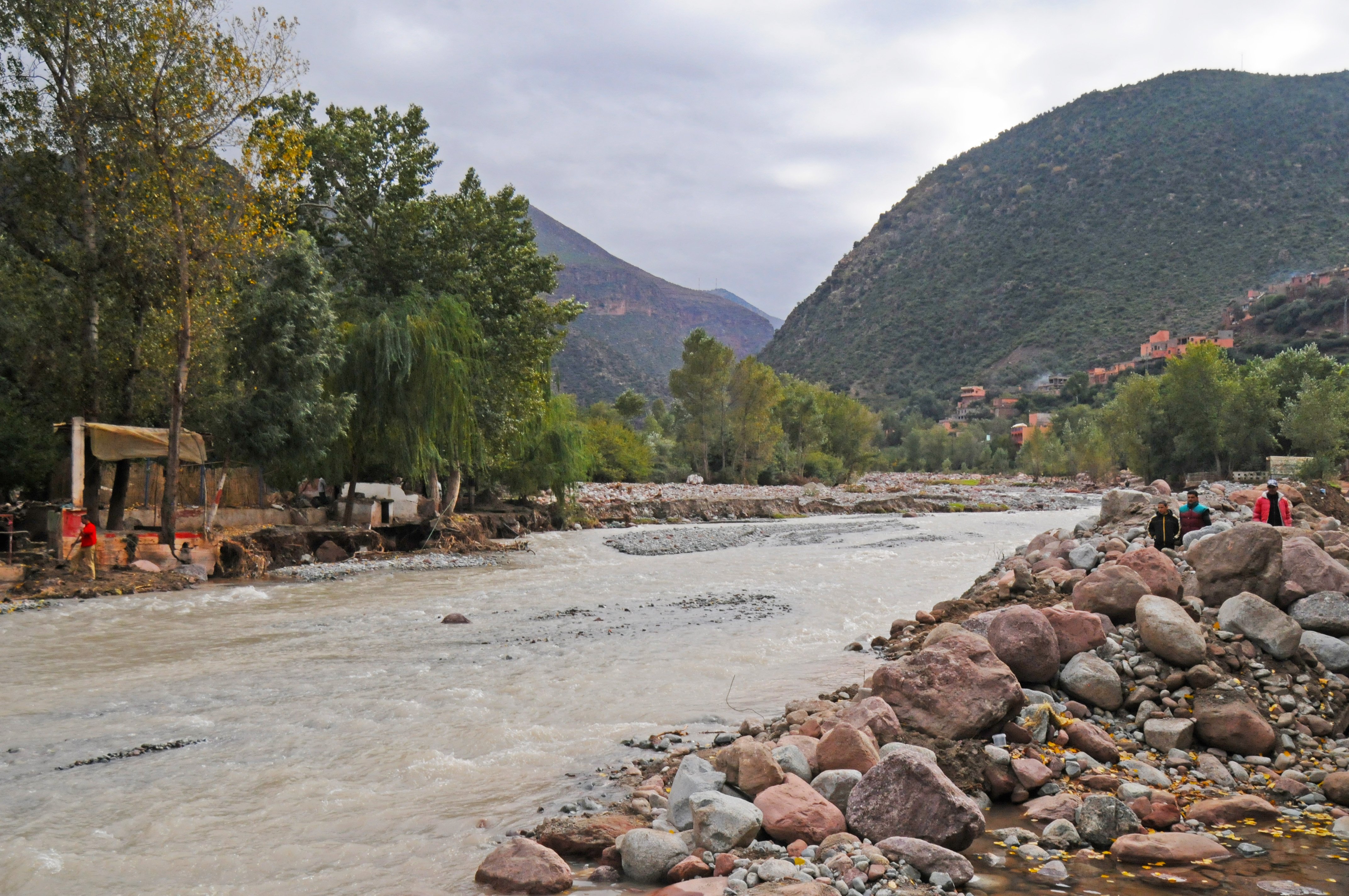
High Atlas valley near Marrakesh where Berber villages cling above a fast-running mountain river.
The Ourika Valley is one of the finest day trips from Marrakesh — a narrow gorge cutting into the High Atlas where Berber villages cling to red rock cliffs above a fast-running river. It takes about an hour to get there, and the contrast with the city is immediate: cooler air, rushing water, terraced gardens bright with vegetables.
The first stretch of road out of Marrakesh is flat and unremarkable. But after the village of Asgaour — where a lively Sunday souk takes over the roadside — the landscape opens up dramatically. Snow-capped peaks appear, the valley narrows, and the air cools. Roadside restaurants dangle fresh trout from hooks to attract passing traffic; stopping for grilled fish above the river is one of the valley's reliable pleasures.
Setti Fatma, at the end of the paved road around 65km from Marrakesh, is the main destination. From here you can walk up into the gorge to a series of seven waterfalls. The lower falls are easy enough; the higher ones involve some scrambling and are genuinely slippery on the way down. Wear proper shoes. In spring, snowmelt turns the river into a torrent and the track can wash out completely.
The valley has a difficult history. In August 1995 a catastrophic flash flood swept through, killing over 200 people and destroying entire villages. Most of what you see today was rebuilt afterwards — the neatly reconstructed settlements give little hint of what happened, but locals remember it clearly.
For serious trekkers, Setti Fatma is also a starting point for routes into the Atlas. You can reach Toubkal from here in a few days, or make a three-day crossing of the Zat Valley, ending below Taddert on the Tizi n'Tichka pass. The Djebel Yagour plateau, reachable in a long day, has an extraordinary collection of prehistoric rock carvings — thousands of engravings of animals, humans, and symbols etched into the rock face. For guides, the Café Azagza in Setti Fatma is the place to ask.
Guide
Getting Around
There is one road through the valley. It runs along the Ourika River from the plains outside Marrakesh all the way to Setti Fatma, roughly 65km in total. Everything of interest is on or just off this road.
If you arrive by grand taxi or bus, you will likely be dropped in one of the villages and can walk between spots or flag down a passing vehicle. The road is well-trafficked during daylight hours. In the busy summer season, shared minibuses shuttle between Setti Fatma and lower villages.
Walking is the only way to reach the waterfalls above Setti Fatma. The path starts just beyond the last cluster of restaurants and involves crossing the river several times on stepping stones. Allow 30–45 minutes to reach the lowest waterfall; reaching the higher falls takes two to three hours and requires more agility.
If you have a rental car, driving yourself gives the most flexibility to stop at villages, markets, and roadside restaurants. Park away from the central area in Setti Fatma — the approach road is narrow and gets congested on busy days.
Guide
When to Go
The valley is worth visiting year-round, but the season matters. Spring (March–May) is lush and green, with wildflowers along the river terraces and snow still visible on the upper peaks. It is the prettiest time, but snowmelt can make the track beyond Setti Fatma impassable and the river runs fast and high — take care near the water.
Summer (June–September) is the peak season for Moroccans escaping Marrakesh's fierce heat. The valley stays noticeably cooler than the city — 10°C or more in high summer — and the roadside restaurants and guesthouses fill up at weekends. Come midweek or early morning to beat the crowds.
Autumn (October–November) is probably the best compromise: clear skies, comfortable temperatures, fewer people, and the river low enough to make trekking safe and easy.
Winter brings snow to the higher elevations and cold nights, but the valley road itself is usually passable and the midday light is good. The landscape is stark rather than lush.
Avoid the valley on public holidays and summer weekends, when the single road in and out can turn into a slow-moving queue of cars and minibuses.