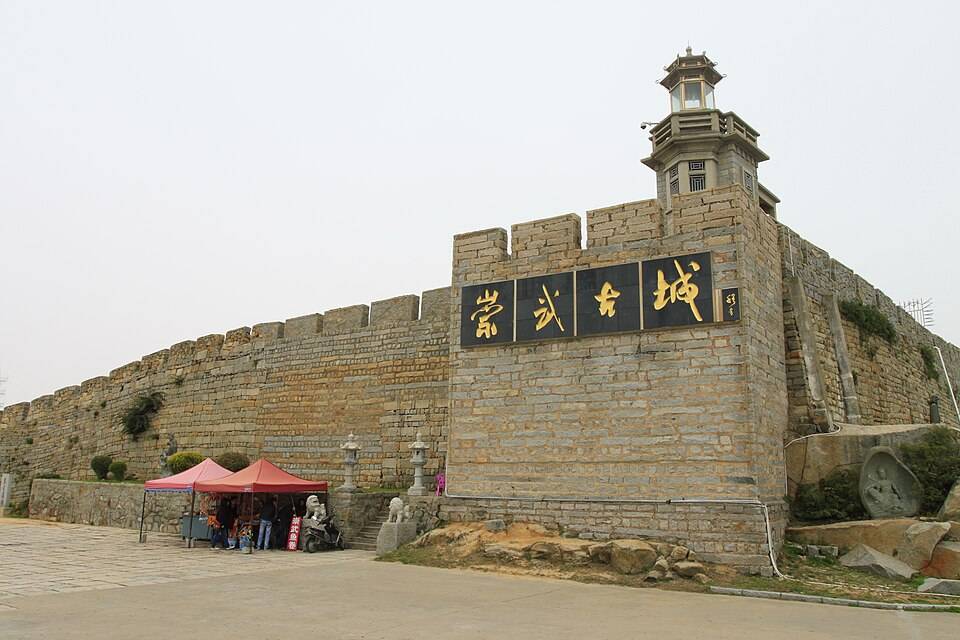
Chongwu is a small town on a sandy peninsula jutting into the Taiwan Strait in Hui'an County, within Quanzhou Prefecture. Its distinction is one of the best-preserved Ming Dynasty coastal fortresses in China — a complete walled town built in the 14th century to defend against Japanese pirates, whose grey granite ramparts and gate towers have survived in remarkably intact condition. It is an easy day trip from Quanzhou and far less visited than it deserves.
The fortress walls are walkable along much of their circuit, offering views over the town's tightly packed stone-built lanes and out across the strait. Inside the walls, the streetscape retains its historic character more faithfully than most Chinese old towns: the buildings are predominantly stone-and-tile construction rather than concrete reconstruction, and the population is still partly working-class fishing families rather than souvenir vendors. Hui'an women, locally famous for their distinctive traditional dress — embroidered headwraps and short midriff blouses — are still sometimes seen in the old town, a costume tradition with a history of several centuries. The Chongwu Army Temple, a Ming dynasty garrison shrine dedicated to the martial deity Guan Yu, is worth a stop on the circuit.
Between the walls and the shoreline runs a strip of coastal park, a bit manicured but useful for access to the sea. West Bay Beach, just outside the fortress, is a reasonable swimming beach, and the coastal rock formations around the peninsula are photogenic. The seafood in the small restaurants near the fishing harbour is fresh and inexpensive. Most visitors come from Quanzhou as a half-day excursion, which is about the right amount of time unless you are a serious student of military architecture.