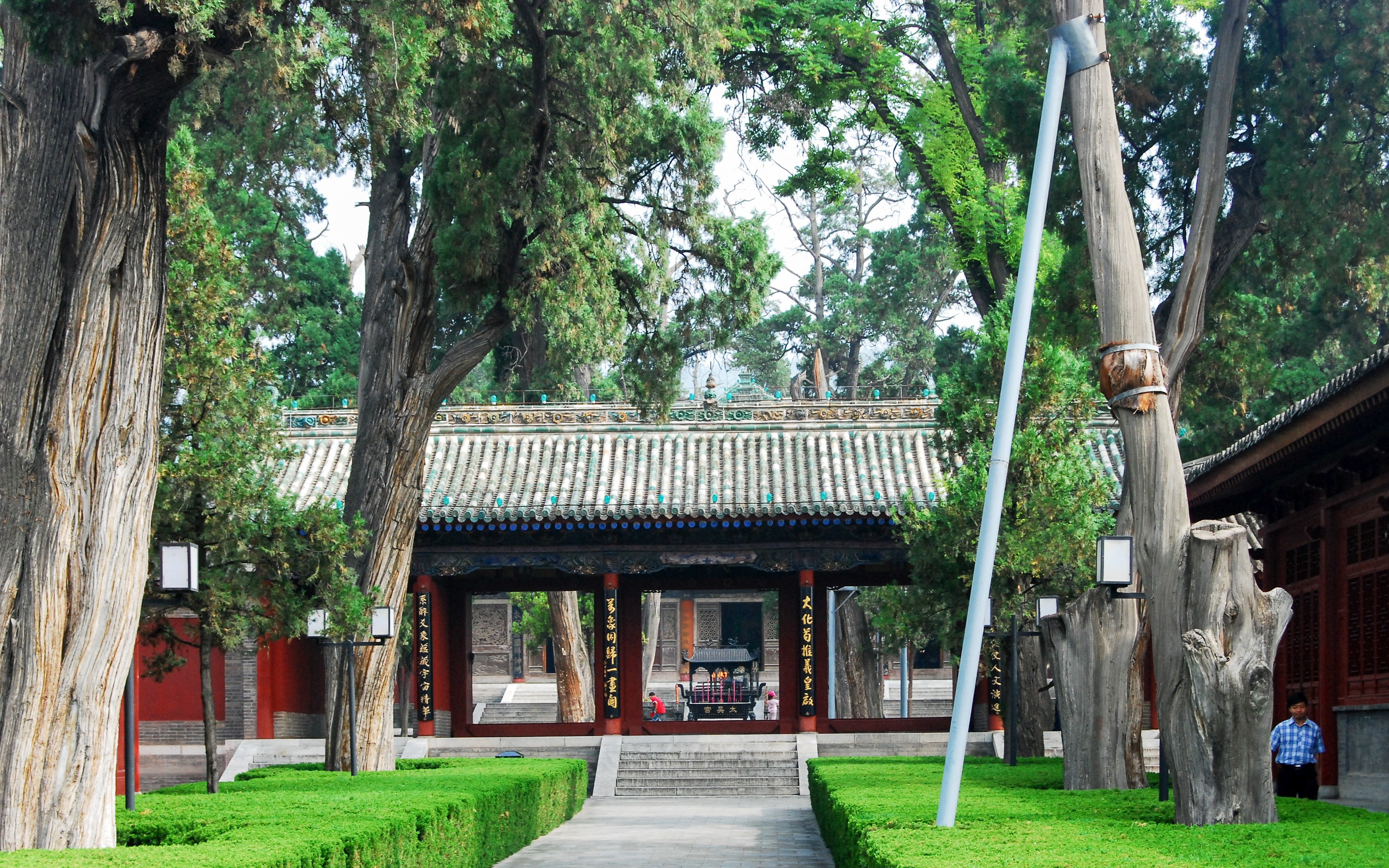
Tianshui is the second city of Gansu and, by the standards of Chinese provincial cities, an unusually atmospheric one — green, hilly, less industrial than much of the northwest, set in a valley where the Wei River begins. It is also, in Chinese mythology, the birthplace of Fuxi, the culture hero credited with inventing writing, music, and the eight trigrams of the I Ching. The Fuxi Temple in the old quarter is an active site of veneration, its courtyard planted with old cypress trees.
The principal reason to come to Tianshui, though, is Maijishan — a haystack-shaped sandstone mountain forty-five kilometres southeast of the city whose near-vertical faces have been covered with Buddhist grottoes since the fifth century. Over 194 caves hold 7,200 clay sculptures and 1,000 square metres of murals accumulated across the Northern Wei, Sui, Tang, Song, and Ming dynasties. The sculptures here are considered among the finest examples of Chinese Buddhist art, distinct from the more famous Mogao Caves at Dunhuang in being made primarily of clay rather than painted onto flat surfaces. The grottoes are connected by narrow wooden walkways and iron stairs bolted directly into the cliff face.
In the city itself, the Houjie Mosque in the old quarter represents Tianshui's Muslim heritage. The Wushan Water Curtain Caves, about ninety kilometres to the northwest, contain a thirty-metre Buddha carved into a cliff and are far less visited than Maijishan. The Tianshui City Museum holds a strong collection of painted pottery from the Yangshao and Majiayao neolithic cultures, along with bronzeware from the Zhou and Han periods, and admission is free.
Tianshui has a high-speed rail station — Tianshui South — with direct connections to Xi'an in about two hours and to Lanzhou in under an hour. It is an easy and undervisited stop between those two cities, with enough in its immediate vicinity to justify a full day or two.