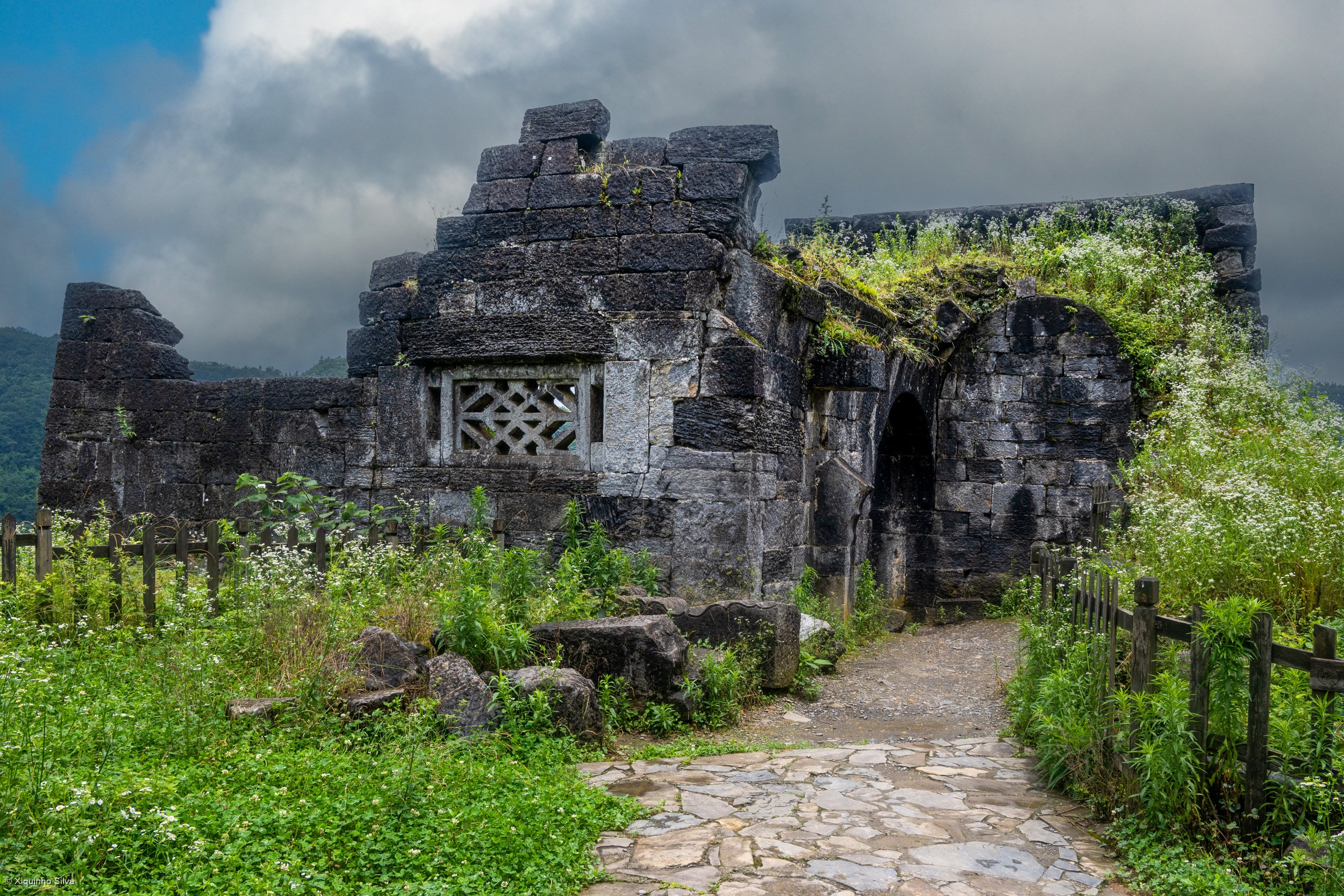
Hailongtun is the best-preserved feudal castle ruin in China — a statement that sounds like tourist-board copy until you consider that the country's history of continuous habitation and destruction has left almost nothing of this kind standing. The fortress sits on the summit of Longyan Mountain, covering 1.59 square kilometres with nearly 6 kilometres of defensive walls and gate passes, archer towers, and a moat. It was built in 1257 by the Yang family, hereditary chieftains of the Bozhou region under the tusi system — the Ming and Qing empire's method of governing frontier territories through local strongmen granted nominal authority in exchange for tribute and military service.
The Yang family held Bozhou for 725 years through the Southern Song, Yuan, and Ming dynasties, until the last tusi Yang Yinglong launched a rebellion against central authority in the 1590s. The Ming suppressed it in 1600 after three years of campaign, Yang Yinglong died by suicide in the ruins of his fortress, and Hailongtun was burned and partially demolished. What remained was left as ruins — no subsequent population took the site over, and the clifftop location made informal occupation difficult. The result is an unusual archaeological honesty: Hailongtun was destroyed once and has simply remained destroyed since.
UNESCO designated the site in 2015 as part of the Tusi Sites World Heritage listing, which covers three locations across southwestern China where the tusi system left substantial physical evidence. The other two sites are in Hunan and Hubei; Hailongtun is the most dramatically positioned. The mountain location required the Yang to build their supply roads and water systems into the rock, and those engineering features are as interesting as the walls themselves.
The fortress is about 30 kilometres northwest of Zunyi city centre (see /asia/china/guizhou/zunyi), accessible by taxi or tourist bus. The climb to the summit from the base takes about an hour on a stone path through forest. The views from the walls — over the Guizhou plateau and toward the Sichuan border — are a secondary reward.