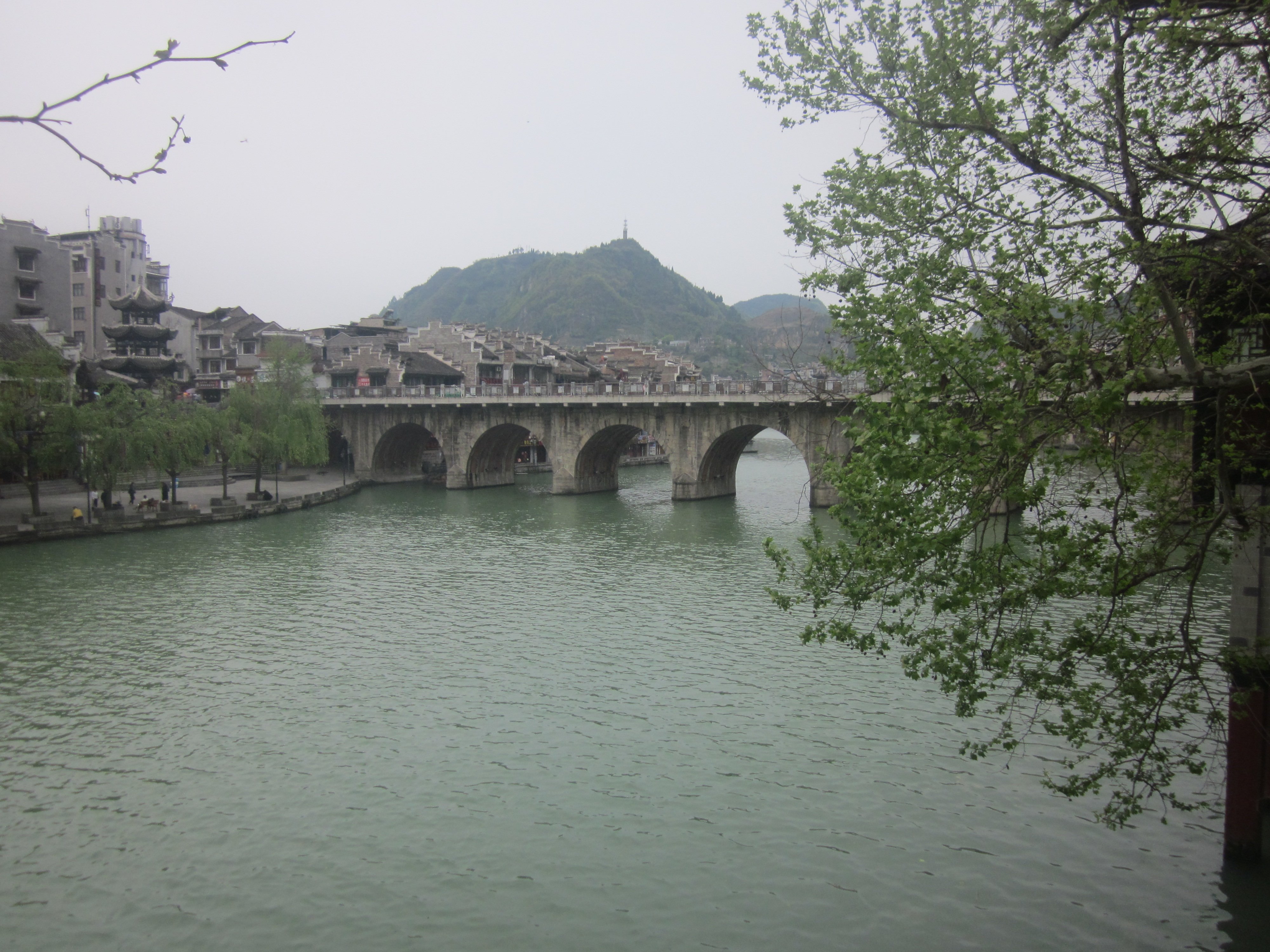
Zhenyuan is one of the most satisfying ancient towns in China, which is a strong claim in a country that has preserved — or reconstructed — a great many of them. What makes it different is the setting: the riverside old town sits along the Wuyang River in a narrow gorge between limestone karst cliffs, with wooden houses climbing the banks on both sides and temple complexes attached directly to the cliff faces above. At night, when the stone walls and overhanging rocks are lit from below and reflected in the river, the effect is theatrical in the best sense.
The town has over 700 years of recorded history as a defensive settlement — it sits on an old military road connecting central China to the southwest frontier, and the ancient city walls and watchtowers reflect that function. The Qinglongdong architectural complex is the centrepiece: a cluster of Buddhist, Taoist, and Confucian temples and pavilions built into and onto the cliff on the north bank, stacked vertically over several hundred metres of rock face. The three religious traditions sharing a cliff without apparent doctrinal friction is a distinctly Guizhou arrangement. The ancient walls themselves, Ming and Qing construction, can be walked for views across the river and rooftops below.
Zhenyuan is 96 kilometres east of Kaili and connected by train — about an hour on the slower trains, which is the right way to travel this landscape. The Wuyang River gorge running east from the town is a route of exceptional beauty, accessible by boat from the pier near the old town. The Zhusheng Bridge at the east end of the old town has spanned the river since the Ming dynasty. The local tea, Tianyin Tribute Tea, has been produced here for over 1,200 years and is grown on the hillsides above the river valley; the spring harvest in April is the best time to find it fresh.
The town is at the right size for walking — large enough to have a working life beyond tourism, small enough to cover in a day. A night here means watching the town quiet down after the day-trip coaches have left, which is when the riverside restaurants fill with locals and the cliffs turn amber in the last light.