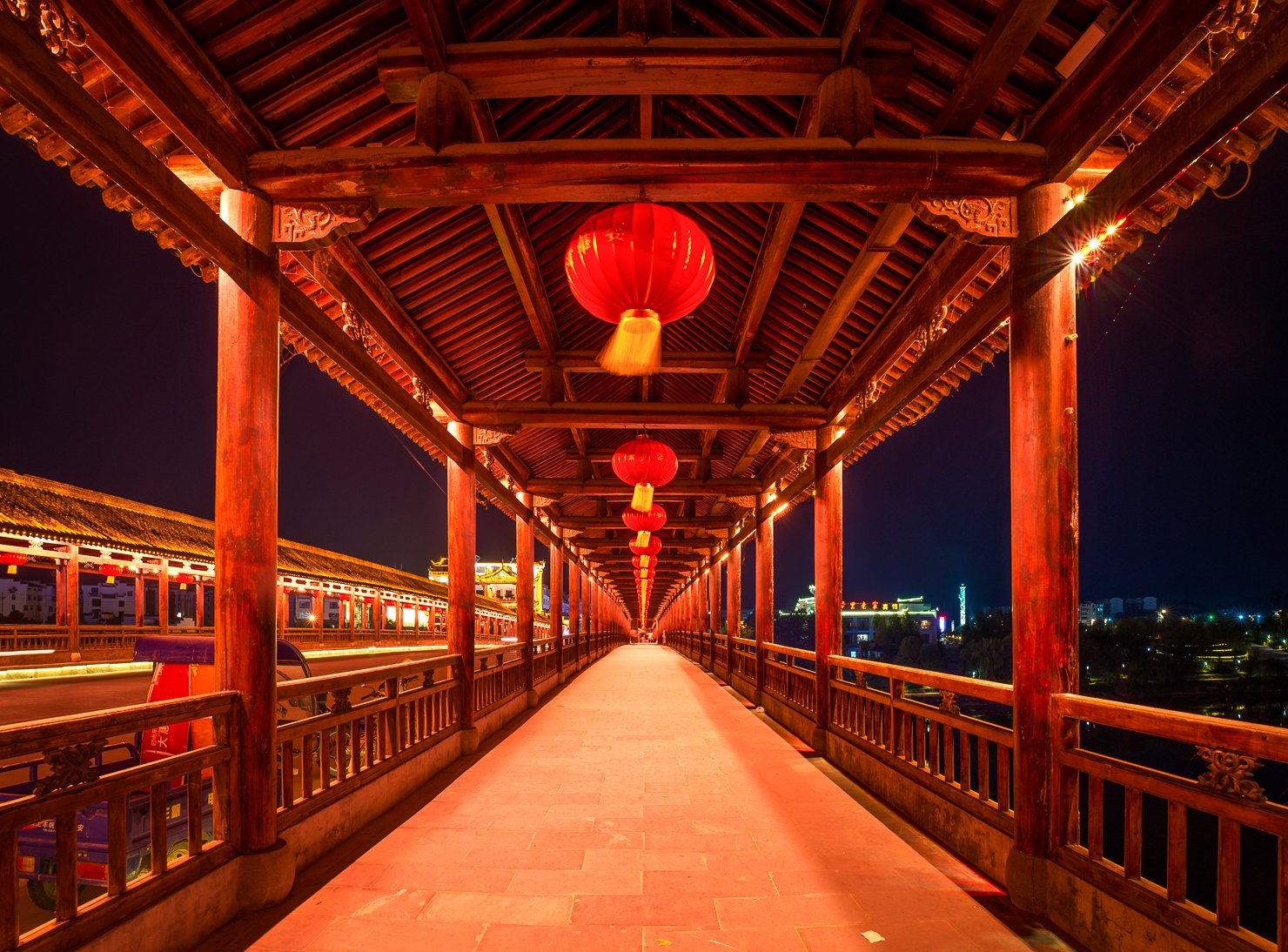
Ancient Jiangxi village cluster of Huizhou houses, tea fields, and spring rapeseed valleys.
Wuyuan (婺源) is the most photographed corner of Jiangxi — a cluster of ancient Huizhou-style villages with whitewashed walls, grey tile roofs, and carved wooden interiors, set among tea fields and forested hills. In spring, rapeseed fields turn the valley floors a violent yellow, and the combination of blossoms and old architecture draws enormous crowds of Chinese photographers and tour groups. If you're going in March or April, accept the crowds or don't go.
The villages are scattered across a fairly wide area rather than concentrated in one place. Likeng has a canal running through it and is popular enough to have souvenir shops clogging every alley, but the houses themselves are genuine Song-to-Qing dynasty merchant architecture. Sixi Yancun offers a quieter version of the same, with maze-like alleys that actually feel like a living village rather than a theme park. Xiaoqi is better still — the upper hamlet especially has rice paddies, fewer visitors, and the unhurried atmosphere that is increasingly hard to find in the lower valley. Wangkou has the finest ancestral hall in the region.
The Wuyuan green tea is legitimately good and sold everywhere at a range of prices. The local dish worth ordering is the steamed pumpkin with rice flour. Bus connections from Jingdezhen are straightforward (about 2 hours), and high-speed rail links to Shanghai, Hangzhou, and other major cities make the region easy to reach. Very little English is spoken; a translation app will carry most of the weight.
Guide
Books
The Huizhou Merchants in Ming and Qing China by Harriet Zurndorfer — An academic study of the merchant families whose wealth built the villages of Wuyuan and the broader Huizhou region. Dry in places but authoritative on the economic basis of the architectural splendor you'll see in the villages. Available in academic libraries.
Culture and Commerce: The Tea Industry in Late Imperial China by Robert Gardella — Tea was one of the pillars of Huizhou merchant wealth, and Wuyuan's tea culture connects directly to the commercial networks this book describes. Provides useful background for understanding why such elaborate architecture exists in these remote valleys.
Dream of the Red Chamber (红楼梦) by Cao Xueqin — Not set in Wuyuan, but the social world of the Qing dynasty gentry-merchant class that this novel depicts — the elaborate household architecture, the emphasis on feminine virtue and male scholarship, the anxiety about family decline — is directly relevant to the culture you're seeing preserved in these villages.
Guide
Eating Out
Wuyuan's village guesthouses typically offer home-cooked meals with local ingredients. The regional specialty worth ordering is the steamed pumpkin with rice flour (南瓜粉蒸), which appears on almost every table in the area. The local fish from the mountain streams — small, sweet-fleshed fish either fried whole or braised in a soy and chilli sauce — is genuinely good when it's the day's catch rather than a tank fish. Wuyuan green tea appears with every meal.
The restaurants in Wuyuan town itself are more varied and cheaper than the tourist-facing places in the villages. If you're based in town, an evening meal there is better value than eating in Likeng or Sixi where prices are calibrated to the tourist trade.
Guide
Getting There
Wuyuan has its own high-speed rail station on the Shanghai-Kunming line, making direct access easy from Shanghai (about 2.5 hours), Hangzhou (2 hours), and Nanchang (1.5 hours). Jingdezhen is about 2 hours by bus — a useful combination for a trip that covers both porcelain culture and Huizhou architecture.
From Wuyuan town, local buses serve the main villages. The bus system works but requires some patience: routes are not always labeled in English, timetables change seasonally, and vehicles can be infrequent in the afternoon. Many visitors hire a driver through their guesthouse for a day to cover multiple villages efficiently. The key villages are spread across a fairly wide area — some 20 to 30 kilometers from Wuyuan town — making a car or motorbike more practical than cycling or walking between them.
Guide
When to Go
Spring (mid-February to early April) is the famous rapeseed season, when the valley floors turn yellow between the old villages. The beauty is real but the crowds are equally real — tour groups, weekend visitors from Shanghai and Hangzhou, and domestic photographers fill the village lanes from 8am on weekends. If you're visiting during peak season, arrive on a weekday, stay for at least two nights, and start each morning before the buses arrive.
Autumn (September to November) offers the second-best visiting window: the rice harvest, the russet foliage on the surrounding hills, and a much more manageable crowd level. The villages look different but still beautiful. Winter is cold and sometimes misty, which some visitors find atmospheric; summer is hot and humid, with the tea fields in full growth but the famous yellow fields absent.